Research
/Security News
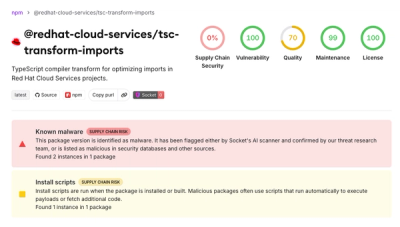
Mini Shai-Hulud Campaign Hits Red Hat Cloud Services npm Packages
A mini Shai-Hulud campaign compromised Red Hat Cloud Services npm packages to steal developer and CI/CD secrets during installation.
LibVLCSharp
Advanced tools
LibVLCSharp is a cross-platform audio and video API for .NET platforms based on VideoLAN's LibVLC Library. It provides a comprehensive multimedia API that can be used across mobile, server and desktop to render video and output audio. Mono, .NET Framework and .NET Core runtimes are supported. This package contains the core features of LibVLCSharp (libvlc loading and initialization, .NET-friendly classes to ease the use of libvlc...). All other `LibVLCSharp.*` packages depend on this one. Features: - Play every media file formats, every codec and every streaming protocols - Run on every platform, from desktop (Windows, Linux, Mac) to mobile (Android, iOS) and TVs - Hardware and efficient decoding on every platform, up to 8K - Network browsing for distant filesystems (SMB, FTP, SFTP, NFS...) and servers (UPnP, DLNA) - Playback of Audio CD, DVD and Bluray with menu navigation - Support for HDR, including tonemapping for SDR streams - Audio passthrough with SPDIF and HDMI, including for Audio HD codecs, like DD+, TrueHD or DTS-HD - Support for video and audio filters - Support for 360 video and 3D audio playback, including Ambisonics - Able to cast and stream to distant renderers, like Chromecast and UPnP renderers. This package also contains the views for the following platforms: - Android - iOS - Mac - tvOS - UWP If you need Xamarin.Forms support, see LibVLCSharp.Forms. LibVLC needs to be installed separately, see VideoLAN.LibVLC.* packages.
FAQs
LibVLCSharp is a cross-platform audio and video API for .NET platforms based on VideoLAN's LibVLC Library. It provides a comprehensive multimedia API that can be used across mobile, server and desktop to render video and output audio. Mono, .NET Framework and .NET Core runtimes are supported. This package contains the core features of LibVLCSharp (libvlc loading and initialization, .NET-friendly classes to ease the use of libvlc...). All other `LibVLCSharp.*` packages depend on this one. Features: - Play every media file formats, every codec and every streaming protocols - Run on every platform, from desktop (Windows, Linux, Mac) to mobile (Android, iOS) and TVs - Hardware and efficient decoding on every platform, up to 8K - Network browsing for distant filesystems (SMB, FTP, SFTP, NFS...) and servers (UPnP, DLNA) - Playback of Audio CD, DVD and Bluray with menu navigation - Support for HDR, including tonemapping for SDR streams - Audio passthrough with SPDIF and HDMI, including for Audio HD codecs, like DD+, TrueHD or DTS-HD - Support for video and audio filters - Support for 360 video and 3D audio playback, including Ambisonics - Able to cast and stream to distant renderers, like Chromecast and UPnP renderers. This package also contains the views for the following platforms: - Android - iOS - Mac - tvOS - UWP If you need Xamarin.Forms support, see LibVLCSharp.Forms. LibVLC needs to be installed separately, see VideoLAN.LibVLC.* packages.

We found that libvlcsharp demonstrated a healthy version release cadence and project activity because the last version was released less than a year ago. It has 1 open source maintainer collaborating on the project.
Did you know?

Socket for GitHub automatically highlights issues in each pull request and monitors the health of all your open source dependencies. Discover the contents of your packages and block harmful activity before you install or update your dependencies.

Research
/Security News
A mini Shai-Hulud campaign compromised Red Hat Cloud Services npm packages to steal developer and CI/CD secrets during installation.

Research
/Security News
The North Korean malware loader hides in a Packagist-listed package and its GitHub branch to fetch and execute remote code in a likely Contagious Interview-style lure.

Security News
The Rust project is moving toward formal rules on LLM use in contributions after months of internal debate over maintainer burden, code quality, and contributor experience.