

Company News
AWS Security Hub Adds Socket for Supply Chain Security
Socket is now in the AWS Security Hub Extended plan. Adopt it through AWS, apply committed spend, and block malicious open source packages.
By Feross Aboukhadijeh - Aug 04, 2026
a2db
Advanced tools
Agent-to-Database
Give AI agents safe, read-only access to your databases. One call, multiple queries, clean results.
5 databases · batch queries · pre-configured connections · SQLGlot read-only





Quick Start · MCP Tools · Security · Comparison · Setup
Agent: "Show me active users and their recent orders"
↓
a2db execute → 2 queries, 1 call, structured results
↓
Agent: "Got it — 847 active users, avg order $42.50"
Most database MCP servers make you run one query at a time, repeat connection details on every call, and return results double-encoded inside JSON strings. a2db fixes all of that:
.mcp.json with --register, agent queries immediatelypip install a2db and you're done${DB_PASSWORD} in DSNs, expanded only at connection time| Database | Driver | Async |
|---|---|---|
| PostgreSQL | asyncpg | native |
| SQLite | aiosqlite | native |
| MySQL / MariaDB | mysql-connector-python | wrapped |
| Oracle | oracledb | wrapped |
| SQL Server | pymssql | wrapped |
pip install a2db
Claude Code (with pre-configured connection):
claude mcp add -s user a2db -- a2db-mcp \
  --register myapp/prod/main 'postgresql://user:${DB_PASSWORD}@host/mydb'
Claude Code (minimal — agent calls login on demand):
claude mcp add -s user a2db -- a2db-mcp
Claude Desktop / Cursor / any MCP client (.mcp.json):
{
  "mcpServers": {
    "a2db": {
      "command": "uvx",
      "args": [
        "a2db-mcp",
        "--register", "myapp/prod/main", "postgresql://user:${DB_PASSWORD}@host/mydb"
      ],
      "env": {
        "DB_PASSWORD": "your-password-here"
      }
    }
  }
}
Multiple databases:
{
  "args": [
    "a2db-mcp",
    "--register", "myapp/prod/main", "postgresql://user:${DB_PASSWORD}@host/maindb",
    "--register", "myapp/prod/analytics", "postgresql://user:${DB_PASSWORD}@host/analytics"
  ]
}
--register pre-registers connections at server startup — the agent can query immediately. Passwords use ${ENV_VAR} syntax and are expanded at connection time, never stored in plaintext.
# Save a connection (validates immediately)
a2db login -p myapp -e prod -d main 'postgresql://user:${DB_PASSWORD}@localhost/mydb'

# Query
a2db query -p myapp -e prod -d main "SELECT * FROM users LIMIT 10"

# JSON output
a2db query -p myapp -e prod -d main -f json "SELECT * FROM users LIMIT 10"

# Explore schema
a2db schema -p myapp -e prod -d main tables
a2db schema -p myapp -e prod -d main columns -t users

# List / remove connections
a2db connections
a2db logout -p myapp -e prod -d main
| Tool | Description |
|---|---|
login | Save a connection — validates by connecting first |
logout | Remove a saved connection |
list_connections | List connections (no secrets exposed) |
execute | Run named batch queries with pagination |
search_objects | Explore schema — tables, columns, with detail levels |
execute — the core toolNamed dict with default connection (preferred):
{
  "connection": {"project": "myapp", "env": "prod", "db": "main"},
  "queries": {
    "active_users": {"sql": "SELECT id, name FROM users WHERE active = true"},
    "recent_orders": {"sql": "SELECT id, total FROM orders ORDER BY created_at DESC LIMIT 5"}
  }
}
List format (auto-named q1, q2, ...):
{
  "connection": {"project": "myapp", "env": "prod", "db": "main"},
  "queries": [
    {"sql": "SELECT COUNT(*) AS cnt FROM users"},
    {"sql": "SELECT AVG(total) AS avg_order FROM orders"}
  ]
}
Response (TSV format — default):
{
  "active_users": {
    "data": "id\tname\n1\tAlice\n2\tBob\n3\tCharlie",
    "rows": 3,
    "truncated": false,
    "time_ms": 12
  },
  "recent_orders": {
    "data": "id\ttotal\n501\t129.00\n500\t49.99",
    "rows": 2,
    "truncated": false,
    "time_ms": 8
  }
}
No ::text casts needed — integers, floats, timestamps, arrays, NULLs all work natively.
When a query fails with a column error, a2db enriches the message:
column "nme" does not exist
Did you mean: name?
Available columns: id (integer), name (text), email (text), active (integer)
LLM context windows are expensive. JSON row data is verbose — every row repeats every column name, adds braces, commas, and quotes. TSV is a flat grid: one header row, then just values separated by tabs.
For a 100-row, 5-column result set, TSV typically uses 40-60% fewer tokens than JSON row format. The structured JSON envelope still gives you metadata (row count, truncation status) — only the row payload is TSV.
Set format="json" if you need full structured output with column names on every row.
Every query is parsed by SQLGlot before execution:
This is defense-in-depth — you should also use a read-only database user, but a2db won't let writes through even if the user has write permissions.
Write support is implemented in the core but not yet exposed via MCP. Planned: per-connection write permissions, explicitly enabled by the human operator — not the agent. See TODO.md.
Connections are saved in ~/.config/a2db/connections/ as TOML files.
${DB_PASSWORD} syntax — environment variable references are stored literally and expanded only at connection time. Secrets stay in your environment, not on disk.list_connections shows project/env/db and database type, never DSNs or passwordsa2db currently runs as a local stdio MCP server. It inherits environment variables from the process that launches it (your shell, Claude Code, Docker). This is the standard model for local MCP servers — the same approach used by DBHub, Google Toolbox, and others.
Planned: remote HTTP transport with OAuth 2.1 per the MCP spec. For now, if running in Docker, inject secrets via environment variables at container runtime.
| Feature | a2db | DBHub | Google Toolbox | PGMCP | Supabase MCP |
|---|---|---|---|---|---|
| Databases | 5 (PG, SQLite, MySQL, Oracle, MSSQL) | 5 (PG, MySQL, MSSQL, MariaDB, SQLite) | 40+ (cloud + OSS) | PG only | PG (Supabase) |
| Batch queries | Named dict + list | Semicolon-separated | No | No | No |
| Default connection | Set once, use for all | Per-query | N/A | Single DB | Single project |
| Read-only | SQLGlot AST (enforced) | Keyword check (config) | Hint/annotation | Read-only tx + regex | Config flag |
| Write support | Planned (per-connection) | Config flag | Via tool definition | No | Config flag |
| Output | JSON + TSV data | Structured text | MCP protocol | Table / JSON / CSV | JSON |
| Schema discovery | 3 detail levels | Dedicated tool | Prebuilt tools | Via NL-to-SQL | Dedicated tools |
| Pre-configured | --register in MCP config | Config file | YAML config | Env var | Cloud-managed |
| Credentials | ${ENV_VAR} in DSN | DSN strings | Env vars + GCP IAM | Env var | OAuth 2.1 |
| Drivers bundled | All included | All included | Varies | Built-in | Managed |
| CLI | Yes | No | Yes | Yes | No |
| Error context | Column suggestions + types | No | No | No | No |
| License | Apache 2.0 | MIT | Apache 2.0 | Apache 2.0 | Apache 2.0 |
When to use what:
pip install a2db

# CLI
a2db login -p myapp -e dev -d main 'postgresql://user:pass@localhost/mydb'

# Or add as MCP server (see Quick Start)
FROM python:3.12-slim
RUN pip install a2db
CMD ["a2db-mcp", "--register", "myapp/prod/main", "postgresql://user:${DB_PASSWORD}@host/mydb"]
docker run -e DB_PASSWORD=secret -i my-a2db-image
Secrets are injected as environment variables at runtime — never baked into the image.
pip install a2db

# Pre-configured — no login needed
a2db-mcp --register myapp/ci/main "postgresql://ci_user:${CI_DB_PASSWORD}@db-host/mydb"

# Or use CLI directly
a2db login -p myapp -e ci -d main "postgresql://ci_user:${CI_DB_PASSWORD}@db-host/mydb"
a2db query -p myapp -e ci -d main "SELECT COUNT(*) FROM migrations"
make bootstrap   # Install deps + hooks
make check       # Lint + test + security (full gate)
make test        # Tests with coverage (90% minimum)
make lint        # Lint only (never modifies files)
make fix         # Auto-fix + lint
Apache 2.0
🗄️ Agent-first database access since 2025.
Built by Denis Tomilin
FAQs
Agent-to-Database — CLI and MCP server for AI agents to query databases.
The pypi package a2db receives a total of 148 weekly downloads. As such, a2db popularity was classified as not popular.
We found that a2db demonstrated a healthy version release cadence and project activity because the last version was released less than a year ago. It has 1 open source maintainer collaborating on the project.
Did you know?

Socket for GitHub automatically highlights issues in each pull request and monitors the health of all your open source dependencies. Discover the contents of your packages and block harmful activity before you install or update your dependencies.
Company News
Socket is now in the AWS Security Hub Extended plan. Adopt it through AWS, apply committed spend, and block malicious open source packages.
Research
/Security News
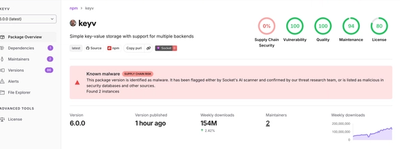
Popular npm packages keyv and cacheable compromised.

Security News
A misconfiguration gave three Anthropic models internet access, and one, believing it was in a simulation, shipped a credential-stealing package to PyPI.