

Company News
AWS Security Hub Adds Socket for Supply Chain Security
Socket is now in the AWS Security Hub Extended plan. Adopt it through AWS, apply committed spend, and block malicious open source packages.
By Feross Aboukhadijeh - Aug 04, 2026
amormorri-memory-kernel
Advanced tools
Focused local memory for AI agents with SQLite FTS5 and deterministic context packing.
Memory Kernel is a small local memory layer for AI agents.
It helps you save useful things such as decisions, constraints, tasks, facts, and notes in a local SQLite database, then pull back only the few memories that matter for the current task.
Published package name on PyPI: amormorri-memory-kernel
CLI command after install: memory-kernel
Practical guide in Ukrainian: docs/OPERATING_GUIDE_UK.md
Release notes: CHANGELOG.md
In plain English, Memory Kernel does 4 things:
This project is not trying to create a magical black-box memory. It is trying to create a memory layer you can inspect, control, export, and trust.
If you just want to try it, do this:
pip install amormorri-memory-kernel
memory-kernel init
memory-kernel remember --scope my.project --kind decision --title "Keep memory local" --content "We store memory on the user's machine."
memory-kernel search "memory local"
memory-kernel export --format json --output exports\memory.json
What happened there:
init created a local database.remember saved one clear memory.search fetched it back.export created a backup file you can move or restore later.If you are using the repository instead of PyPI:
pip install -e .[dev]
Most people will use it like this:
remember.ingest.search, context, or wake-up.show, update, or delete.import.rememberUse remember when you already know exactly what should be saved.
Good examples:
memory-kernel remember --scope project.alpha --kind decision --title "Use SQLite FTS5" --content "We use SQLite FTS5 for local retrieval."
ingestUse ingest when you have raw text and want the system to split it into structured memories.
Good examples:
memory-kernel ingest --scope project.alpha --file notes.txt --source sprint-review --tags planning transcript
Add --dry-run to preview the segments and inferred kinds/titles/tags without writing to the database. Useful before committing a long file.
memory-kernel ingest --scope project.alpha --file notes.txt --dry-run
memory-kernel ingest --scope project.alpha --text "..." --dry-run --json
Add --interactive for a guided flow that prompts for scope, source, tags, and the text itself, then shows a preview and asks for confirmation before saving. Helpful for first-time users or for ad-hoc captures from the terminal without remembering the flag names.
memory-kernel ingest --interactive
searchUse search when you want a few relevant exact memories for a query.
memory-kernel search "context budget"
contextUse context when you want a compact pack for an agent prompt.
memory-kernel context "How do we keep memory cheap?" --budget-chars 700
wake-upUse wake-up when you want a small "hot memory" pack before a task starts.
memory-kernel wake-up --budget-chars 500
statsUse stats when you want to see database size and whether the native accelerator is active.
memory-kernel stats
memory-kernel stats --since 7d
memory-kernel stats --since 2026-04-01
--since adds recent-activity counts (created and updated since the cutoff) plus a per-kind breakdown for the window. Accepts either a relative form like 7d or an ISO date.
listUse list to browse recent memories (most recently updated first) with optional filters.
memory-kernel list
memory-kernel list --scope project.alpha --limit 50
memory-kernel list --kind decision --tags rust memory
memory-kernel list --json
Default limit is 20. The output shows id, kind/scope, title, and the timestamps so you can pipe ids into show/update/delete.
showUse show when you have a memory id (printed by search, remember --json, or export) and want the full record.
memory-kernel show --id 9f1e8c0a4b2d4e7f8a1b2c3d4e5f6a7b
memory-kernel show --id 9f1e8c0a4b2d4e7f8a1b2c3d4e5f6a7b --json
updateUse update to fix specific fields on an existing memory without re-importing the whole database.
memory-kernel update --id 9f1e... --title "Renamed memory" --importance 0.95
memory-kernel update --id 9f1e... --tags rust memory acceleration
memory-kernel update --id 9f1e... --tags
Only the fields you pass change. Pass --tags with no values to clear tags. Pass --kind, --importance, or --certainty to revise validation-bound fields.
deleteUse delete to drop a memory you saved by mistake or that no longer applies.
memory-kernel delete --id 9f1e8c0a4b2d4e7f8a1b2c3d4e5f6a7b
The command exits non-zero if the id does not exist, so wrap it in shell logic if you script around it.
forget / restoredelete removes a memory permanently. When you only want it out of recall but kept for safety, use forget — a soft-archive. Archived memories disappear from search, context, wake-up, and list, but the data stays and restore brings it back.
memory-kernel forget --id 9f1e...
memory-kernel restore --id 9f1e...
memory-kernel list --include-archived   # see archived/superseded memories
Re-saving the same memory with remember/ingest also resurrects it automatically.
reviseWhen a new memory replaces an old one, record the relationship with revise: the old memory is marked superseded (hidden from recall, kept for history with a pointer to its replacement).
memory-kernel revise --id <new-id> --supersedes <old-id>
This keeps memory self-curating: stale decisions fade out of recall as newer ones take their place, instead of piling up as contradictory noise.
decaydecay applies a forgetting curve: it auto-archives memories that are old, rarely recalled, and low-value, so the store and your recall stay lean over time. Each memory has a retention score built from its importance, how often it has been recalled (reinforcement), and how long since it was last seen (time decay).
memory-kernel decay --dry-run          # preview what would fade
memory-kernel decay                    # apply (archives, recoverable)
memory-kernel decay --min-age-days 60 --max-access 0 --scope project.alpha
Only note and fact memories are eligible — decision, constraint, task, and preference are never decayed. Archiving is the soft, recoverable kind, so restore and list --include-archived still reach faded memories. This is the heart of the project's thesis: spend the budget on what matters, let trivia fade.
completionUse completion to print a shell completion script for memory-kernel. The script is generated dynamically from the current parser, so it stays in sync as commands are added.
memory-kernel completion powershell | Out-File -Encoding utf8 $PROFILE.CurrentUserAllHosts -Append
memory-kernel completion bash > ~/.local/share/bash-completion/completions/memory-kernel
After installing, memory-kernel <Tab><Tab> shows all subcommands; memory-kernel remember --<Tab> lists flags for that command; memory-kernel remember --kind <Tab> cycles through valid kind values.
verifyUse verify to check that the database is internally consistent: schema version is current, derived columns (stems_text, fingerprint) match the source content, and the FTS5 index row count matches the memories table.
memory-kernel verify
memory-kernel verify --repair
memory-kernel verify --repair --json
Without --repair, exit code is 0 when healthy and 1 when issues are found. With --repair, mismatches are recomputed in-place and the FTS index is rebuilt if its row count drifted; exit code is 0 if everything was fixed.
Useful after restoring from a manual backup, after editing the database with raw SQL, or as a periodic sanity check in CI.
exportUse export for backup, migration, or inspection.
memory-kernel export --format json --output exports\memory.json
memory-kernel export --scope project.alpha --format jsonl --output exports\project-alpha.jsonl
importUse import to restore a previous export.
memory-kernel import --file exports\memory.json
memory-kernel import --file exports\project-alpha.jsonl
import is idempotent for the same exported records because it upserts by memory id.
Memory Kernel ships an MCP server so an LLM can save and recall memories itself during a session. It works with Claude Desktop, Claude Code, Cursor, and any other MCP client, over stdio.
Install with the MCP extra:
pip install "amormorri-memory-kernel[mcp]"
Run it directly to check it starts:
memory-kernel-mcp --db .memory-kernel\memory.db
# or via the main CLI:
memory-kernel serve-mcp --db-path .memory-kernel\memory.db
Then register it with your client. For Claude Desktop (claude_desktop_config.json):
{
  "mcpServers": {
    "memory-kernel": {
      "command": "memory-kernel-mcp",
      "env": { "MEMORY_KERNEL_DB": "C:\\Users\\you\\.memory-kernel\\memory.db" }
    }
  }
}
For Claude Code / Cursor (.mcp.json in the project root):
{
  "mcpServers": {
    "memory-kernel": {
      "command": "memory-kernel-mcp",
      "args": ["--db", "${workspaceFolder}/.memory-kernel/memory.db"]
    }
  }
}
The server exposes seven tools:
| Tool | Purpose | Read-only |
|---|---|---|
memory_remember | Save one precise memory | no (dedup-merge, non-destructive) |
memory_ingest | Split raw text into structured memories | no |
memory_forget | Soft-archive a memory (recoverable) | no (reversible) |
memory_search | Find relevant memories (Ukrainian forms bridged) | yes |
memory_build_context | Budget-limited context pack for a prompt | yes |
memory_wake_up | Hot-memory pack for session start | yes |
memory_list | Browse recent memories | yes |
memory_stats | Store statistics | yes |
memory_forget is exposed because it is reversible — an agent can let a stale memory fade, and a human can restore it from the CLI. Truly destructive edits (delete, update, revise) are deliberately not exposed over MCP: an agent can add, recall, and soft-forget, but only you can permanently rewrite or remove.
Tools take flat parameters, so the model sees scope, kind, title, … directly. Verify the whole protocol round-trip any time with python scripts/mcp_smoke.py, and see docs/REAL_AI_TEST.md for a hand-test script to run on a real model.
The core idea is simple:
SQLite and FTS5.That is how Memory Kernel reduces both blur and overhead.
flowchart TD
    A[Raw input: note, transcript, command] --> B{Entry mode}
    B -->|remember| C[One validated memory]
    B -->|ingest| D[Split into memory candidates]
    D --> E[Infer kind, title, summary, tags, importance, certainty]
    E --> F[Duplicate-aware upsert]
    C --> F
    F --> G[(SQLite + FTS5)]
    G --> H[Search candidates]
    H --> I[Deterministic ranking]
    I --> J[Top memories]
    J --> K[Context pack with hard size limit]
    K --> L[LLM or AI agent]
flowchart LR
    U[User or Agent] --> CLI[CLI or Python API]
    CLI --> STORE[MemoryStore]
    STORE --> DB[(SQLite + FTS5)]
    STORE --> ACCEL[Optional Rust accelerator]
    STORE --> PACK[Context pack builder]
    PACK --> MODEL[LLM]
MemoryRecord
|- scope
|- kind
|- title
|- summary
|- content
|- tags
|- source
|- importance
|- certainty
|- access_count
|- created_at
|- updated_at
\- last_accessed_at
When building a context or wake-up pack, Memory Kernel skips a memory whose content closely overlaps one already included (token-overlap above a threshold). Under the same character budget, the pack then carries more distinct facts and less repetition — directly lowering the redundant context handed to the model. Tune or disable per call with dedup_threshold (1.0 disables).
Search bridges Ukrainian morphology in two layers:
вирішили → виріш*). This finds вирішили, вирішення, вирішує, вирішена — anything sharing the same prefix.stems_text column inside the FTS5 index. The query also matches against deep stems exactly (stems_text:ріш). This bridges across different prefixes, so a search for рішення also finds вирішили and невирішене — they all collapse to the same ріш stem.Stored title/summary/content/tags stay exact, so fingerprints, deduplication, ranking, and export all remain deterministic. Only the FTS5 index gains a derived stems_text column.
Disable with:
$env:MEMORY_KERNEL_DISABLE_STEMMER=1
Disabling only affects the query side. stems_text keeps being populated on writes so toggling the env back on does not require a rebuild.
Memory Kernel stays small on purpose:
SQLite + FTS5 instead of a mandatory vector databaseRust acceleration only where it actually helpsFor embedded Python usage, MemoryStore keeps a long-lived SQLite connection for throughput. Prefer with MemoryStore(...) as store: or call store.close() when you are done.
This is a good fit when you want:
This is a weaker fit when you want:
Current stage: working alpha.
Already working:
Still in progress:
The Python implementation is the stable default.
If you want lower overhead on ingest and heuristic hot paths, build the optional Rust module:
.\scripts\build_native.ps1
After that, memory-kernel stats will show whether accelerator: rust is active.
You can benchmark the current hot paths with:
python .\scripts\benchmark_ingest.py
python .\scripts\benchmark_upsert.py
Experimental native ranking is available for profiling:
$env:MEMORY_KERNEL_EXPERIMENTAL_NATIVE_RANK=1
Apache License 2.0 (see LICENSE and NOTICE). Versions up to and including 0.3.1 were released under the Unlicense and remain available under those terms; all later versions are Apache-2.0. Contributions require a DCO sign-off — see CONTRIBUTING.md.
Issue tracker: https://github.com/Artem362/memory-kernel/issues
Issue template chooser: https://github.com/Artem362/memory-kernel/issues/new/choose
There is also a first-run feedback template in:
.github/ISSUE_TEMPLATE/first-run-feedback.yml
The most useful early report includes:
FAQs
Focused local memory for AI agents with SQLite FTS5 and deterministic context packing.
We found that amormorri-memory-kernel demonstrated a healthy version release cadence and project activity because the last version was released less than a year ago. It has 1 open source maintainer collaborating on the project.
Did you know?

Socket for GitHub automatically highlights issues in each pull request and monitors the health of all your open source dependencies. Discover the contents of your packages and block harmful activity before you install or update your dependencies.
Company News
Socket is now in the AWS Security Hub Extended plan. Adopt it through AWS, apply committed spend, and block malicious open source packages.
Research
/Security News
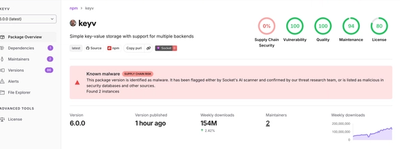
Popular npm packages keyv and cacheable compromised.

Security News
A misconfiguration gave three Anthropic models internet access, and one, believing it was in a simulation, shipped a credential-stealing package to PyPI.