

Product
Socket for ClickUp Is Now Available
Create ClickUp tasks from Socket alerts, automate ticketing with custom rules, and keep alert and task status synchronized.
By Jeppe Hasseriis - Aug 26, 2026
apolo-cad
Advanced tools
CAD paramétrico 3D agente-nativo para maquinaria industrial, conducible por un agente de IA vía MCP
An agent-native 3D parametric CAD for industrial machinery. Built to be driven by an AI agent (Claude Opus or others) over MCP — or by hand in your browser.
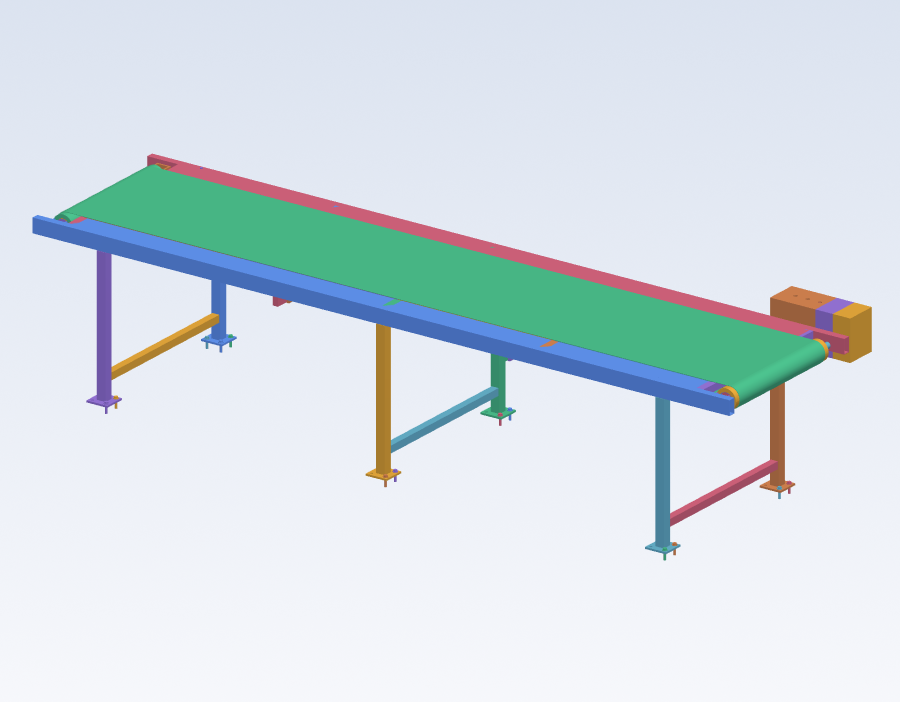
Apolo is a headless parametric CAD for designing real machines. Its edge isn't the kernel (it uses OpenCascade, like FreeCAD) but its agent-native architecture: every operation is a command against an API, the whole document is an editable command log, and the same JSON Schemas that generate the UI also generate the agent's tools.
The upshot: an AI agent can design complete machines end to end —not just autocomplete— and verify them: detect interferences, simulate gravity, look at a render (vision) and emit fabricable shop drawings.
pip install apolo-cad
Optional extras: apolo-cad[physics] (gravity/drop tests, MuJoCo), apolo-cad[fea] (linear
static FEA), apolo-cad[sketch] (PlaneGCS solver where no wheel is published — needs a C++
toolchain; otherwise the sketcher falls back to the SciPy engine automatically).
apolo --open # API + web UI on http://127.0.0.1:8000
Apolo exposes 79 MCP tools, so any MCP-compatible client (Claude Code, Claude Desktop, …) can
design machines. Keep apolo running, then register the stdio server:
{
  "mcpServers": {
    "apolo-cad": {
      "command": "apolo-mcp",
      "env": { "APOLO_URL": "http://127.0.0.1:8000" }
    }
  }
}
Then just ask:
"Design a 4 m × 600 mm belt conveyor for 1–15 kg parcels, with a hollow-shaft gearmotor and gravity-type take-up tensioning. Check there are no interferences and show me a render."
The agent models (run_batch — atomic batches, one undo step), perceives (render_view
returns an image → vision), validates (check_interference, engineering_check,
gravity_test) and documents (drawing_set, assembly_manual → shop drawings, cut lists,
BOMs, assembly manuals). Everything lives in the command log: editable, undoable, reproducible.
Installed from PyPI, your projects live in ~/.apolo/ (override with APOLO_HOME, or point
APOLO_DB at a specific SQLite file). Running from a source checkout, they stay in the repo's
data/ — same as before.
MIT © 2026 Mario Rojas. Built on OpenCascade (LGPL), build123d, FastAPI, three.js and MuJoCo.
FAQs
CAD paramétrico 3D agente-nativo para maquinaria industrial, conducible por un agente de IA vía MCP
The pypi package apolo-cad receives a total of 27 weekly downloads. As such, apolo-cad popularity was classified as not popular.
We found that apolo-cad demonstrated a healthy version release cadence and project activity because the last version was released less than a year ago. It has 1 open source maintainer collaborating on the project.
Product
Create ClickUp tasks from Socket alerts, automate ticketing with custom rules, and keep alert and task status synchronized.

Product
Create and manage Asana tasks directly from Socket alerts, with manual task creation, automated ticketing rules, and two-way sync.

Security News
Open VSX has removed three extension IDs from its malicious-extension list as the legitimate publishers they impersonated move to claim the names for themselves.