

Company News
AWS Security Hub Adds Socket for Supply Chain Security
Socket is now in the AWS Security Hub Extended plan. Adopt it through AWS, apply committed spend, and block malicious open source packages.
By Feross Aboukhadijeh - Aug 04, 2026
baton-orchestrator
Advanced tools
Baton — a cross-provider multi-model AI orchestration engine (supervisor task-DAG routing, agentic tools, forgery-resistant evaluation).


A cross-provider multi-model AI orchestration engine. A supervisor model decomposes a goal into a task DAG, routes each sub-task to the best-quality model capable of it — by required strengths and tool support — across providers (Anthropic, any OpenAI-compatible endpoint, Ollama), runs them one-shot or in an agentic tool loop, and synthesizes a final answer. Built without an orchestration framework (no LangChain / CrewAI / LiteLLM).
One conductor, many players — pass the baton from the leader model to the workers and back.
--prefer cash_protect_quota right-sizes instead, to protect subscription quota.AnthropicProvider and a generic OpenAICompatProvider speak to Anthropic,
Google AI Studio (Gemini), Groq, OpenRouter, DeepSeek, Moonshot (Kimi), local Ollama, and any
other OpenAI-compatible endpoint — no code changes, just env vars.run_python
in a subprocess sandbox — container-isolated under BATON_SANDBOX=docker — plus host-mediated
fetch_url / read_file).CostMeter tallies per-model usage and cost, and propagates an estimated
flag when a provider returns no usage.FakeProvider + local subprocesses), ruff-clean.flowchart TD
goal(["goal"]) --> S["Supervisor<br/>plan → validated task DAG<br/>(acyclic · typed · one_shot | agentic)"]
S --> R["Router<br/>strongest capable model per task<br/>(by strengths + tool support)"]
R --> P
subgraph wave["wave execution · asyncio fan-out · fail-fast"]
direction TB
P["Projector<br/>scoped, budget-capped request<br/>(system + task + deps)"]
P --> W["Worker<br/>one-shot"]
P --> AW["AgenticWorker<br/>model ↔ tool loop<br/>(run_python · fetch_url · read_file)"]
end
W --> BB[("Blackboard<br/>append-only · provenance · latest-wins")]
AW --> BB
BB --> SY["Synthesizer<br/>combine artifacts → final answer"]
SY --> result(["result<br/>+ CostMeter totals · usage · duration"])
classDef io stroke:#8b5cf6,stroke-width:2px;
classDef store stroke:#f59e0b,stroke-width:2px;
class goal,result io;
class BB store;
                    ┌──────────────┐
   goal ──────────► │  Supervisor  │  plan → validated task DAG (acyclic, typed, one_shot|agentic)
                    └──────┬───────┘
                           ▼
                    ┌──────────────┐   per task: pick the strongest model whose strengths +
                    │    Router    │   tool support fit the task (quality-first)
                    └──────┬───────┘
                           ▼
        ┌───────────── wave execution (asyncio, fan-out cap, fail-fast) ─────────────┐
        │   ┌───────────┐   scoped, budget-capped request (system + task + deps)      │
        │   │ Projector │──────────────────────────────────────────────────────────► │
        │   └───────────┘                                                             │
        │        ▼                              ▼                                      │
        │   ┌─────────┐  one-shot          ┌───────────────┐  model↔tool loop         │
        │   │ Worker  │                    │ AgenticWorker │  (run_python sandbox,     │
        │   └────┬────┘                    └───────┬───────┘   fetch_url, read_file)   │
        │        └──────────────┬──────────────────┘                                   │
        └───────────────────────┼───────────────────────────────────────────────────┘
                                 ▼
                    ┌──────────────────────┐   append-only, provenance, latest-wins
                    │  Blackboard          │◄──────────────────────────────────────
                    └──────────┬───────────┘
                               ▼
                    ┌──────────────┐
                    │ Synthesizer  │  combine artifacts → final answer
                    └──────┬───────┘
                           ▼
                        result  (+ CostMeter totals, usage, duration)
| Component | File | Responsibility |
|---|---|---|
| Supervisor | src/baton/supervisor.py | Decompose goal → validated task DAG |
| Router | src/baton/router.py | Task → strongest capable model (by strengths + tool support) |
| Projector | src/baton/projector.py | Scoped, budget-capped request from blackboard artifacts |
| Worker | src/baton/worker.py | One-shot model call |
| AgenticWorker | src/baton/agent.py | Model↔tool loop with per-turn records |
| Blackboard | src/baton/blackboard.py | Append-only shared state with provenance |
| Synthesizer | src/baton/synthesizer.py | Artifacts → final answer |
| Runtime | src/baton/runtime.py | Orchestrate: plan → waves → synthesize (streaming, fail-fast) |
| Providers | src/baton/providers/ | Anthropic + OpenAI-compatible adapters (complete/stream/tools) |
| Tools | src/baton/tools/ | Sandbox / DockerSandbox, run_python, fetch_url, read_file |
| Eval | eval/ | 5 composite goals, 3-arm comparison, forgery-resistant scorer |
Requires Python 3.11+ and uv.
git clone https://github.com/ribato22/baton
cd baton
uv sync --dev            # install deps + dev tools
uv run pytest            # 580+ tests, no network
uv run ruff check .      # lint

# See it orchestrate end-to-end with ZERO API keys (FakeProvider demo):
uv run python examples/fake_provider.py
Then configure at least one real provider (see Providers) and run a demo:
cp .env.example .env     # fill in one provider, then `set -a; . .env; set +a`

uv run python demo.py               # show detected providers
uv run python demo.py orchestrate   # full supervisor → workers → synth, streamed live
uv run python demo.py agentic       # one cross-provider agentic coding task (run_python loop)
uv run python demo.py eval          # 3-arm eval suite
demo.py orchestrate streams every phase live, then prints the result (illustrative):
Orchestrate demo — planner/synth model=openai/gpt-4o-mini

(planning + workers + synthesis stream live)
[haiku] Threads run as one— / tasks bloom in parallel time, / the join gathers all.

STATUS: success

FINAL:
Threads run as one—
tasks bloom in parallel time,
the join gathers all.

cost: $0.001834
demo.py eval prints the 3-arm table (format_report); read the VERDICT with the warnings
(illustrative numbers):
GOAL          WINNER            BASE   ORCH   AGEN
-------------------------------------------------
slugify       orchestration     0.70   1.00   0.85
roman         baseline          1.00   0.85   0.55
calc          orchestration     0.55   0.85   0.70
csv_stats     agentic           0.40   0.55   0.85
json_flatten  orchestration     0.70   1.00   0.85
-------------------------------------------------
wins: baseline=1  orchestration=3  agentic=1  ties=0
totals: baseline $0.0210  orchestration $0.0480  agentic $0.0350
VERDICT: ORCHESTRATION
Baton ships three surfaces: a one-command CLI (the primary entrypoint), an optional Web UI, and an importable library. All three need at least one configured provider — see Providers — or (Web UI only) fall back to a no-key demo.
uv run baton "write a haiku about concurrency, then explain the metaphor"
baton streams the plan, each parallel worker's output (labelled per task), and the synthesis live,
then prints a summary. Flags (baton --help):
| Flag | Description |
|---|---|
--prefer {quality,cash_protect_quota,local,cheap} | routing objective (default quality — the strongest model capable of each task). cash_protect_quota right-sizes to protect subscription quota; local/cheap are accepted but currently behave as quality |
--provider NAME / -P NAME | restrict the planner/synth baseline to this provider |
--model ID | override the planner/synth model_id |
--json | print the run summary as one parseable JSON line; disables streaming |
--no-stream | disable live streaming of plan/worker/synth text |
--version | print the installed version and exit |
Exit codes: 0 success, 1 run failure, 2 config error (e.g. no provider configured), 130
Ctrl-C (prints whatever partial output had streamed so far — never a raw traceback).
The text-mode summary reports billed_usd (real cash spent) vs. credit_usd (subscription/plan
API-equivalent valuation of subscription calls, not cash) plus subscription_models (the count of
distinct subscription-billed models used) — a subscription run is cash-free but still consumes your
interactive quota (see below).
uv sync --extra ui
uv run python -m webui          # then open http://127.0.0.1:8000
A small FastAPI + Server-Sent-Events app streams a run live in the browser — the plan, each parallel
worker's output (labelled per task), the synthesis, and the final result with cost. It runs with your
configured providers, or a built-in FakeProvider demo if none are set (no API key needed). This is
a source-checkout feature — webui/ is not shipped in the built wheel/PyPI package.
BATON_UI_HOST / BATON_UI_PORT override the bind address. The page inserts all model output via
textContent only (never raw HTML), so streamed text cannot inject markup.
import asyncio
import baton


async def main() -> None:
    registry, providers, model_id = baton.build_providers_from_env()
    runtime = baton.make_runtime_factory(registry, providers, model_id)()
    result = await runtime.aexecute("your goal")
    print(result.status, result.billed_usd, result.credit_usd)


asyncio.run(main())
The top-level baton package re-exports the common library API (Runtime, Registry,
Router, build_providers_from_env, make_runtime_factory, RunResult, ModelInfo, Task,
LLMProvider, ProviderError — see baton.__all__) so you don't need to reach into submodules
for everyday use.
See examples/ for runnable scripts — including
examples/fake_provider.py, which needs no API key at all. For a
guided tour with hardcoded goals, see the demo script:
uv run python demo.py orchestrate|agentic|eval (walked through in Quickstart).
Baton can drive the official headless CLIs you're already logged into instead of (or alongside) a card-billed API key:
export CLAUDE_CODE_ENABLED=1               # needs `claude` installed and logged in
# CLAUDE_CODE_SYSTEM_PROMPT_MODE=replace is the default — makes `claude -p` behave as a
# raw completion; `append` breaks strict-JSON planning, so leave it unset unless you know why.
export CODEX_ENABLED=1 CODEX_TIER=3         # needs `codex login`
uv run baton "your goal"
⚠️ Subscription runs are cash-free but consume your interactive Claude Code / Codex quota — the same pool your interactive coding sessions draw from. A heavy orchestration run can trip a rate-limit pause. The default
qualityobjective favors the strongest capable model per task, which can lean on subscription models. Pass--prefer cash_protect_quotato mitigate this — it sends bulk/easy work to cheaper local/free-tier models and reserves subscription models for hard tasks only. A card-billed, free-tier, or local model as planner is recommended: subscription CLIs ignoretemperature, so Baton retries planning with self-correction and can gateclaude -pas planner behind a live parse-plan check (it only plans if it demonstrably emits valid plan JSON).This drives the official headless CLIs (
claude -p,codex exec) that you are already logged into — never the claude.ai / ChatGPT web apps. Scraping those web apps is not implemented (it would violate their Terms of Service).
Baton is a CLI first, so it already works in any editor's integrated terminal (uv run baton "…"). For VSCode there are two extra conveniences:
1. One-keystroke tasks. The repo ships .vscode/tasks.json. Open
Terminal → Run Task… (or press ⌘/Ctrl+Shift+B) and pick:
| Task | What it does |
|---|---|
| Baton: Run goal | Prompts for a goal and orchestrates it (streams plan → workers → synthesis). |
| Baton: Web UI | Serves the live Web UI at http://127.0.0.1:8000. |
| Baton: MCP server (stdio) | Runs the MCP server for AI-agent integration (below). |
| Baton: Test / Lint | pytest / ruff over the project. |
2. MCP server — let the AI inside your editor call Baton. Baton ships an
MCP server (baton_mcp/) exposing one tool,
baton_run(goal, prefer?), that plans → routes → runs → synthesizes and returns the final answer
plus an honest cash/plan-credit footer. Any MCP-capable assistant (Claude Code, Cursor, VS Code
Copilot agent mode, Windsurf) can then delegate whole goals to Baton.
Install it clone-free (recommended), or from a source checkout:
# clone-free — uv fetches the published package + the `mcp` extra on demand:
uvx --from "baton-orchestrator[mcp]" baton-mcp

# or install it and run the console script:
pip install "baton-orchestrator[mcp]"   # then:
baton-mcp

# or from a source checkout:
uv sync --extra mcp && uv run --extra mcp python -m baton_mcp
Register it with your client. Claude Code — one command:
claude mcp add baton -- uvx --from "baton-orchestrator[mcp]" baton-mcp
Cursor / VS Code / Windsurf — add to the client's MCP config (e.g. .cursor/mcp.json, or
VS Code's .vscode/mcp.json under a "servers" key):
{
  "mcpServers": {
    "baton": {
      "command": "uvx",
      "args": ["--from", "baton-orchestrator[mcp]", "baton-mcp"]
    }
  }
}
The server reads providers from the environment exactly like the CLI (including
CLAUDE_CODE_ENABLED / CODEX_ENABLED), so configure at least one provider first — it does not
fall back to a demo. A full branded VSCode extension is intentionally not shipped; the CLI,
tasks, and the MCP server cover the same ground.
Listing in an MCP registry. A starting-point server.json manifest is included
for the official MCP registry; the same uvx
command also works for directories like Smithery, mcp.so,
and PulseMCP. Validate the manifest against each registry's current
schema before submitting.
Set environment variables for any subset; baseline priority is
Anthropic > OpenAI-compat > Kimi > Ollama. See .env.example for the full list.
| Provider | Env | Access |
|---|---|---|
| Anthropic (Claude) | ANTHROPIC_API_KEY | Paid API (console.anthropic.com) |
| Generic OpenAI-compatible | OPENAI_COMPAT_BASE_URL, OPENAI_COMPAT_MODEL (+_KEY/_NAME/_CONTEXT/…) | Any OpenAI-compatible endpoint |
| Moonshot / Kimi | MOONSHOT_API_KEY | Paid API |
| Ollama | OLLAMA_BASE_URL | Local & free |
Subscription CLI agents are opt-in and consume your interactive quota. Scraping claude.ai / ChatGPT is not built (ToS, fragile, ban risk). Instead Baton can drive the official headless CLIs you're already logged into — Claude Code (
claude -p) and Codex (codex exec) — with no API key. This is off by default (CLAUDE_CODE_ENABLED=1/CODEX_ENABLED=1plus the CLI installed) and is never used by the eval. Honest caveat:claude -pandcodex exectoday draw from the same interactive subscription pool as the chat apps (not a separate/metered bucket), so a full orchestration run — and especially the 3-arm eval — can burn your Claude Code / Codex allowance and trip a mid-run hard-pause. Baton reportscredit_usd(subscription value consumed) separately frombilled_usd(cash), routes only hard/high-tier tasks to subscription (bulk work goes to local/free-tier), and caps subscription calls per run (BATON_MAX_SUBSCRIPTION_CALLS, default 4).Billing surface moves — re-verify before trusting it. Whether
claude -pbills against the subscription pool vs. a metered API-rate credit bucket has flipped several times in months (announced 2026-06-15, then paused; still paused as of 2026-07-22). When Anthropic next announces a billing change, repeat the live gate indocs/claude-code-live-gate.mdand re-check the Help Center banner, then update the "verified" date recorded there.
Free, high-intelligence option — Google AI Studio (Gemini Flash), via the generic slot:
export OPENAI_COMPAT_BASE_URL=https://generativelanguage.googleapis.com/v1beta/openai/
export OPENAI_COMPAT_KEY=<ai-studio-key>       # aistudio.google.com/apikey
export OPENAI_COMPAT_MODEL=gemini-flash-latest # pick a current model from the endpoint's /models
export OPENAI_COMPAT_NAME=google/gemini-flash
uv run python demo.py orchestrate
The generic slot defaults to industry-standard values (context 128k, output 8k, tool-capable, cost
0 for free tiers) and registers its own ModelInfo, so cost/context accounting is correct.
Several providers at once — add OPENAI_COMPAT_2_*, OPENAI_COMPAT_3_*, … (each with its own
model_id / pricing / context). For example Gemini plus Groq, so the supervisor plans on Gemini
while the cheaper Groq model runs the parallel workers — genuine cross-provider orchestration. See
.env.example.
demo.py eval runs a 3-arm comparison over 5 composite coding goals: baseline (one strong
model, one shot), orchestration (the full engine), and agentic-single (one model + a
run_python loop, no decomposition). Each goal is scored by a hidden reference test.
The scorer runs the model's generated solution.py in a subprocess under process + filesystem
separation: a trusted runner drives the untrusted solution in a separate process that never sees
the expected outputs (nonce-authenticated RPC), so a solution must actually compute correct answers —
it cannot fake a passing score.
Read the verdict together with the warnings the harness emits:
WARNING: some costs are estimated … — a provider returned no usage; cost comparison is soft.WARNING: agentic arm failed N run(s) … — a 0.0 may be infra/provider failure, not capability.WARNING: goal(s) […] produced NO trusted result … — the reference runner itself is broken; those
scores are harness artifacts, not real zeros.This is a study project; its isolation guarantees are deliberately scoped and documented.
Sandbox protects against
accidents, not adversaries: on macOS the host network and disk remain reachable. For real
isolation use BATON_SANDBOX=docker (runs code in a container with --network none, read-only
root, cgroup limits) — this is the prerequisite for the network-isolation guarantee.fetch_url (domain allowlist) and read_file (root-confined)
run in the trusted orchestrator so sandboxed code stays network-isolated. Prompt-injection
containment holds only under the Docker sandbox.setsid() can still escape the killpg group
(the wall-clock timeout still bounds the run). It is process isolation, not a security sandbox for
arbitrary hostile code.src/baton/ # engine (importable package: `baton`)
providers/ # Anthropic + OpenAI-compatible adapters, FakeProvider
tools/ # Sandbox, DockerSandbox, run_python, fetch_url, read_file
eval/ # goals, 3-arm harness, forgery-resistant scorer, runner
examples/ # small runnable library-API scripts (incl. a no-key FakeProvider demo)
webui/ # optional FastAPI + SSE web UI (uv run python -m webui)
tests/ # 560+ tests (unit + opt-in integration)
docs/ # internal design/build records — see docs/README.md; not user docs
demo.py # end-to-end demo (orchestrate | agentic | eval)
uv run pytest uses FakeProvider and local
subprocesses; integration tests that touch the network/Docker are marked integration and skipped
by default (uv run pytest -m integration to opt in).uv run ruff check . (line length 100; E,F,I,UP,B).Baton is a study engine for multi-model orchestration, not a production framework. It deliberately avoids LangChain, LiteLLM, and CrewAI — the point is to see how a supervisor, router, projector, and blackboard actually work under the hood, not to hide them behind an abstraction. Don't adopt it as a drop-in production agent framework; treat it as a reference implementation to read, fork, and learn from.
MIT © 2026 ribato.
FAQs
Baton — a cross-provider multi-model AI orchestration engine (supervisor task-DAG routing, agentic tools, forgery-resistant evaluation).
The pypi package baton-orchestrator receives a total of 351 weekly downloads. As such, baton-orchestrator popularity was classified as not popular.
We found that baton-orchestrator demonstrated a healthy version release cadence and project activity because the last version was released less than a year ago. It has 1 open source maintainer collaborating on the project.
Did you know?

Socket for GitHub automatically highlights issues in each pull request and monitors the health of all your open source dependencies. Discover the contents of your packages and block harmful activity before you install or update your dependencies.
Company News
Socket is now in the AWS Security Hub Extended plan. Adopt it through AWS, apply committed spend, and block malicious open source packages.
Research
/Security News
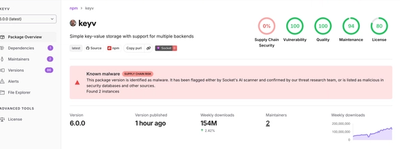
Popular npm packages keyv and cacheable compromised.

Security News
A misconfiguration gave three Anthropic models internet access, and one, believing it was in a simulation, shipped a credential-stealing package to PyPI.