

Product
PHP and Composer Support Is Now in Beta
Socket’s PHP and Composer support is now in Beta for all customers, with PHP reachability analysis generally available.
By Trevor Norris, Benjamin Barslev - Aug 21, 2026
cloudarmor-mcp
Advanced tools
MCP server for Google Cloud Armor WAF log patrol — deny summaries, false-positive checks, preview rules
English | 日本語
MCP server for Google Cloud Armor WAF log patrol — deny summaries per rule, home-region false-positive checks, and preview (dry-run) rule review, straight from Cloud Logging.
Built for a daily "is the WAF healthy?" patrol: one daily_brief call answers what did we block, did we block anyone we shouldn't have, and are the preview rules ready to promote.
Documentation: https://shigechika.github.io/cloudarmor-mcp/
| Tool | Purpose |
|---|---|
daily_brief | One-call morning summary: enforced DENYs by rule priority, home-region false-positive lens, preview DENYs |
enforce_denies | Enforced DENY counts per rule priority |
home_region_denies | Enforced DENYs whose source IP geolocates to your home region — anything not marked known-normal is a false-positive candidate |
preview_denies | Preview (dry-run) DENY counts — a quiet preview rule is a promotion candidate |
health_check | Version, config presence, and a minimal Cloud Logging probe |
All tools are read-only. Counts are hard-capped (default 2000 entries per query) and a capped result is reported as >= N (capped), never as an exact total.
Create a service account with roles/logging.viewer only and download a key. Unlike human accounts, service accounts are not subject to organization re-authentication policies, so an unattended patrol never silently expires.
gcloud iam service-accounts create waf-log-viewer --project=YOUR_PROJECT
gcloud projects add-iam-policy-binding YOUR_PROJECT \
  --member=serviceAccount:waf-log-viewer@YOUR_PROJECT.iam.gserviceaccount.com \
  --role=roles/logging.viewer
gcloud iam service-accounts keys create key.json \
  --iam-account=waf-log-viewer@YOUR_PROJECT.iam.gserviceaccount.com
pip install cloudarmor-mcp
# or
uv tool install cloudarmor-mcp
| Variable | Required | Meaning |
|---|---|---|
CLOUDARMOR_PROJECT | yes | GCP project ID that receives the load-balancer logs |
GOOGLE_APPLICATION_CREDENTIALS | yes | Path to the service-account key file |
CLOUDARMOR_BACKEND_SERVICES | no | Comma-separated backend service names to filter (default: all) |
CLOUDARMOR_HOME_REGION | no | ISO region code treated as home traffic, e.g. JP. Enables the false-positive lens |
CLOUDARMOR_RULES_INI | no | Path to a rules INI (labels + known-normal priorities, see below) |
CLOUDARMOR_MAX_ENTRIES | no | Max entries fetched per query (default 2000) |
Keep your rule numbering out of prompts and give the reports human-readable labels:
[rules]
101 = block non-home deep-path crawlers
500 = AutoDiscover probe block
1002 = OWASP LFI protection

[home]
; home-region DENYs on these priorities are expected, not false positives
known_normal_priorities = 500, 600
This repository doubles as a single-plugin marketplace, so Claude Code can install the server for you:
/plugin marketplace add shigechika/cloudarmor-mcp
/plugin install cloudarmor-mcp@cloudarmor-mcp
The plugin launches uvx cloudarmor-mcp and reads the same environment variables
described in Environment variables above; export them
before starting Claude Code. GOOGLE_APPLICATION_CREDENTIALS still has to point at
a service-account key file that exists on your own machine — the plugin can't ship
or fetch that file for you, so this server can't be fully configured through the
plugin's own settings alone.
uvx must be on the PATH of the process that runs Claude Code — a login
shell usually has it, but a GUI-launched app may not; install
uv system-wide if the plugin fails to start.
claude mcp add cloudarmor -- cloudarmor-mcp
with the environment variables above in the server's env.
cloudarmor-mcp --version   # print version
cloudarmor-mcp --check     # config + API probe (exit 0 when healthy)
cloudarmor-mcp --brief     # print daily_brief to stdout (cron / smoke tests)
known_normal_priorities list keeps expected rules (e.g. an AutoDiscover block) out of the suspicious list.MIT
FAQs
MCP server for Google Cloud Armor WAF log patrol — deny summaries, false-positive checks, preview rules
The pypi package cloudarmor-mcp receives a total of 192 weekly downloads. As such, cloudarmor-mcp popularity was classified as not popular.
We found that cloudarmor-mcp demonstrated a healthy version release cadence and project activity because the last version was released less than a year ago. It has 1 open source maintainer collaborating on the project.
Product
Socket’s PHP and Composer support is now in Beta for all customers, with PHP reachability analysis generally available.
Product
Socket is bringing experimental protection to Firefox, scanning 97,000+ extensions in Mozilla's official directory for malware and risky updates.
Research
/Security News
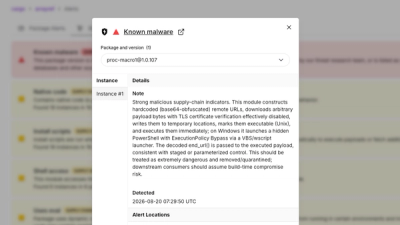
Three compromised Rust crates pulled in a malicious dependency that downloaded and executed cross-platform malware during Cargo builds.