


Company News
AWS Security Hub Adds Socket for Supply Chain Security
Socket is now in the AWS Security Hub Extended plan. Adopt it through AWS, apply committed spend, and block malicious open source packages.
By Feross Aboukhadijeh - Aug 04, 2026
ebay-mcp
Advanced tools




Give an AI agent real, live market prices — straight from the largest secondhand marketplace on the internet.
eBay is a continuously-updating ledger of what physical things actually cost right now. This wraps its Browse API as an MCP server with three tools, so an agent can search listings, pull a single item, and — the useful one — get an aggregated price landscape for anything: min, median, max, broken down by condition.
Python 3.12+ · MIT · MCP server · app-token auth, no user login
Setup is one free eBay app keyset — no user login, no OAuth consent screen to click through. Point an agent at it and ask "what does an RTX 5080 actually go for?" — one call back comes a grounded answer, split by condition, with the cheapest listings attached.
ebay_price_check: how the landscape is built| Tool | What it does |
|---|---|
ebay_price_check | Aggregated price landscape for a query — count, min/median/max, a breakdown by condition, and the cheapest listings. The headline tool. |
ebay_search | Listing search with sorting and filtering — returns clean {itemId, title, price, condition, seller, itemWebUrl} rows. |
ebay_get_item | Full detail for one item by ID. |
// ebay_price_check  ·  query: "RTX 5080", exclude: ["laptop", "notebook"]
{
  "count": 47, "currency": "USD",
  "min": 899, "median": 1099, "max": 2200,
  "by_condition": {
    "New":  { "count": 18, "min": 1099, "median": 1199, "max": 1634 },
    "Used": { "count": 21, "min": 899,  "median": 1050, "max": 1499 }
  },
  "cheapest": [ { "price": 899, "condition": "Used", "title": "…", "itemWebUrl": "…" } ]
}
Every tool flows through a single EbayBrowseClient, which owns the token and
talks to eBay. There's one place credentials are read, one place a token is
cached, one place HTTP happens — nothing to drift.
flowchart LR
    Agent(["AI agent / Claude"])
    subgraph server["ebay-mcp · stdio server"]
        Tools["ebay_search<br/>ebay_get_item<br/>ebay_price_check"]
        Client["EbayBrowseClient"]
        Cache[("OAuth token<br/>in-memory, auto-refresh")]
    end
    Cfg["~/.ebay-mcp.toml<br/>or env vars"]
    eBay["eBay Browse API"]

    Agent -->|"MCP tool call"| Tools
    Tools -->|"search / get_item"| Client
    Client <-->|"reuse or mint token"| Cache
    Client -->|"Bearer token + query"| eBay
    eBay -->|"listings JSON"| Client
    Cfg -.->|"keyset + active env"| Client
The server is async; the client is plain synchronous requests, run in a thread
(asyncio.to_thread) so a slow eBay call never blocks the event loop.
ebay_price_check is the one tool that does more than pass through — it runs a
search and then aggregates the result (see below).
eBay's Browse API uses an application token (the OAuth client-credentials grant) — no user is involved. The client mints one on first use, caches it in memory, and silently refreshes when it's about to expire. You never think about it.
sequenceDiagram
    participant T as Tool call
    participant C as EbayBrowseClient
    participant O as eBay OAuth
    participant B as Browse API

    T->>C: search("RTX 5080")
    alt token missing or expired
        C->>O: POST /identity/v1/oauth2/token<br/>Basic(app_id:cert_id), grant=client_credentials
        O-->>C: access_token + expires_in
        Note over C: cache until (expires_in − 60s)
    end
    C->>B: GET /item_summary/search<br/>Authorization: Bearer …
    B-->>C: listings JSON
    C-->>T: parsed results
The 60-second buffer means a token is treated as expired slightly early, so a call never races a token that dies mid-flight. Tokens live ~2 hours; in practice one fetch covers a long session.
ebay_price_check: how the landscape is builtThe other two tools are thin wrappers. This one is the reason the project exists: it turns a pile of raw listings into a number you can reason about.
flowchart LR
    Q["query<br/>+ exclude[]"] --> S["search<br/>(up to 50 listings)"]
    S --> F["drop excluded titles<br/>+ unpriced listings"]
    F --> G["group by condition"]
    G --> A["aggregate<br/>min · median · max"]
    G --> H["cheapest N<br/>(the tail)"]
    A --> R(["{ count, min, median, max,<br/>by_condition, cheapest }"])
    H --> R
exclude is what makes the number honest — a search for "RTX 5080" is full of
laptops and prebuilt PCs, and exclude: ["laptop", "notebook", "prebuilt"]
strips them so the median reflects the actual card. The by_condition split
matters just as much: a "median" that blends new-in-box with used-and-abused is
noise; split by condition and each tier tells the truth.
One honest limitation worth knowing: the Browse API returns active asking prices, not completed sales. Treat the floor as "best currently advertised," not "what it sold for."
git clone https://github.com/cunicopia-dev/ebay-mcp
cd ebay-mcp
python3.12 -m venv .venv && source .venv/bin/activate
pip install -e .
You need a (free) eBay developer application keyset — see docs/SETUP.md for the five-minute walkthrough. Then wire it into your MCP client:
{
  "mcpServers": {
    "ebay": { "command": "/path/to/ebay-mcp/.venv/bin/ebay-mcp" }
  }
}
Credentials come from environment variables (highest priority) or a
~/.ebay-mcp.toml file. The active env selects the keyset and the API
base URL together — so production creds can never accidentally point at the
sandbox, or vice versa.
flowchart TD
    Start(["load_config()"]) --> Env{"EBAY_ENV /<br/>EBAY_*_APP_ID<br/>in environment?"}
    Env -->|"set"| UseEnv["take keyset<br/>from env vars"]
    Env -->|"unset"| Toml{"~/.ebay-mcp.toml<br/>present?"}
    Toml -->|"yes"| UseToml["take keyset<br/>from TOML"]
    Toml -->|"no"| Default["default env = production<br/>(error if creds missing)"]
    UseEnv --> Pick["env → keyset + base URL<br/>(locked together)"]
    UseToml --> Pick
    Default --> Pick
# ~/.ebay-mcp.toml   (chmod 600)
env = "production"

[production]
app_id  = "YourApp-PRD-..."
cert_id = "PRD-..."

[sandbox]
app_id  = "YourApp-SBX-..."
cert_id = "SBX-..."
Check what's active any time — credentials are masked in the output:
ebay-mcp-config
# env:      production
# app_id:   Keit****87dd
# cert_id:  PRD-****0914
# api_base: https://api.ebay.com
# OK — configuration is valid.
Flip env between sandbox and production to switch environments — same code,
different endpoints and keyset. The sandbox is good for proving the auth flow
wires up; its inventory is sparse and seeded, so for real prices you want a
production keyset.
src/ebay_mcp/
  config.py    # env + TOML loader; ebay-mcp-config CLI
  browse.py    # EbayBrowseClient — OAuth cache + search / get_item
  server.py    # MCP server: list_tools / call_tool / main
tests/         # config precedence, aggregation, tool listing (no network)
docs/SETUP.md  # getting an eBay keyset
MIT
FAQs
eBay Browse API MCP server — buy-side listing search and price intelligence
The pypi package ebay-mcp receives a total of 32 weekly downloads. As such, ebay-mcp popularity was classified as not popular.
We found that ebay-mcp demonstrated a healthy version release cadence and project activity because the last version was released less than a year ago. It has 1 open source maintainer collaborating on the project.
Did you know?

Socket for GitHub automatically highlights issues in each pull request and monitors the health of all your open source dependencies. Discover the contents of your packages and block harmful activity before you install or update your dependencies.
Company News
Socket is now in the AWS Security Hub Extended plan. Adopt it through AWS, apply committed spend, and block malicious open source packages.
Research
/Security News
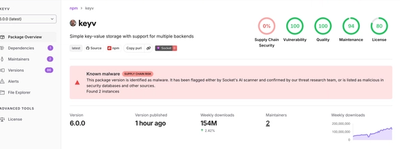
Popular npm packages keyv and cacheable compromised.

Security News
A misconfiguration gave three Anthropic models internet access, and one, believing it was in a simulation, shipped a credential-stealing package to PyPI.