

Product
PHP and Composer Support Is Now in Beta
Socket’s PHP and Composer support is now in Beta for all customers, with PHP reachability analysis generally available.
By Trevor Norris, Benjamin Barslev - Aug 21, 2026
electronics-rfq-agent-cli
Advanced tools
AI quoting agent for electronics distributors. RFQ in, quote out in seconds.
Your sales engineers are spending 2-4 hours turning RFQ documents into quotes. This does it in seconds.
Electronics RFQ Agent is a Python library and CLI that reads RFQ documents (PDF, Excel, Word), looks up every line item against your ERP catalog, and outputs a draft quote. It connects to SAP, Epicor, Oracle, and Microsoft Dynamics through MCP servers, so it works with Claude, GPT-4, or any agent framework that speaks MCP.




pip install electronics-rfq-agent-cli
# or
uv add electronics-rfq-agent-cli
To install from source instead:
git clone https://github.com/RudrenduPaul/electronics-rfq-agent
cd electronics-rfq-agent
pip install -e .
# or, with uv:
uv sync
Parsing RFQ documents (PDF, Excel, Word) calls the Anthropic API, so set ANTHROPIC_API_KEY before running anything that touches a real document:
export ANTHROPIC_API_KEY="sk-ant-..."
You don't need this key to run erfa audit against an existing quote file, or to explore the CLI with --help. Only document parsing calls out to Claude.
We were working with electronics distributors who had 3-5 sales engineers spending most of their day on quote entry. Every tool we found was either tied to one specific ERP or required a 6-month integration project. We wanted something that worked with what distributors already had, could be self-hosted (quote data is sensitive), and was actually extensible.
The MCP architecture means adding a new ERP is writing one file. The parser handles the document formats distributors actually send: hand-filled PDFs, multi-sheet Excel files, and the occasional scanned table.
No ERP system required to try it out; the mock backend ships with 200 realistic electronics parts. You do need ANTHROPIC_API_KEY set, since parsing the RFQ document is still a real Claude call:
from electronics_rfq_agent import QuoteAgent
from electronics_rfq_agent.mcp.mock import MockERP

agent = QuoteAgent(erp=MockERP())
quote = agent.run_sync("path/to/rfq.xlsx")

for line in quote.lines:
    print(f"{line.rfq_line.part_number}: {line.status} @ {line.unit_price}")

print(quote.summary())
MockERP applies quantity-based pricing tiers automatically: qty >= 1000 gets 20% off, qty >= 100 gets 10% off, qty >= 10 gets 5% off. List price applies below qty 10. This mirrors real-world volume pricing so benchmarks and integration tests reflect realistic cost curves.
Connect to a real ERP:
from electronics_rfq_agent import QuoteAgent
from electronics_rfq_agent.mcp import EpicorMCP

agent = QuoteAgent(
    erp=EpicorMCP(base_url="https://your-epicor.company.com", api_key="..."),
    max_concurrent=10,  # parallel ERP lookups (default: 10)
)
quote = agent.run_sync("rfq_2026_0619.xlsx")
print(quote.summary())
erfa ships two subcommands. Every flag below is pulled straight from erfa --help.
| Command | Arguments | Flags | What it does |
|---|---|---|---|
erfa quote | rfq (path, required) | --mock, --margin <float> (default 0.15), --output/-o <path> | Parses an RFQ file and prints a draft quote. Needs ANTHROPIC_API_KEY; parsing always goes through Claude, --mock only swaps the ERP backend. |
erfa audit | quote_file (path, required) | none | Prints a full audit report (found / substituted / not found, fill rate) for a quote JSON file saved with erfa quote --output. Reads a local file only, no API key needed. |
erfa mcp | none | none | Launches an MCP stdio server exposing quote_rfq, lookup_part, and audit_quote as typed tools, so any MCP-compatible agent (Claude, GPT-4, Gemini) can call them directly without shelling out to the CLI. Point your MCP client config at erfa mcp as the command. |
# Generate a quote from an RFQ file against the mock ERP
export ANTHROPIC_API_KEY="sk-ant-..."
erfa quote rfq.xlsx --mock

# Save the quote as JSON for later inspection
erfa quote rfq.xlsx --mock --output quote.json

# Audit what happened: what was found, substituted, or missing and why
erfa audit quote.json
Audit output example (real output from erfa audit docs/example-quote.json, generated by running the mock ERP's pricing logic against the sample RFQ in tests/fixtures/sample_rfq.txt):
Audit Report - Quote df9fd083
RFQ Source : tests/fixtures/sample_rfq.txt
Lines      : 5
Total      : USD 64.04

FOUND (4)
------------------------------------------------------------
  L  1  RES-0402-10K-1PCT               qty=1000  unit=0.0064  ext=6.40
  L  2  CAP-100NF-50V-X7R-0402          qty=500  unit=0.0104  ext=5.20
  L  3  IC-LM358-SOIC8                  qty=50  unit=0.7101  ext=35.50
  L  4  XTAL-16MHZ-SMD                  qty=25  unit=0.6774  ext=16.94

NOT FOUND (1)
------------------------------------------------------------
  L  5  MOSFET-NMOS-20V-3A-SOT23        Part 'MOSFET-NMOS-20V-3A-SOT23' not found in ERP catalog

Fill rate: 80%  (4 found / 0 substituted / 1 not found)
Zero-price parts: If a part exists in the ERP catalog but has a unit price of $0.00, the agent quotes $0 rather than skipping the line, and sets
line.notesto a message flagging the zero price so you catch it before quoting the customer. Checkline.notesfor any found or substituted line before sending a quote out.
The full reference lives in docs/api.md: every QuoteAgent parameter, the shared ERP connector interface, Quote/QuoteLineItem field-by-field, and the exception hierarchy. The exports below are what from electronics_rfq_agent import ... actually gives you, grepped from src/electronics_rfq_agent/__init__.py, not guessed:
| Export | What it is |
|---|---|
QuoteAgent | Orchestrates parsing + ERP lookup + quote assembly. run() (async) and run_sync(). |
EpicorMCP, SAPMCP, OracleMCP, DynamicsMCP | ERP connectors, one per supported system. All implement the same search_parts / get_part / get_price / check_inventory interface. |
MockERP (from electronics_rfq_agent.mcp.mock) | In-memory backend with 200 realistic parts. No credentials, no network. |
Quote, QuoteLineItem, RFQLineItem, ERPPartResult, ERPConfig | Pydantic v2 models for the quote, each line, the parsed RFQ line, raw ERP data, and connector config. |
ERPConnectionError, RFQParseError | The two exceptions QuoteAgent can raise: connection/auth failures and unparseable documents. Per-line ERP failures don't raise; they land in line.notes instead. |
TelemetryCollector, TelemetryEvent | Opt-in local telemetry (telemetry=True on QuoteAgent), counts and timings only, no RFQ content. |
| Electronics RFQ Agent | Manual process | SAP Joule | Generic AI (ChatGPT) | |
|---|---|---|---|---|
| Multi-ERP support | SAP + Epicor + Oracle + Dynamics | N/A | SAP-centric (Joule Studio can reach non-SAP sources via SAP Integration Suite) | No ERP access |
| Quote time (50 lines) | ~15s | 2-4 hours | Not publicly documented | N/A |
| Self-hostable | Yes | N/A | No (SAP BTP cloud service) | No |
| Data stays local | Yes | Yes | No | No |
| Open source | MIT | N/A | No | No |
| Dev mock backend | Yes | N/A | Not publicly documented | N/A |
| MCP compatible | Yes | N/A | Not publicly documented | No |
| ERP | Status | Connection | Docs |
|---|---|---|---|
| Epicor Kinetic | Supported | REST API | Setup |
| SAP ECC / S/4HANA | Beta (manual install) | PyRFC (BAPI) | Setup |
| Oracle Cloud SCM | Supported | REST API | Setup |
| Microsoft Dynamics 365 | Supported | Graph API | Setup |
| Mock backend | Built-in | In-memory | No config needed |
SAP note: pyrfc requires the SAP NetWeaver RFC Library, which is not on PyPI and must be downloaded manually from SAP's support portal (S-user required). See docs/erp-setup/sap.md for step-by-step instructions.
Measured using the in-memory mock backend (200 realistic parts, no ERP system required). Run it yourself:
git clone https://github.com/RudrenduPaul/electronics-rfq-agent
cd electronics-rfq-agent
uv run python benchmarks/run.py
ERP lookup latency (100 individual lookups, mock backend):
| P50 | P99 | Mean |
|---|---|---|
| 0.00025ms | 0.0023ms | 0.00032ms |
Quote assembly time by RFQ size (parser mocked, no Anthropic API call):
| RFQ size | Assembly time |
|---|---|
| 10 lines | 0.004s |
| 25 lines | 0.001s |
| 50 lines | 0.001s |
These numbers cover ERP lookup and quote assembly only. The RFQ parser is mocked and no Anthropic API call is made. In production, AI document parsing adds 5-15s per document and real ERP lookups add 100-500ms per line (parallelised at up to max_concurrent=10), giving a realistic total of ~15s for a 50-line RFQ. Manual baseline: 2-4 hours.
Electronics RFQ Agent works with any agent framework that supports MCP:
| Framework | Install | Example |
|---|---|---|
| Claude (built-in) | pip install electronics-rfq-agent-cli | 01-basic-quote |
| LangGraph | pip install 'electronics-rfq-agent-cli[langgraph]' | 04-langgraph-agent |
| OpenAI Agents SDK | pip install electronics-rfq-agent-cli[agents] | 05-openai-agents |
| CrewAI | pip install electronics-rfq-agent-cli[crewai] | n/a |
git clone https://github.com/RudrenduPaul/electronics-rfq-agent
cd electronics-rfq-agent
cp .env.example .env   # add your ERP credentials and Anthropic API key
docker compose up -d
Your quote data never leaves your environment.
What does Electronics RFQ Agent actually do? It takes an RFQ document (PDF, Excel, or Word) from a customer, extracts every line item with Claude, looks each part up against your ERP catalog through an MCP connector, and returns a priced draft quote with margin applied. A sales engineer reviews and sends it instead of building it from scratch.
Is it production ready? It's Beta (v0.2.x). The core library, Epicor, Oracle, and Dynamics connectors are covered by CI (lint, mypy strict, pytest with an 80% coverage gate, Trivy scanning) across Python 3.10-3.12. SAP support is explicitly marked Beta and requires a manual install step (the SAP NetWeaver RFC Library isn't on PyPI).
Do I need an ERP system to try it?
No. MockERP ships with 200 realistic electronics parts and applies quantity-based pricing tiers, so you can run the full parse-lookup-quote flow with zero ERP credentials. You do still need ANTHROPIC_API_KEY, since document parsing is a real Claude call. Only erfa audit (reading an already-saved quote file) works with no key at all.
How is this different from asking ChatGPT to read the RFQ? A generic chat model can read a document and even guess at prices, but it has no connection to your actual ERP catalog, inventory, or contract pricing, so it's making numbers up. Electronics RFQ Agent looks up every line item against your real catalog data and only quotes what's actually in stock at the actual cost price plus your configured margin.
How is this different from SAP Joule? Joule is SAP's proprietary AI assistant suite, built into SAP's cloud platform (SAP BTP) and centered on SAP data. Electronics RFQ Agent is MIT-licensed, self-hosted, and works with SAP, Epicor, Oracle, and Dynamics through the same MCP interface. Your quote data never has to leave your environment, and you're not tied to one ERP vendor.
How do I call this from an agent instead of the CLI?
Run erfa mcp to launch an MCP stdio server exposing quote_rfq, lookup_part, and audit_quote as typed tools. Point any MCP-compatible client (Claude, GPT-4, Gemini, or a custom agent framework) at erfa mcp as the launch command, and it can call those tools directly with structured JSON in and out, no CLI output to parse.
Which document formats does it parse?
PDF (including scanned tables, via Claude's vision capability), Excel (.xlsx/.xls, searches every worksheet for the line-item header row), and Word (.docx, reads all tables). Plain text RFQs work too.
What happens to a line item that isn't in the ERP catalog?
It's marked not_found with a note explaining why (rather than silently dropped or guessed at), and it's excluded from the quote total. Run erfa audit on the saved quote JSON to see exactly which lines were found, substituted, or missing, and why.
Can I use this commercially? Yes. It's MIT licensed, so you can use it, modify it, and ship it commercially with no royalty and no obligation to open-source your changes. Attribution via the license file is all that's required.
Is my RFQ and pricing data sent anywhere besides Anthropic? Only the RFQ document content goes to the Anthropic API for parsing. ERP lookups go directly from your machine to your ERP system over the connector you configure: there's no intermediary service, and nothing is stored outside your own environment unless you choose to persist quote JSON yourself.
Is this published to PyPI?
Yes, as electronics-rfq-agent-cli (pip install electronics-rfq-agent-cli). The publish pipeline (build, Sigstore signing, SBOM, trusted-publisher upload) lives in .github/workflows/release.yml and runs on every v* tag push. The Python import path (electronics_rfq_agent) and the erfa CLI command are unchanged; only the registry-facing package name carries the -cli suffix, matching this maintainer's naming convention for CLI tools.
electronics_rfq_agent/mcp/; each is a self-contained file with no changes to coreGitHub Discussions: Ask questions, share ideas Discord: coming soon
Full docs: Getting started · API reference · ERP setup: Epicor · SAP · Oracle · Dynamics 365 · Changelog
MIT. Contributions welcome.
MIT. See LICENSE.
If you use Electronics RFQ Agent in research, please cite:
@software{paul2026electronicsrfq,
  author = {Paul, Rudrendu and Nandy, Sourav},
  title = {Electronics RFQ Agent: AI Quoting Agent for Electronics Distributors},
  year = {2026},
  url = {https://github.com/RudrenduPaul/electronics-rfq-agent},
  license = {MIT}
}
Built by Rudrendu Paul and Sourav Nandy
FAQs
AI quoting agent for electronics distributors. RFQ in, quote out in seconds.
We found that electronics-rfq-agent-cli demonstrated a healthy version release cadence and project activity because the last version was released less than a year ago. It has 1 open source maintainer collaborating on the project.
Product
Socket’s PHP and Composer support is now in Beta for all customers, with PHP reachability analysis generally available.
Product
Socket is bringing experimental protection to Firefox, scanning 97,000+ extensions in Mozilla's official directory for malware and risky updates.
Research
/Security News
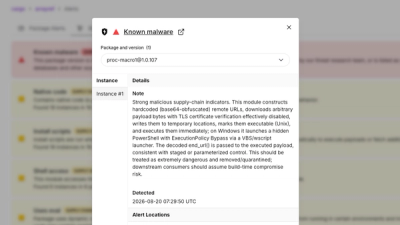
Three compromised Rust crates pulled in a malicious dependency that downloaded and executed cross-platform malware during Cargo builds.