Ephemora Cell — The execution layer for untrusted AI-generated code. Fast, capability-based WASM execution with explicit CPU, memory, time, I/O, and filesystem limits.
Deterministic execution for untrusted AI-generated code.
Run AI-generated code, MCP tools and plugins with exact, predictable cost — every execution bounded, measured, and reproducible.
~0.5 ms warm · ~3M executions/hour per core (one-liner) up to ~5.5M pooled · deterministic, not "isolated and hoped for"
Built for AI agents, MCP tools, plugins, code interpreters, and other untrusted workloads.
Fast, capability-based WASM execution: CPU, memory, time, I/O and filesystem budgets enforced per execution, with sign-ready execution records (RFC 8785 JCS canonicalization + ES256 sign()/verify() primitives).
The problem
AI agents increasingly need to write and execute code, call tools, and run plugins. The question that decides whether that is safe:
How do you let an agent execute untrusted code without giving that code access to your host, your credentials, your network, or unlimited compute — with nothing pre-opened by default?
AI Agent ──▶ Tool / MCP ──▶ Ephemora Cell ──▶ WASM ──▶ bounded result
Ephemora Cell is a small, capability-based WASM execution runtime for exactly that job: an execution primitive — not an agent framework — that sits underneath your existing agent stack, MCP server, plugin system, or application.
Every execution leaves evidence
Every tool call answers three questions at once — attached to the result as _meta.execution, canonicalized (RFC 8785 JCS) and signable:
"Verifying. Not claimed." is data, not a slogan: any record can be re-checked — rewrite one field and verify() fails. Runnable demo: python examples/signed_record_demo.py.
Quick Start
Three commands: install Cell, run something untrusted, read its audited receipt.
1 — Install (use a virtualenv; on Ubuntu ≥ 23.04 / Fedora a bare pip install
is refused by PEP 668. Windows: use Git Bash or WSL, and python instead of python3):
2 — Run something untrusted (the repo ships examples, or bring any .wasm):
git clone https://github.com/MichaelS1011/ephemora-cell.git && cd ephemora-cell
ephemora-cell run examples/hello.wasm --isolated
(adds OS-level process isolation around the run, a few ms — recommended for code you didn't build)
Hello from Ephemora Cell!
3 — Read the audited receipt — same run, machine-readable. Here a hostile module
(examples/fuel_bomb.wasm) is given a 100-unit fuel budget and stopped, exactly as
budgeted:
ephemora-cell run examples/fuel_bomb.wasm --fuel 100 --isolated --json
Same from Python — every result carries status, cost and captured output:
from ephemora_cell import run_wasm
result = run_wasm("examples/hello.wasm", max_fuel=1_000_000, timeout_seconds=30)
print(result.stdout) # captured output (10 KB cap)print(result.status.name) # SUCCESSprint(result.elapsed_ms) # wall timeprint(result.fuel_consumed) # compute actually used
Time to value: no policy file, no access rules, no container to provision. One pip install, one call, and you are already running untrusted WASM under a hard fuel + memory boundary at ~0.5 ms warm — the same call that took a stock docker run ~186 ms to start (macOS M5, mean over 100 runs, benchmarks/results/2026-09-14/competitive_benchmark.json; on the DGX GB10 the same baseline measured 312–349 ms, mean–p95 across both images, while Cell stayed sub-millisecond — benchmarks/results/2026-09-20/competitive_benchmark-dgx-aarch64.json). Measure the cost you actually pay per execution instead of billing a container you can't see inside.
Scale check on a single core: the one-liner run_wasm() path sustains ~3M executions/hour (n=500, hello.wasm, Mac M5, wasmtime 47.0.1 — regenerate below). Reuse one WASIConfig/sandbox across calls in a hot loop and the pooled path reaches ~5.5M/hour — that is what "every call sandboxed" costs when it is not the exception.
from ephemora_cell import run_wasm
import time
t0 = time.perf_counter()
for _ inrange(500):
run_wasm("examples/hello.wasm", max_fuel=1_000_000)
per_hour = 500 / (time.perf_counter() - t0) * 3600print(f"{per_hour/1e6:.1f}M executions/hour on this core (one-liner path)")
Where to next: agent/tool isolation → Secure MCP tool execution (3-line setup) · CI gating for untrusted PRs → GitHub Action · CLI reference and usage recipes → docs/recipes.md. Something failed? The usual suspects are venv not activated, python3 vs python on Windows, or a wrong .wasm path — docs/recipes.md covers them.
Real CLI session: install, first run, machine-readable --json report with the security baseline, a fuel bomb stopped at exactly 100/100 units, and an attack module (exploit.wasm) blocked at the WASI import layer. Verify every frame: the commands run as shown from a clone.
The local devtools loop for agent tools
The same three commands above are a development loop for agent tools — edit, run, read the receipt — with no Dockerfile, no image build, no container to provision:
Command
What it does in the loop
ephemora-cell build tool.rs
Compile Rust, Go, C, AssemblyScript or Zig source straight to WASM (languages & recipes)
ephemora-cell run tool.wasm --json
Execute and get the verdict immediately: status, exit code, fuel_consumed, elapsed_ms
ephemora-cell inspect tool.wasm
Imports, exports, memory — see what a module wants before you run it
ephemora-cell benchmark tool.wasm
Cold/warm latency and fuel spread while you iterate
Failures come back graded, not crashing: an infinite loop returns status: "fuel_exhausted" with its receipt, a memory hog memory_exceeded, a crash a non-zero exit code — the same statuses the auto-grader and the CI test-bench job consume. A tool that misbehaves never takes your terminal with it; you read the cost it caused and fix the code. Warm executions run sub-millisecond (0.17 ms guest / 0.51 ms end-to-end, pooled, measured; benchmarks/results/) — feedback at edit speed, against the same enforced boundary your tools will face in production.
Why this matters
Agent-generated code is different from application code: it can be buggy, computationally unbounded, unexpectedly expensive — or hostile. The runtime must enforce boundaries, not document them. Every Cell run does:
Enforced, not promised — fuel metering (CPU), memory caps, epoch-based wall-clock timeouts, output caps and I/O budgets are enforced per execution; the effective posture is attested in an execution record that is
canonicalized (RFC 8785 JCS) and sign-ready (sign()/verify() shipped).
Deterministic loop-stop — AI-generated code ships infinite loops and unbounded retries by default. Fuel is the hard CPU-instruction exhaustion boundary: a hostile or buggy module that loops forever is stopped at precisely the budget you set, every time, and the run cannot overshoot its fuel budget. The epoch-based wall-clock timeout is the safety net on top of it — fuel counts CPU, the clock bounds everything else; no timeout races, no heuristic kill.
Measured isolation advantage — of the attack vectors that succeed against a stock Docker container (shell, fork, socket, host filesystem, symlink escape, …), all 8 are blocked here (live-verified, script in the repo).
Sub-millisecond warm execution — 0.17 ms guest / 0.51 ms end-to-end (pooled, measured 2026-09-14; benchmarks/results/) makes sandboxing every call affordable instead of exceptional.
What is enforced
Security is never opt-in. Every execution — in-process or isolated — runs under enforced limits (CPU fuel, memory, wall-clock time, output caps — always on, neither the guest nor the caller can switch them off). The one thing you choose is the process boundary: add --isolated (or call run_isolated()) when the module comes from outside your own build — agent output, third-party plugins, PR-contributed code. The in-process path stays for modules you build and trust. The enforced defaults:
Resource
Default
WASM memory
128 MB (Store.set_limits)
Fuel / CPU budget
1,000,000 (~13 fuel/iteration, R² = 1.000 across the 7 successful points up to 1M iterations; the curve flattens above that — re-measured 2026-09-14, macOS arm64, benchmarks/results/2026-09-14/fuel_boundary.json; fuel counts are per-platform, not cross-platform)
Wall-clock timeout
30 s (epoch interruption)
Captured stdout/stderr
10 KB
Network
disabled — Preview1: no socket APIs; WASI 0.2: linked, denied at call time (measured)
Additional controls: I/O budgets (io_cpu_seconds=2.0 / io_budget_bytes=64 MiB — walls for host work, not just guest compute), dual-ABI (WASI Preview1 + WASI 0.2 components, opt-in), memory64 opt-in, GC-heap declared cap (recorded in the security baseline; fuel remains the effective bound), named state (64 entries · 256 KiB · 1 MiB per session), and an egress sidecar reference mediator (allowlist-validated host-side API calls — docs/egress_patterns.md).
Security
Evidence ladder — strongest first. Every row is measured, the raw evidence is committed, and each run is reproducible:
Real exploit paths of two patched CVEs are denied at the engine level; governed loading fails closed on a tampered payload — also verified on WASI 0.2 components, with a measured call-time socket denial
Pinned vulnerable reference server vs Cell, random marker tokens, positive controls on both sides
18 container/K8s escape scenarios mapped to WASM: 8 execution-tested and denied, 10 not expressible on the WASI surface · OSS slice of the Ephemora benchmark program (see note below)
Structural mapping + live attempts, granted-preopen positive control
python benchmarks/sandbox_escape_18.py
3
8 attack intents × 3 boundaries
Same intents, same exit-code rule: stock Docker 0/8 blocked · hardened Docker 2/8 · Cell 8/8 (matrix below)
72 pass / 1 documented xfail / 0 fail against the pinned upstream suite — re-run weekly in CI (weekly ubuntu runs land 71–72 on varying fs tests; a documented runner quirk, not a Cell defect — see the conformance section)
Runtime adapter over the official suite, raw JSON committed
Fuel deterministic per platform (spread 0), platform-bound values
Same tool call on macOS arm64 / DGX GB10 / x86_64
python benchmarks/determinism_probe.py
Row 2 in context. The 18 scenarios are external (UK AI Security Institute, MIT — provenance note below). This mapping is the open-source execution-boundary slice of a broader benchmark and assurance program; the wider program — including the agentic escape evaluation the upstream benchmark actually runs — is part of the Ephemora enterprise edition (docs/enterprise.md).
Where the 18 scenarios come from. They are not ours: the UK AI Security Institute's SandboxEscapeBench (arXiv 2603.02277, scenarios: UKGovernmentBEIS/sandbox_escape_bench, MIT) documents 18 ways code escapes container/Kubernetes sandboxes. Their benchmark tests whether AI agents can escape misconfigured containers; this suite does something narrower — each container scenario is mapped to its closest WebAssembly/WASI equivalent and executed against Cell, with no model in the loop. The result is a statement about the attack surface: the primitives those container escapes rely on (privileged modes, namespaces, cgroups, kernel primitives, raw sockets) do not exist on the WASI surface, and the scenarios with a WASM-expressible equivalent (filesystem, sockets) are denied by the live boundary. This repo covers the execution-boundary slice only; prompt-injection and agent-behavior security are different layers, out of scope for an execution sandbox by design. The Ephemora enterprise edition builds on Cell's isolation and runs a broader benchmark and assurance program for regulated environments — see docs/enterprise.md.
What we do not compare — and why. Prompt-injection suites (garak, InjecAgent) test the model and agent layer, not the execution boundary — out of scope for an execution sandbox. Cloud sandbox providers are cited from third-party sources with their source status; third-party numbers never appear in the same table as our measured cells. Startup and throughput benchmarks live in docs/performance.md with their scope caveats.
The guest receives only the capabilities explicitly made available to it. Live verification of eight attack classes (benchmarks/verify_8_vectors.py) — measured against three boundaries, same intents, same measurement rule (exit code decides, nothing hardcoded):
Attack class
Docker
Docker (hardened¹)
Ephemora Cell
Layer
Shell (os.system) / fork
ALLOWED
ALLOWED
BLOCKED — APIs don't exist in WASI
1
Network sockets
ALLOWED
ALLOWED — creation needs no capability
BLOCKED — APIs don't exist in WASI
1
fsync (os.fsync)
ALLOWED
BLOCKED — EROFS via --read-only
BLOCKED — import-level rejection
2
Host filesystem (/etc/passwd)
ALLOWED
ALLOWED — the container's own file
BLOCKED — preopen default-deny
2
Symlink escape
ALLOWED
BLOCKED — EROFS via --read-only
BLOCKED — dangerous directory filter
2
Multi-threading
ALLOWED
ALLOWED
BLOCKED — wasm_threads=False
2
Environment access
ALLOWED
ALLOWED
BLOCKED — controlled via allow_env
2
The boundary is three layers, and the table measures them separately:
Layer 1 — WASI surface: the guest format itself has no shell/fork/socket entry points to call.
Layer 3 — OS process wall (--isolated): a disposable worker process with OS rlimits and a hard kill — the mitigation layer for engine 0-days (SECURITY.md documents the April 2026 wasmtime advisories).
Result: 8/8 attack vectors blocked (live-verified); both Docker baselines are measured live per run — never hardcoded.
For context, the same eight intents were measured against gVisor (runsc, pinned release, executed in CI twice for determinism): 8/8 ALLOWED. gVisor walls the host off from the container, but the guest keeps the Linux ABI — so the same primitives stay available to guest code. Expectation matrix pre-declared in benchmarks/gvisor_docker_probe.py; raw evidence: benchmarks/results/2026-09-19/08_gvisor_docker_attack_probe.json (committed from the gvisor-boundary CI job).
¹ Hardened = exactly these flags — tell us which to add: --network none --read-only --cap-drop=ALL --security-opt no-new-privileges --pids-limit 64 --user 65534:65534 (image pinned by digest; Docker's default seccomp profile is active in both columns). Both hardened blocks are --read-only file-system effects — the flags wall the container off, not the guest in: socket creation, the container's own /etc/passwd, fork, threading and environment stay available to the guest.
Same eight attack primitives, measured live (arm64 image pinned by digest; positive control proving the preopen grant works): a stock python:3.12-slim container lets every one through (0/8 blocked), a hardened container still lets 6 of 8 through — both of its blocks are --read-only flag effects — and the Ephemora Cell boundary blocks all eight (8/8). Measured on two platforms with identical results: macOS arm64 (2026-09-18) and DGX Spark GB10 / aarch64-Linux (2026-09-20, evidence in benchmarks/results/2026-09-20/*-dgx-aarch64.json). Reproduce all three columns:
Environment: MacBook Pro M5, macOS arm64, wasmtime 47.0.1, Docker 28.5.1
Docker probes (2026-09-18, linux/arm64 image pinned by digest): stock via docker run --rm, hardened via exactly the declared flag set — the measured exit code decides ALLOWED vs BLOCKED, nothing hardcoded. Historical stock baseline (2026-09-02, x86_64 image under emulation): benchmarks/results/2026-09-02/
Cell probe (2026-09-18, same day):verify_8_vectors.py against the live runtime — same eight attack intents, expressed natively per platform (equivalence below); verification method detailed in docs/security_posture.md
Workload: self-contained payloads, no downloads, no credentials
Positive control: each blocked vector is paired with a granted-capability control that must succeed on the same sandbox config (e.g. the symlink test's real target file must open errno 0) — if the control fails, the harness is broken, not the sandbox, and the run does not count
#
Attack intent
Docker probe body (python3 -c)
Cell probe guest (WASM)
1
shell
os.system('id …') == 0
no exec/system entry point in the WASI import surface (live scan)
2
fork
os.fork()
no fork/vfork in the import surface (live scan)
3
socket
socket.socket(…)
no socket/sock_* in the import surface (live scan)
4
fsync
open + write + os.fsync
module imports fd_psync → trapped by the sandbox
5
host FS
open('/etc/passwd').read()
path_open('/etc/passwd') with no preopen
6
symlink escape
os.symlink + realpath outside
path_open through a symlink out of a preopened dir (control: real file opens errno 0)
Raw evidence:benchmarks/results/2026-09-18/ (01_hardened_docker_attack_probe.json · 02_docker_attack_probe.json · 03_cell_8_vector_verify.json) + historical benchmarks/results/2026-09-02/
MCP CVE replays. The official MCP reference servers have real, patched CVEs against this exact surface. benchmarks/mcp_cve_replay.py replays them as their original exploit paths — pinned vulnerable reference server vs. Cell, same files, positive controls on both sides (2026-09-17, measured:true):
CVE-2025-53109/53110 ("EscapeRoute", symlink escape + prefix traversal): the vulnerable reference server leaked the protected file in both intents; Cell blocked both at the engine level (EPERM/ENOTCAPABLE) — with the granted-capability control reading successfully on both sides.
CVE-2025-54136 class ("MCPoison", payload swap after trust): a signed tool is accepted once, then a single tampered wasm byte makes the next governed-load request fail closed (hash mismatch).
Same replays against WASI 0.2 components (evidence, abi: "component"): the component path denies the same escape intents (symlink escape → EPERM, traversal → no preopen base) and the same governed-load tamper fails closed. The network vector gets its own intent — the WASI 0.2 world linkswasi:sockets (unlike Preview1), so a TCP connect is attempted under the sandbox and refused at call time, with the granted-read control passing in the same run.
Secure MCP tool execution
listed in the official MCP Registry (io.github.MichaelS1011/ephemora-cell-mcp, stdio via PyPI).
Ephemora Cell ships a dependency-free MCP stdio server whose tools are WASM modules executed inside the Cell — determinism, fuel metering, output cap, no network, SEP-2787-ready signable execution records:
pip install ephemora-cell
ephemora-cell-mcp # bundled tools: clock + echo; --tools-dir ./tools replaces the bundled set with your own# One-line setup for GitHub Copilot in VS Code:
code --add-mcp '{"name":"Ephemora Cell","command":"ephemora-cell-mcp"}'
Ask your agent for the current time: the answer comes from the bundled clock tool — a WASM module reading only the WASI real-time clock — and the call report shows exactly what that answer cost.
What you get, at a glance:
Run untrusted, agent-built tools locally. Every tool is a WASM module inside a Cell sandbox — no network, fuel- and memory-bounded, output-capped. If a tool misbehaves, it hits a wall, not your machine.
Verify every call, not just the install. Each result carries its execution record (_meta.execution: fuel consumed, wall time, security baseline), and get-policy reports the exact sandbox policy that enforced it.
Deploy it anywhere. The server is stateless (MCP 2026-07-28 revision): no session state, so you can restart, replace or load-balance it between calls without breaking a client — and hosts cache the tool list (ttlMs/cacheScope).
Connect anything, today. Claude Desktop, VS Code, Copilot, Codex and friends work over the standard handshake; modern clients skip it entirely. Both eras, one process, proven in CI against the official MCP SDK.
What every Cell tool call carries:
Isolation you can inspect. The native get-policy tool returns the effective sandbox policy per tool — fuel budget, memory limit, preopens, network policy — computed from the same code path that enforces it, so the report and the enforcement cannot drift. Policy reads are tools; policy writes are host decisions (ADR-006): an agent cannot grant itself network or filesystem access, and no socket connect succeeds (Preview1 exposes no socket APIs; in the WASI 0.2 world connect is denied at call time — measured). Per-call evidence is measured side-by-side against the alternatives in the comparison doc.
Compatibility proven, not assumed. The shipped server is verified in CI against the official MCP Python SDK on every push — both eras: the legacy handshake (initialize, tools/list, a real tools/call with execution _meta) and the stateless 2026-07-28 revision (full round trip without ever sending initialize) — with per-client setup documented for Claude Desktop, VS Code, Codex, OpenCode, and Hermes.
Stateless by design (2026-07-28 revision). The server speaks both MCP eras: clients on the current 2026-07-28 revision skip the initialize handshake entirely — every request stands alone, no session state lives on the server, so you can load-balance, restart or scale the server between calls without breaking a client. Results carry resultType: "complete" (no partial-result handling) and tools/list answers with ttlMs/cacheScope so hosts can cache the tool list. Handshake-era clients (Claude Desktop, VS Code, Codex, …) keep working unchanged — both eras are served from one process and tested side-by-side. Details: docs/mcp.md.
Isolation priced for every call — three numbers, don't mix them up (comparison):
Path
Cost per call
Why
Library pooled runtime (io_budget_bytes=None)
~0.5 ms
cached engine, trusted workloads
MCP stdio server, default
~12 ms
fresh sandbox per tools/call — the ADR-002 I/O wall enforced via a per-run engine, measured end-to-end
MCP stdio server, --pooled
~0.5 ms
verified tools on the pooled engine; the relaxed I/O wall is attested in get-policy
Sandbox every call becomes the default, not a trade-off.
The agent cannot rewrite its own security boundary.
The agent may only propose a capability (ADR-006); the host verifies signature, module hash and policy out-of-band before anything runs; the runtime enforces per execution and returns evidence. No arrow in that chain points backwards — there is no tool-call path that widens a grant, and get-policy reports exactly what the enforcement path applies (reads are tools; writes are not).
vs Microsoft Wassette. Wassette is Microsoft's capability-based runtime for MCP tools, built on the same Wasmtime engine family — the architecture thesis is converging, and its OCI pull model moves the trust decision to install time. Cell adds what a caller can verify per call: deterministic fuel metering, I/O budgets, and a sign-ready execution record (_meta.execution). Current status and the full side-by-side (Wassette re-verified 2026-09-18): docs/comparison-mcp-servers.md.
This is an execution boundary, not a claim that guest software is trustworthy. Cell does not evaluate whether a module is malicious or correct — a guest can still misbehave within the budgets it was given.
The two execution paths differ materially.run_wasm() runs the guest inside your process; run_isolated() adds OS-level walls around a disposable worker (and returns the report fields as a dict). For guests from outside your own build — agent output, third-party plugins, PR-contributed code — use the isolated path:
Control
run_wasm() (in-process)
run_isolated() (subprocess)
Fuel metering (guest CPU)
✅
✅
Memory cap (Store.set_limits)
✅
✅
Wall-clock timeout (epoch)
✅
✅ + hard process kill
10 KB output cap
✅
✅
I/O byte wall (io_budget_bytes)
✅ watcher + epoch interrupt
✅
I/O CPU wall (io_cpu_seconds)
❌ documented-trusted
✅ worker rusage watchdog
Disk quota (disk_quota_bytes)
❌ trusted capability
✅ RLIMIT_FSIZE (per file)
RLIMIT_NOFILE/AS/RSS, 32 MB module cap
❌
✅
Preopen deny + grant-time TOCTOU revalidation
✅
✅
Rows marked ❌ in-process are documented-trusted: the knob is honored as a declared capability, not an enforced wall — a kernel-level cap there would limit your own process. Full matrix and rationale: SECURITY.md.
Not self-written test suites — the shipped CLI and the engine configuration Cell ships are run against both official suites: the WebAssembly/wasi-testsuite preview-1 suite through a runtime adapter, and the official WebAssembly core spec suite (W3C Wasm 3.0 era, wast2json harness) — evidence committed under conformance/results/:
WASI: 72 pass, 1 documented by-design xfail, 0 fail across the applicable preview-1 suites (pinned suite commit 609c44613995, 2026-09-14; 55 preview-3 tests skipped — Cell declares preview 1 only)
Core spec (run 2026-09-19, pinned b464a4cd100d, 257 files / ~36k commands): 31,931 pass with every deviation documented, none unexpected — 3,282 classified (memory64/multi-memory modules are by design outside the shipped engine config; v128 cannot pass through the wasmtime-py 47 binding; relaxed-simd files abort natively upstream), 684 text-format asserts skipped (wabt parser domain), and a 46-assert remainder at the wasmtime-py binding NaN-bit level, listed verbatim in the evidence JSON. Reproduce: python conformance/run_core_spec.py
A weekly CI job re-runs the pinned suite and uploads the raw JSON, so drift surfaces within a week (.github/workflows/wasi-conformance.yml). Known, documented runner quirk: shared ubuntu x86_64 runners show rare wasmtime engine aborts on varying fs tests; the CI job absorbs each abort with a single recorded retry (adapters/cell_retry_wrapper.py, every retry visible in the evidence JSON) — a healthy run lands 72 pass, as in the 2026-09-19 CI run — deterministic on macOS arm64 and in clean containers (conformance/README.md)
The one deviation is documented:sock_shutdown-invalid_fd expects EBADF on a runtime with no preopens; Cell's sandbox scratch dir is preopened as fd 3 by design, so the call returns ENOTSOCK. The property Cell claims — no socket surface — is unaffected.
Honest scope: this is standards conformance, not a security certification. No third party certifies Cell; the evidence is the pinned suite, the committed JSON and the CI history.
Performance
What does the security boundary cost? 0.376 ms — the warm wall-clock overhead a sandboxed run adds over the same work run bare (measured, not estimated).
Latest reproducible benchmark — 2026-09-14 · Mac M5 · wasmtime 47.0.1 · n=1000. Every number below regenerates from a fresh clone via the commands at the end.
Scenario (2026-09-14, n=1000, hello.wasm, Mac M5, wasmtime 47.0.1)
Wall median
Wall p95
Guest median
Pooled engine (io_budget_bytes=None, trusted runs)
Cold vs. warm (2026-09-14, n=300 each, fresh sandbox per run vs. cached engine, first run discarded): cold median 0.59 ms guest / 0.99 ms wall, warm median 0.55 ms guest / 0.93 ms wall — sandbox overhead (warm wall − guest) = 0.376 ms (overhead_warm_ms, benchmarks/results/2026-09-14/pov_benchmark.json).
Live cold-start comparison (2026-09-14, same Mac, n=100 per image after warmup): docker run python:3.12-slim 185.9 ms vs Cell 0.49 ms = 383× — this is a container-cold-start vs invoked-WASM comparison for this benchmark workload, not a general claim that WASM is always faster than Docker.
Reproduce: python benchmarks/pool_vs_budget.py · python benchmarks/competitive_benchmark.py (raw results with measured:true committed under benchmarks/results/). Agentic workloads and more: docs/performance.md.
Sandbox tax on an industry-standard workload (EEMBC CoreMark 1.01)
The same committed coremark.wasm (EEMBC CoreMark 1.01, pinned sources, wasi-sdk-34) runs interleaved under three Cell configurations and, when their CLIs are on PATH, under external engines — every run must pass CoreMark's own self-validation. Scores are CoreMark's self-timed "Iterations/Sec":
Read as facts, not a ranking: on this workload the engine choice spans a ~12× range, the Cell sandbox layer costs 8.6–10.0% over the bare engine on the same machine, and instruction-level fuel metering a further 12.5–14.7%. External engines are context, not competitors measured by Cell's API; wasmer requires --enable-tail-call (the build ships the upstream Lime1+tail-call feature set). Evidence with verbatim commands, versions and per-run scores: benchmarks/results/2026-09-19/09_coremark_wasi_*.json. Reproduce: python benchmarks/coremark_wasi.py --rounds 3.
Any language that compiles to WASM
Cell executes the .wasm — it does not know the source language. One-command build with actionable error hints from the measured friction matrix:
ephemora-cell build src/main.rs # inside a cargo project → tool.wasm → run it
A bare .rs file outside a cargo project gets actionable guidance instead of
a guess (the builder searches upward for the manifest, like cargo).
Language
Compiler
Verified
Rust
cargo build --target wasm32-wasip1
✅ Compiled + executed (CI)
Go
GOOS=wasip1 GOARCH=wasm go build
✅ Compiled + executed (CI)
C
wasi-sdk clang --target=wasm32-wasip1
✅ Compiled + executed (CI)
AssemblyScript
asc --runtime stub
✅ Compiled + executed (CI)
Zig
zig build-exe -target wasm32-wasi
✅ Compiled + executed (CI)
Python
—
Guidance: run on a wasi-python interpreter (no AOT exists)
All five compiled-language gates verify on every push (.github/workflows/ci.yml). Platforms: macOS (Apple M5) ✅ · Ubuntu 24.04 ✅ · DGX Spark GB10 ✅
Use Cases
AI-generated code — run agent-produced tools with explicit limits:
result = run_wasm(
    "llm_generated.wasm",
    max_fuel=200_000,
    timeout_seconds=5,
    allow_dirs=("/input", "/output")
)
Plugin systems — accept user-uploaded plugins without giving them unrestricted host access:
config = WASIConfig(allow_dirs=("/data",), max_fuel=500_000)
result = WASISandbox(config=config).run("user_plugin.wasm")
Also documented: serverless/edge workloads, air-gapped validation, WASI 0.2 components, FastAPI integration — docs/recipes.md. Agent-framework integration tests (LangGraph, CrewAI, AutoGen, OpenAI Agents SDK, Semantic Kernel, Hermes, NemoClaw) live in integration/.
Untrusted PR code in GitHub Actions
This repository ships a composite action: run a WASM module in the Cell sandbox inside your own workflow — with fuel metering, memory cap, epoch timeout and (default) the --isolated subprocess path (OS-level rlimits, hard kill):
-id:run-tooluses:MichaelS1011/ephemora-cell/action@mainwith:module:path/to/module.wasm# e.g. built from a PR-provided recipeprofile:llm# fuel: 500_000-run:echo"status=${{ steps.run-tool.outputs.status }} fuel=${{ steps.run-tool.outputs.fuel_consumed }}"
Non-success statuses fail the step (fail-on: non-success, default) — a module that burns its budget or trips the memory cap cannot take your workflow with it. This repo dogfoods the action on every push: .github/workflows/action-demo.yml runs a benign module and feeds the same module a 100-unit fuel budget, asserting live that the sandbox stops it and accounts every unit.
Verifying. Not claimed.
Around the sandbox sits a verifiable trust chain for third-party tools:
TOOL ──▶ SIGNED MANIFEST ──▶ HOST VERIFY ──▶ EPHEMORA CELL ──▶ SIGNED EXECUTION
        (vendor ships)     (fail-closed,      runs inside       RECORD
                           hash + policy      the sandbox       (tamper-evident)
                           check)
Anything failing verification is rejected before a single instruction executes — execution never depends on a happy path.
Signed tool manifests. Third-party tools ship an Ed25519-signed manifest (RFC 8785 JCS); the server verifies before registering and rejects unsigned, tampered or hash-mismatched tools fail-closed — a bare .wasm without a manifest never loads in signed-tools mode. ephemora-cell-mcp --require-signed-tools pub.pem, sign with python -m ephemora_cell_mcp.sign_tool.
Governed dynamic loading. An agent can only propose a tool — a tool.request.json dropped into an operator-allowlisted directory; the host verifies signature, module hash and policy, then installs and announces it (notifications/tools/list_changed). The agent proposes; the host disposes (ADR-006).
Signed execution records. Any run folds into a tamper-evident record covering status, fuel, timing and the attested security baseline — rewrite one field and verification fails. Runnable demo: python examples/signed_record_demo.py.
Trusted fast path.ephemora-cell-mcp --pooled serves verified tools from the pooled engine at ~0.5 ms per call instead of ~12 ms (measured) — the relaxed I/O wall is attested in get-policy.
Every frame is a verbatim capture from a real run — reproduce them from a clone. Fuel numbers are exact (budgets are enforced); see SECURITY.md for the platform note on fuel costs.
That makes execution suitable for auditing, policy enforcement, and resource accounting — not just running code. Full CLI (run, --json with security_baseline, inspect, benchmark, build, profiles incl. --profile analytical) in the CLI docs and ephemora-cell --help.
What Cell is — and is not
Cell is: a WASM execution primitive · a capability-based isolation layer · a resource-bounded runtime · an embeddable Python library · a CLI · an MCP execution layer.
Cell is not: an agent framework · an LLM · a code-generation system · a malware detector · a full VM · a replacement for every container workload.
What each enforced control does not claim — every row is an honest boundary, tested at the boundary:
Enforced control
Does guarantee
Does not guarantee
Memory cap (128 MB)
guest cannot exceed the configured heap
correct guest behavior — a bug inside the budget is the guest's bug
Fuel budget
no unbounded CPU burn; execution stops at the limit
malware detection — code with hostile intent that stays within budget runs fine; nothing inspects what the module means
Wall-clock timeout
no runaway execution; epoch interruption fires
that the app logic is correct or fast
Network denial (no socket APIs)
no sockets, no outbound connections by the guest
safe behavior within granted capabilities — exfiltration via allowed channels (e.g. writing secrets to a granted preopen) remains the integrator's concern (SECURITY.md)
Filesystem capability control (preopen only, default deny)
file access limited to explicitly mounted dirs
full VM semantics — mounted-path content is exactly what the integrator chose to expose
Output caps (10 KB)
captured output is bounded; unbounded prints cannot fill the host disk
that truncated output is complete — inspect result.stdout and the record
The goal is narrow: make untrusted execution cheap enough and controlled enough that an application can safely do it by default.
Testing & Verification
424 tests · 85% statement coverage (Cell + MCP, gate 80%) · 8/8 attack vectors blocked · 72-pass official wasi-testsuite conformance (pinned, 0 fail) · CI-enforced on every push (tests, coverage, pip-audit, SBOM, bandit, official MCP SDK interop) — see .github/workflows/ci.yml.
Can you break Cell?
Found an execution path that violates the documented security boundary — an escape, a budget bypass, an attestation gap? That is exactly the report we want: SECURITY.md (private disclosure, responsible handling). The threat model and its documented residual risks tell you where to aim; the methodology boxes on this page tell you how we measure. Security research on Cell is welcome.
Execution records & decisions · ADR-006 — who may change a running workload's security boundary · ADR-001…007 — all decision records · examples/signed_record_demo.py — sign and tamper-check a run
Ephemora Cell is the open-source isolation layer (Apache 2.0, standalone — no Ephemora dependency). The Ephemora enterprise edition builds on Cell's isolation for production and regulated deployments. Cell is complete for isolation; the enterprise edition is complete for operation — see docs/enterprise.md for when that conversation is worth having.
Ephemora Cell — The execution layer for untrusted AI-generated code. Fast, capability-based WASM execution with explicit CPU, memory, time, I/O, and filesystem limits.
We found that ephemora-cell demonstrated a healthy version release cadence and project activity because the last version was released less than a year ago.It has 1 open source maintainer collaborating on the project.
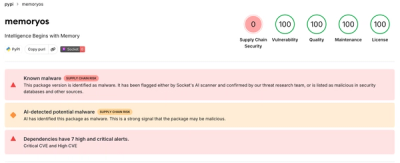
The compromise affects MemTensor's MemOS, an open source memory framework for large language models (LLMs) and AI agents. Both npm package @memtensor/memos-cloud-openclaw-plugin and the PyPI package MemoryOS are compromised. They drop cross-platform Go binaries that exfiltrate developer secrets.