
Research
/Security News
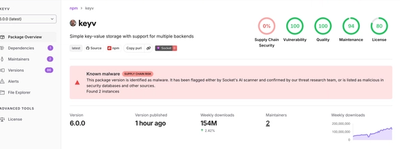
Popular npm Packages in the keyv and Cacheable Namespaces Compromised in Active Supply Chain Attack
Popular npm packages keyv and cacheable compromised.
By Socket Research Team - Aug 04, 2026
footnote-mcp
Advanced tools
MCP server for source-grounded web research: search, structured-data extraction, evidence verification, and browser automation.

An MCP server for source-grounded web research. It searches the web, fetches and extracts pages, pulls structured data out of tables/files/APIs, and — the part that sets it apart — verifies that a claim is actually supported by its source instead of trusting a snippet. 45 tools over stdio MCP, driven by any MCP client (Claude Desktop, Cursor) or by the companion Scholiast research agent.
The design priority is trustworthiness over convenience: search snippets are treated as discovery only, every fetched page is cached with provenance, and claims are checked against the source text before they count. It also degrades gracefully — with no API keys and no config it still works (scraped search + an automatic headless-browser fallback + an offline verification heuristic); keys and env vars only make it better.
From PyPI (Python ≥ 3.10):
pip install footnote-mcp
python -m playwright install chromium # the headless browser used by the fetch fallback
footnote-mcp # start the server (speaks MCP over stdio)
Or from source:
python3 -m venv .venv && source .venv/bin/activate
pip install -e .                        # installs the `footnote-mcp` console script + deps
python -m playwright install chromium   # the headless browser used by the fetch fallback
footnote-mcp                            # start the server (speaks MCP over stdio)
footnote-mcp now waits for an MCP client on stdio. Point a client at it by dropping this
into its MCP settings (Claude Desktop: claude_desktop_config.json; Cursor: ~/.cursor/mcp.json):
{
  "mcpServers": {
    "footnote": { "command": "footnote-mcp" }
  }
}
This repository also includes an authenticated Streamable HTTP deployment. The stdio command above remains the recommended local option; the hosted endpoint is for MCP clients that support remote servers.
render.yaml, builds the included Dockerfile
(including Chromium and Tesseract), and exposes the health check at /healthz.FOOTNOTE_MCP_PUBLIC_URL in Render to
its exact public origin, for example https://my-footnote-mcp.onrender.com.
FOOTNOTE_MCP_API_KEY is generated by the Blueprint; it is the owner key.
Keep it secret and use it only for administration/testing.https://my-footnote-mcp.onrender.com/mcp with:Authorization: Bearer <FOOTNOTE_MCP_API_KEY>
The API key is required: a public, unauthenticated research and browser server would let strangers consume its outbound traffic and call its tools. The service also validates its configured public host and browser Origin to protect the MCP endpoint from DNS rebinding.
Render Free is suitable for demos, not production: it sleeps after 15 minutes of inactivity, cold starts take about a minute, and both outbound bandwidth and instance hours are limited. The filesystem is ephemeral, so do not rely on the source cache or browser profile persisting across restarts.
Never distribute the owner key. Create a separate random key for each person:
python -m footnote_mcp.keygen
Then update FOOTNOTE_MCP_API_KEYS in Render's Environment settings and
redeploy. Its value is JSON, where each user has a key and a personal
requests-per-minute limit:
{
  "alice": {"key": "fn_alice_key_here", "rpm": 20},
  "bob": {"key": "fn_bob_key_here", "rpm": 10}
}
Give each person only their own value. To revoke access, remove that user from the JSON and redeploy; the other keys keep working. Limits are held in memory, which is appropriate for this one-instance Free service and reset on restart.
No API keys are required to start — search falls back to scraping Bing + DuckDuckGo. Add
keys later under "env" (see Search backends). Pass --headed to watch
the browser tier work.
Optional runtime variables are documented in .env.example. Copy it to
.env for local shells, or paste selected variables into your MCP client config:
{
  "mcpServers": {
    "footnote": {
      "command": "footnote-mcp",
      "env": {
        "TAVILY_API_KEY": "..."
      }
    }
  }
}
To run without installing, straight from the source tree:
PYTHONPATH=src python -m footnote_mcp
The reason to use this over a plain search tool is evidence_entailment and friends:
they tell a claim a source supports from one it does not. benchmarks/run_benchmark.py
measures that on a labeled set of claim/source pairs (and demos corroborate_claim and
locate_claim_span):
python benchmarks/run_benchmark.py                    # offline heuristic (deterministic)
python benchmarks/run_benchmark.py --backend ollama   # LLM judge (needs ollama)
Offline-heuristic result on the labeled set (benchmarks/REPORT.md):
| Set | n | Accuracy | Unsupported-claim catch rate | Precision on "supported" |
|---|---|---|---|---|
| Data domain (numeric + factual) | 15 | 100% | 100% | 100% |
| Overall (incl. semantic) | 18 | 83% | 78% | 80% |
On its design domain — numeric and factual data claims — the offline heuristic never
blesses an unsupported claim and never misses one. Its blind spot is purely-semantic
negation/paraphrase; for those, evidence_entailment with backend="ollama" (a local LLM
judge) closes the gap. Run the --backend ollama line above to score that path on your own
machine.
| Tool | Description |
|---|---|
web_search | Configured SearXNG first, then keyed providers, then scraped Bing + DuckDuckGo. Snippets are discovery only. |
web_search_recent | Search restricted to a recency window (day/week/month/year). |
web_deep_search | Automatically route across web/papers/encyclopedia/GitHub/archive sources, then fetch, extract, rerank, and return source context. |
web_read | Fetch one URL, extract text, classify source quality, persist cache metadata. |
papers_search | Search Crossref and arXiv through one normalized, zero-key paper contract. |
encyclopedia_search | Search Wikipedia/Wikidata entities or run read-only Wikidata SPARQL. |
github_search | Search public repositories, issues, code, or commits; authentication is optional. |
archive_search | Find URL captures through Wayback Machine and Common Crawl, optionally extracting archived text. |
web_archive_fetch | Find the closest Wayback Machine snapshot for a dead/changed URL. |
web_fetch_authenticated | Fetch a page that needs cookies or custom headers. |
web_crawl | Breadth-first crawl from a start URL, on-host by default (≤ 50 pages). |
generate_search_queries | Generate operator queries (site:, filetype:csv, API/data-table variants). |
| Tool | Description |
|---|---|
web_extract_tables | Parse HTML tables into columns/rows with source-URL provenance. |
web_detect_downloads | Detect linked CSV/TSV/XLS/XLSX/PDF/JSON/XML files. |
web_parse_file | Download and parse CSV/TSV/XLS/XLSX/PDF/JSON. |
web_fetch_json | Fetch direct API/JSON endpoints into parsed JSON. |
check_date_completeness | Validate required date coverage (day/week/month). |
resolve_units | Detect currencies, currency pairs, measurement units. |
validate_unit_rows | Reject rows with incompatible units or currency pairs. |
reconcile_time_series | Align series on a key, compute deltas, flag missing keys/outliers. |
export_dataset | Write consolidated rows to a csv/xlsx/json file. |
| Tool | Description |
|---|---|
classify_source | Classify official / aggregator / blog / forum / interactive / blocked / error. |
evidence_entailment | Strict claim-vs-source checker: heuristic, auto, ollama, optional local_nli. |
corroborate_claim | Triangulate a claim across excerpts (corroborated / conflicting / single_source / …). |
locate_claim_span | Locate supporting sentence(s) with char offsets and a containment score. |
source_cache_get / source_cache_put | Inspect and write persistent source-cache entries. |
build_research_debug_report | Compact report of queries, URLs, source quality, verification gaps. |
startup_health_check | Check parser, OCR, browser, and cache dependencies. |
When generic parsers fail, synthesize a sandboxed parser:
| Tool | Description |
|---|---|
tool_spec_propose | Propose a task-specific extraction recipe spec. |
tool_code_generate | Generate a starter extract(source_text, input_payload) recipe. |
tool_code_validate | Validate recipe code against a static safety allowlist. |
tool_code_run_sandboxed | Run validated code in a limited subprocess (JSON output only). |
tool_promote | Save a validated recipe as reusable memory (no server edit). |
recipe_registry | Manage promoted recipes: list / get / run / delete. |
A controlled Chromium session for JS-heavy or interactive pages:
| Tool | Description |
|---|---|
web_navigate · web_snapshot · web_click · web_type · web_extract · web_scroll | Drive a page via stable element refs. |
browser_set_date_range · browser_extract_tables · browser_extract_tables_for_date_range | Set a date range, submit, extract visible tables. |
web_screenshot | Save a PNG and optionally OCR text locked inside the image. |
web_search routes through a provider layer. A configured zero-key SearXNG instance is tried
first, followed by keyed providers and finally scraped Bing + DuckDuckGo. Results are
normalized to one shape regardless of backend.
| Provider | Env vars | Notes |
|---|---|---|
| SearXNG | FOOTNOTE_SEARXNG_URL (or SEARXNG_URL) | Zero-key JSON API; instance must enable JSON output. |
| Tavily | TAVILY_API_KEY | LLM-oriented search API. |
| Brave | BRAVE_API_KEY | Independent web index. |
GOOGLE_API_KEY + GOOGLE_CSE_ID | Programmable Search (Custom Search JSON API). | |
| Bing + DuckDuckGo | none | Default fallback; scraped, no key. |
auto (default) tries configured providers in order SearXNG → Tavily → Brave → Google,
then scrapes. Force one with the provider argument
(searxng/tavily/brave/google/scrape).
The public MCP surface is organized by user intent rather than by HTTP API:
| Intent tool | Backends | Routing notes |
|---|---|---|
papers_search | Crossref + arXiv | source=auto queries both; force either backend when needed. |
encyclopedia_search | Wikipedia + Wikidata | Entity search by default; optional read-only SPARQL for structured facts. |
github_search | GitHub REST search | Public zero-key requests work at GitHub's unauthenticated rate limit; GITHUB_TOKEN is optional. |
archive_search | Wayback + Common Crawl | Accepts a URL/host pattern. fetch_text=true attempts archived-content extraction. |
All four return title, url, snippet, published, authors, source, and
source_type where those fields apply. web_deep_search accepts an optional sources
array (web, papers, encyclopedia, github, archive). With an empty array it always
uses general web discovery and adds specialized sources when the query signals their intent.
Semantic reranking. Pass semantic: true to web_search to reorder by meaning rather
than keyword overlap: it over-fetches, embeds query and results with a local ollama model,
and sorts by cosine similarity (each result gains semantic_score). Best-effort — if ollama
is unavailable the original order is returned. Model: FOOTNOTE_EMBED_MODEL (default bge-m3).
web_read fetches through an escalation ladder (scraper.py):
the cheapest method runs first and escalates only when a result looks blocked or empty. A
block/quality detector decides when to escalate; a per-domain rate limiter, circuit breaker,
and negative cache keep it polite. The tier used and the full attempt trace come back in
fetch_tier / scrape_tiers.
| Tier | Method | Enabled by |
|---|---|---|
| 1 | HTTP (curl_cffi TLS impersonation) | always |
| 2 | HTTP through a rotating proxy | FOOTNOTE_PROXIES set |
| 3 | Headless Chromium (runs JavaScript) | FOOTNOTE_BROWSER_FALLBACK=1 (default on) |
| 4 | Chromium through a proxy | proxies + browser |
| 5 | Hosted scrape API (Firecrawl / ScrapingBee) | FOOTNOTE_SCRAPE_API set |
With nothing configured it is the plain HTTP path plus an automatic browser fallback for JavaScript-rendered pages.
| Env var | Default | Purpose |
|---|---|---|
FOOTNOTE_BROWSER_FALLBACK | 1 | Escalate blocked/JS pages to headless Chromium. |
FOOTNOTE_PROXIES | (none) | Comma-separated proxy URLs; sticky per domain with health tracking. |
FOOTNOTE_SCRAPE_API | (none) | firecrawl or scrapingbee (needs the matching API key). |
FOOTNOTE_DOMAIN_RPS / _BURST | 3 / 5 | Per-domain rate limit (token bucket). |
FOOTNOTE_BREAKER_THRESHOLD / _COOLDOWN | 5 / 120 | Per-domain circuit breaker. |
FOOTNOTE_NEGCACHE_TTL | 300 | Seconds to remember a blocked URL. |
FOOTNOTE_THIN_CONTENT_CHARS | 200 | Below this extracted length, a script-heavy page counts as a JS shell. |
~/.footnote-mcp/source_cache/        # persistent page cache (with provenance)
~/.footnote-mcp/research_memory.json # persistent research memory
Override the cache location with FOOTNOTE_SOURCE_CACHE=/path/to/cache footnote-mcp.
check_date_completeness supports the calendars calendar, business_day, crypto_24_7,
forex_weekday, us_business_day, and ru_business_day (pass explicit holidays for
source-specific ones; the us_/ru_ variants use the optional holidays package).
Docker bundles Chromium and tesseract — nothing else to install:
docker build -t footnote-mcp .
docker run -i --rm footnote-mcp        # the client launches this; see MCP config below
Published images are available from GitHub Container Registry:
docker run -i --rm ghcr.io/kazkozdev/footnote-mcp:0.2.3
docker run -i --rm ghcr.io/kazkozdev/footnote-mcp:latest
{
  "mcpServers": {
    "footnote": {
      "command": "docker",
      "args": ["run", "-i", "--rm", "ghcr.io/kazkozdev/footnote-mcp:latest"]
    }
  }
}
pipx / uvx (isolated install of the entry point):
pipx install /path/to/footnote-mcp          # or: pipx install git+<repo-url>
uvx --from /path/to/footnote-mcp footnote-mcp   # ad-hoc, no install
OCR. PDF/image OCR uses pytesseract + the system tesseract binary (brew install tesseract on macOS). Local NLI backend for evidence_entailment backend="local_nli":
pip install -r requirements-nli.txt (model via FOOTNOTE_NLI_MODEL). Either way,
startup_health_check reports what is actually available. Runtime dependency ranges
are declared in pyproject.toml and mirrored in requirements.txt.
pip install -r requirements-dev.txt
python -m pytest -q          # offline unit + smoke tests; no network or keys needed
tests/test_mcp_smoke.py launches the server over real MCP stdio and exercises the tools
end to end against a local HTTP fixture; the rest are offline unit tests of the parsers,
fetch ladder, search providers, and dispatch. The live search test is opt-in:
RUN_LIVE_WEB_TESTS=1 python -m pytest -m live
CI runs the same suite (.github/workflows/tests.yml).
MIT — see LICENSE.
FAQs
MCP server for source-grounded web research: search, structured-data extraction, evidence verification, and browser automation.
We found that footnote-mcp demonstrated a healthy version release cadence and project activity because the last version was released less than a year ago. It has 1 open source maintainer collaborating on the project.
Did you know?

Socket for GitHub automatically highlights issues in each pull request and monitors the health of all your open source dependencies. Discover the contents of your packages and block harmful activity before you install or update your dependencies.
Research
/Security News
Popular npm packages keyv and cacheable compromised.

Security News
A misconfiguration gave three Anthropic models internet access, and one, believing it was in a simulation, shipped a credential-stealing package to PyPI.

Security News
/Company News
Socket has joined the new Composer and Packagist sponsorship program as a launch sponsor, supporting the team that keeps PHP's package ecosystem secure.