
Product
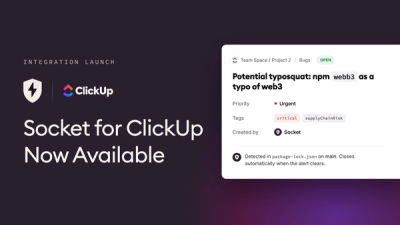
Socket for ClickUp Is Now Available
Create ClickUp tasks from Socket alerts, automate ticketing with custom rules, and keep alert and task status synchronized.
By Jeppe Hasseriis - Aug 26, 2026
freelancer-payment-protection-cli
Advanced tools
Command-line client for freelancer-payment-protection: automated invoice escalation, legal document generation, and client risk scoring for freelancers.
Command-line client for freelancer-payment-protection:
automated invoice escalation, legal document generation, and client risk
scoring for freelancers. This package wraps the project's FastAPI backend
(apps/api/app/routers/*.py) so the same clients, invoices, escalations,
and risk-scoring data you'd otherwise reach through the dashboard or the
raw HTTP API is scriptable from a terminal or an agent.
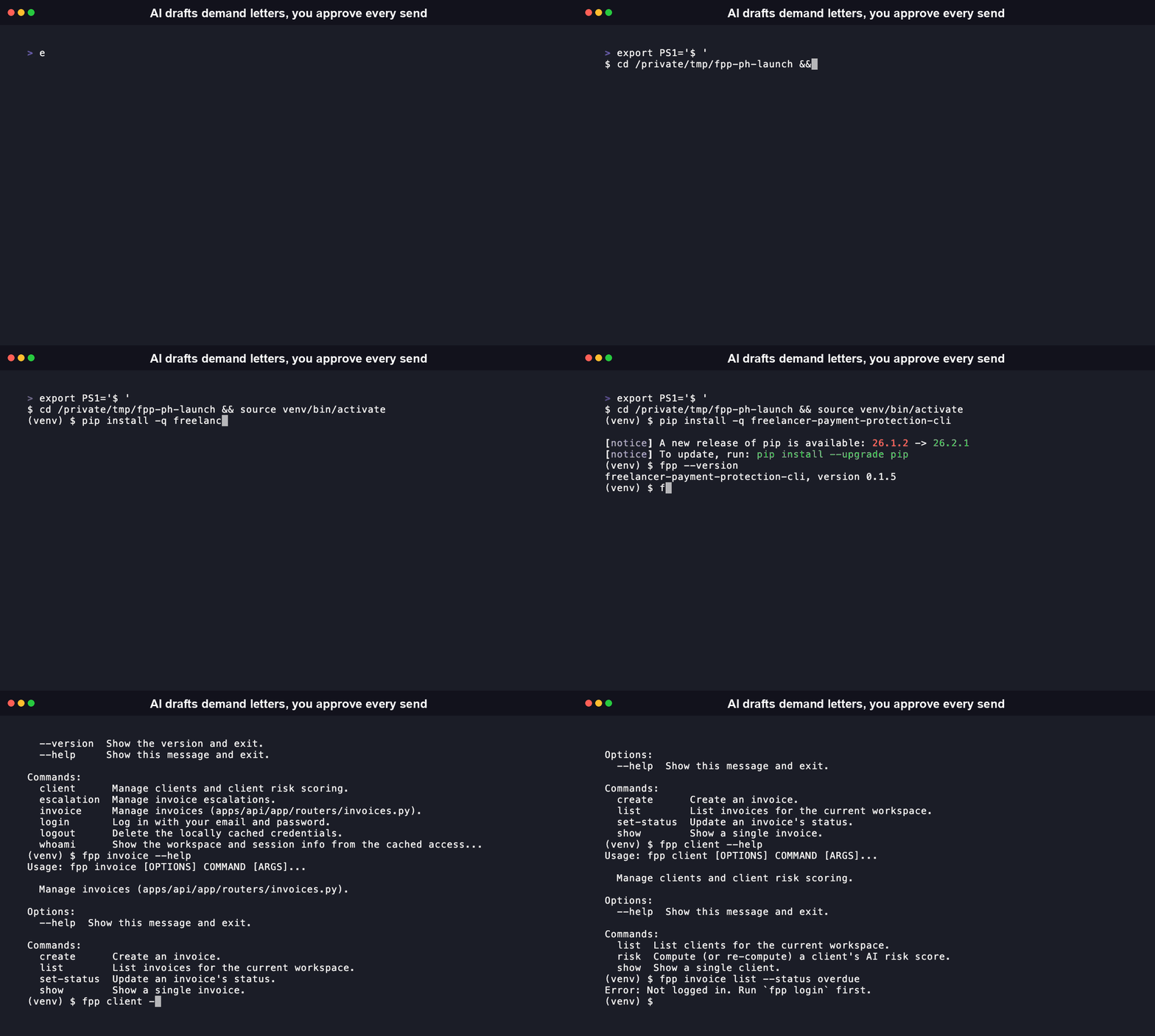
pip install freelancer-payment-protection-cli
uvx freelancer-payment-protection-cli --help
pipx install freelancer-payment-protection-cli
Requires Python 3.10+. The console command is installed as both fpp
(short form) and freelancer-payment-protection (full form), the same
entry point either way.
The CLI needs to know two things: which backend API to talk to, and which Supabase project issues your login tokens.
| Variable | Purpose | Default |
|---|---|---|
FPP_API_URL | Backend API base URL | http://localhost:8000 |
FPP_SUPABASE_URL (or SUPABASE_URL) | Your Supabase project URL | none, required for login |
FPP_SUPABASE_ANON_KEY (or SUPABASE_ANON_KEY) | Your Supabase project's anon key | none, required for login |
The anon key is the same public key the web app's Supabase client uses.
It is not a secret, and it's the key already in apps/web/.env.example as
NEXT_PUBLIC_SUPABASE_ANON_KEY.
export FPP_SUPABASE_URL="https://your-project.supabase.co"
export FPP_SUPABASE_ANON_KEY="your-anon-key"
fpp login
fpp login prompts for your email and password, then calls Supabase's own
REST auth endpoint directly:
POST {SUPABASE_URL}/auth/v1/token?grant_type=password
Header: apikey: <anon key>
Body:   {"email": ..., "password": ...}
This is the same call the web dashboard's Supabase client makes. The CLI
never talks to a login endpoint of its own, because the backend
(apps/api/app/middleware/auth.py) doesn't mint tokens; it only validates
Supabase-issued JWTs. On success, the returned access_token and
refresh_token are cached to ~/.config/freelancer-payment-protection-cli/credentials.json
(mode 600). Every later command reads the JWT's workspace_id claim the
same way get_current_workspace() does server-side, and transparently
refreshes the access token with the cached refresh token once it expires.
Run fpp logout to delete the cached credentials, or fpp whoami to see
which workspace and email the cached token resolves to.
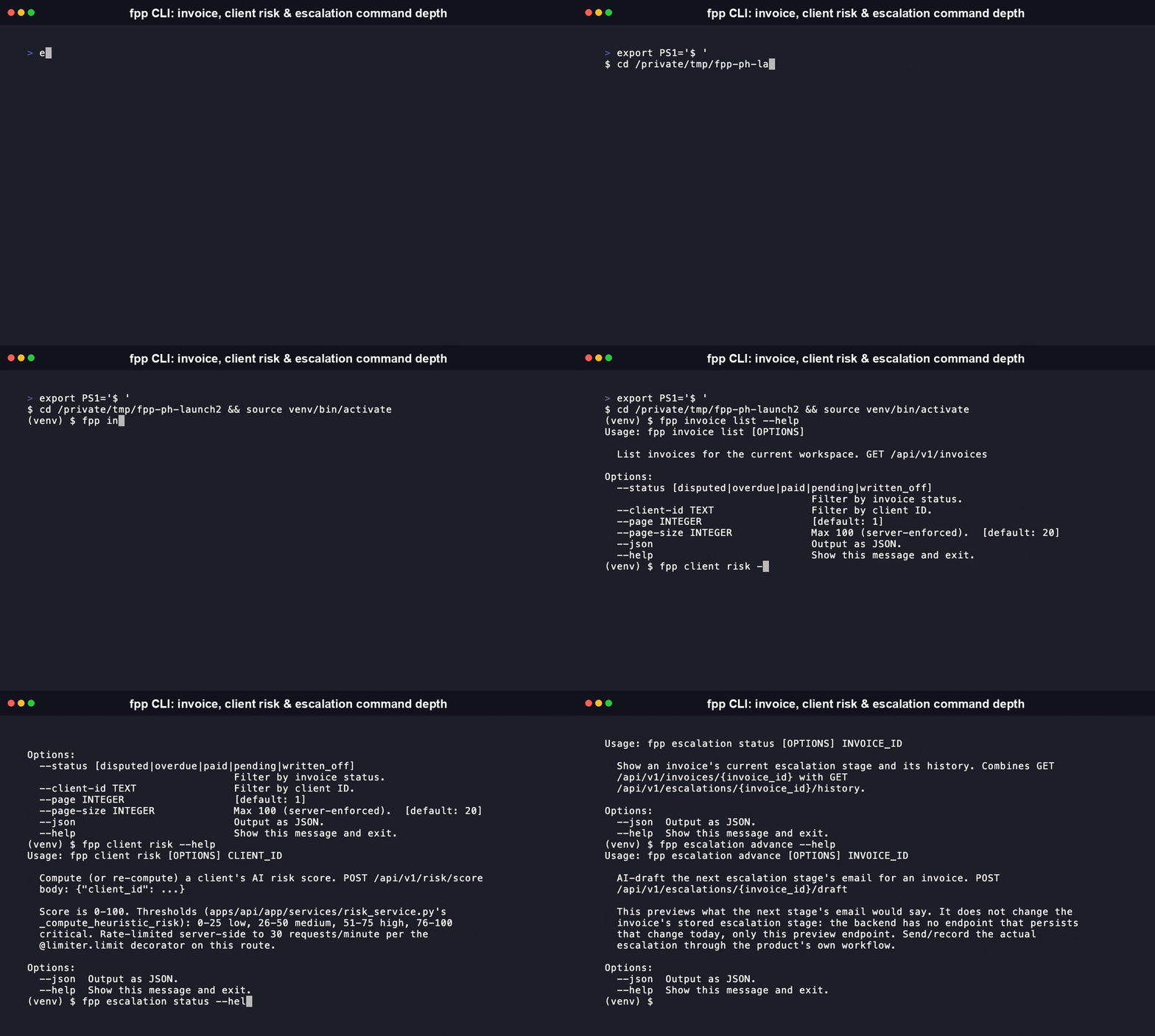
Every data-returning command supports --json for scripting and agent use.
fpp login                                   Log in (prompts for email/password)
fpp logout                                  Remove cached credentials
fpp whoami [--json]                         Show cached workspace/session info

fpp invoice list [--status] [--client-id] [--page] [--page-size] [--json]
fpp invoice create --client-id --invoice-number --amount --due-date [...] [--json]
fpp invoice show <invoice-id> [--json]
fpp invoice set-status <invoice-id> <status> [--json]

fpp escalation list [--json]                Active escalations, grouped by stage
fpp escalation status <invoice-id> [--json] Current stage + full history
fpp escalation advance <invoice-id> [--json] AI-draft the next stage's email

fpp client list [--risk-level] [--search] [--page] [--page-size] [--json]
fpp client show <client-id> [--json]
fpp client risk <client-id> [--json]        Compute/refresh the AI risk score
Run fpp --help or fpp <command> --help for full flag references.
This package ships a Model Context Protocol (MCP) server, so an agent (Claude Desktop,
Claude Code, or any other MCP client) can call fpp commands as tool calls instead of
shelling out to the CLI directly.
Install with the mcp extra:
pip install "freelancer-payment-protection-cli[mcp]"
Claude Desktop config (claude_desktop_config.json):
{
  "mcpServers": {
    "freelancer-payment-protection": {
      "command": "fpp-mcp"
    }
  }
}
The server (freelancer_payment_protection_cli/mcp_server.py) exposes one tool, run,
that shells out to the installed fpp binary with the given argument list and returns
its output as structured JSON when possible — every fpp subcommand is reachable
through it. Example: run(args=["client", "risk", "<client-id>", "--json"]) returns the
same 0-100 risk score, factor breakdown, and AI reasoning that
fpp client risk <client-id> --json prints to a terminal.
escalation advanceThe backend's escalation router (apps/api/app/routers/escalations.py)
exposes exactly three routes: list active escalations, draft the next
stage's email, and read history. There is no route that persists a stage
change. draft_escalation_email in escalation_service.py computes and
returns what the next stage's email would say, but never writes
escalation_stage back to the database. fpp escalation advance calls
that draft endpoint and shows you the preview; it does not claim to move
the invoice to the next stage, because the API it wraps doesn't do that
either.
fpp invoice list --status overdue --json | jq '.[] | {id, invoiceNumber, daysPastDue}'
fpp client risk "$CLIENT_ID" --json | jq '.level'
Field names in --json output match the backend's actual Pydantic response
models exactly (camelCase, e.g. invoiceNumber, daysPastDue,
escalationStage) since the CLI passes the API's response straight
through rather than remapping it.
What is this, and how is it different from just calling the API with curl?
It's a typed command-line wrapper around the same backend the web
dashboard uses (invoices, escalations, and client risk scoring), with
persistent login (so you're not re-attaching a bearer token to every
request), human-readable tables by default, and a --json flag on every
data command for piping into jq, scripts, or an agent's tool-calling
loop. The differentiator versus curl is session handling (login once,
silent token refresh after) and consistent, documented output shapes
instead of hand-rolled request construction.
What platforms and Python versions does it support?
Python 3.10 through 3.13, on any OS pip/uvx/pipx runs on (Linux,
macOS, Windows). It has no compiled dependencies; the only runtime
dependencies are click and httpx, both pure-Python-installable wheels.
How do I log in, and where are my credentials stored?
Run fpp login, enter your email and password when prompted. The CLI
calls Supabase's password-grant token endpoint directly (see "Login and
authentication" above) and caches the resulting access and refresh tokens
to ~/.config/freelancer-payment-protection-cli/credentials.json with
file mode 600 (owner read/write only). Nothing is sent anywhere except
Supabase's own auth endpoint and the backend API you configure via
FPP_API_URL.
I ran a command and got Error: Internal Server Error. Is that a CLI bug?
Usually not. The CLI's error handling surfaces whatever the backend
returned; a 500 means the backend itself failed. Two real, backend-side
causes to check first: (1) fpp client risk and fpp escalation advance
both trigger AI calls through packages/legal_ai/client.py. If
ANTHROPIC_API_KEY isn't a real key on the server, client risk falls
back to a heuristic score automatically, but escalation advance has no
such fallback and will 500. (2) Confirm you're running a backend build
that includes the packages/legal_ai module-name fix and the
risk_scoring.py request-parameter fix, both real bugs in this
repo (a hyphenated packages/legal-ai directory that the code imports as
packages.legal_ai, and a rate-limiter/parameter-name collision on
/api/v1/risk/score) that this CLI's own end-to-end testing surfaced and
this same change fixed. A plain 401 means your cached token expired and
couldn't refresh. Run fpp login again.
Does fpp escalation advance actually send the escalation email or move the invoice to the next stage?
No. It calls the backend's /api/v1/escalations/{id}/draft endpoint,
which only returns an AI-drafted preview of what the next stage's email
would say. The backend has no endpoint today that persists a stage change
or sends the email. See "A note on escalation advance" above.
Can I point this at a self-hosted or non-default backend?
Yes. Set FPP_API_URL to your backend's base URL (default is
http://localhost:8000, matching the FastAPI dev server's default port).
Every command reads that variable at call time, so switching environments
is just re-exporting it.
What's the licensing situation? Can I use or modify this commercially?
This CLI ships from the same repository as, and under the same license
as, freelancer-payment-protection itself: the MIT license, copyright
Rudrendu Paul and Sourav Nandy. It's free and open source, and you can
use, modify, and redistribute it, commercially or otherwise, subject to
the terms in the LICENSE file.
Why isn't there a hosted/default API URL I can just start using? freelancer-payment-protection is self-hosted software, not a hosted multi-tenant SaaS with a public API endpoint today. You (or whoever operates your workspace) runs the backend; the CLI just needs its URL.
cd packages/cli
python -m venv .venv && source .venv/bin/activate
pip install -e ".[dev]"
pytest
All HTTP calls (to Supabase and to the backend API) are mocked in tests
with respx; the test suite makes no live network calls.
This package lives inside the freelancer-payment-protection monorepo. See the repository root for contribution guidelines.
MIT. See LICENSE.
FAQs
Command-line client for freelancer-payment-protection: automated invoice escalation, legal document generation, and client risk scoring for freelancers.
The pypi package freelancer-payment-protection-cli receives a total of 96 weekly downloads. As such, freelancer-payment-protection-cli popularity was classified as not popular.
We found that freelancer-payment-protection-cli demonstrated a healthy version release cadence and project activity because the last version was released less than a year ago. It has 1 open source maintainer collaborating on the project.
Product
Create ClickUp tasks from Socket alerts, automate ticketing with custom rules, and keep alert and task status synchronized.
Product
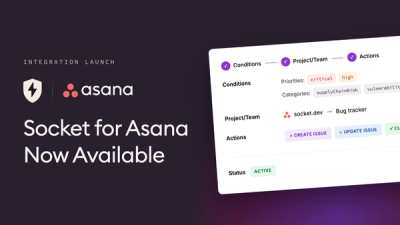
Create and manage Asana tasks directly from Socket alerts, with manual task creation, automated ticketing rules, and two-way sync.

Security News
Open VSX has removed three extension IDs from its malicious-extension list as the legitimate publishers they impersonated move to claim the names for themselves.