
Product
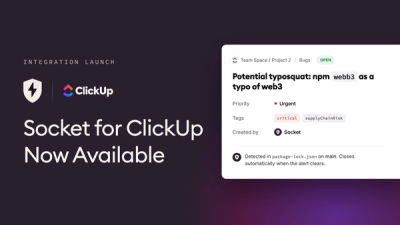
Socket for ClickUp Is Now Available
Create ClickUp tasks from Socket alerts, automate ticketing with custom rules, and keep alert and task status synchronized.
By Jeppe Hasseriis - Aug 26, 2026
grafyx-mcp
Advanced tools
MCP server that gives AI coding assistants real-time codebase understanding via Graph-sitter




Real-time codebase understanding for AI coding assistants.
AI coding tools read raw files with zero architectural understanding -- they don't know what calls what, which classes inherit from where, or how your modules connect. Grafyx fixes this by parsing your entire codebase into a full relationship graph using Graph-sitter (built on tree-sitter), then exposing that graph to any AI assistant through the Model Context Protocol (MCP). Your assistant can trace call chains, map dependencies, find related code by description, detect conventions, and understand your project's architecture -- all in real time, with a file watcher that keeps the graph current as you edit.
# Zero-install (recommended)
claude mcp add --scope user grafyx -- uvx --from grafyx-mcp grafyx
# Or install with pip first
pip install grafyx-mcp
claude mcp add --scope user grafyx -- grafyx
Add to your MCP config file:
.cursor/mcp.json (project) or ~/.cursor/mcp.json (global)~/.codeium/windsurf/mcp_config.json{
"mcpServers": {
"grafyx": {
"command": "uvx",
"args": ["--from", "grafyx-mcp", "grafyx"]
}
}
}
Add to .vscode/mcp.json:
{
  "servers": {
    "grafyx": {
      "command": "uvx",
      "args": ["--from", "grafyx-mcp", "grafyx"]
    }
  }
}
Using pip instead of uvx? Replace the command with:
"command": "grafyx"(no args needed).
| Tool | Description |
|---|---|
get_project_skeleton | Full project structure with stats per module |
get_function_context | Everything about a function: callers, callees, deps |
get_file_context | File contents, imports, dependencies |
get_class_context | Class methods, inheritance, usages |
find_related_code | Natural language search across the codebase |
find_related_files | Find files relevant to a feature by matching symbols |
get_dependency_graph | Impact analysis: what depends on what |
get_conventions | Detected coding patterns and conventions |
get_call_graph | Call chain tracing upstream and downstream |
refresh_graph | Force re-parse of the codebase |
get_module_context | Symbols in a directory/package (intermediate zoom) |
get_subclasses | Inheritance tree for a base class |
get_unused_symbols | Dead code detection |
set_project | Switch the served project at runtime |
Your AI Assistant
       |
       | MCP Protocol (stdio)
       v
  +-----------+
  |  Grafyx   |  FastMCP server with 14 tools
  |  Server   |
  +-----------+
       |
  +-----------+     +-----------+     +-------------+
  |  Graph    |---->|  Search   |     | Convention  |
  |  Engine   |---->|  Engine   |     | Detector    |
  +-----------+     +-----------+     +-------------+
       |
       v
  +-----------+
  |  Graph-   |  Tree-sitter based parsing
  |  sitter   |
  +-----------+
       |
  +-----------+
  |  Watchdog |  File watcher for live updates
  +-----------+
Grafyx's find_related_code uses a pretrained code embedding model (default:
jinaai/jina-embeddings-v2-base-code, Apache-2.0, 161M params) running on CPU
via ONNX through fastembed. The model
is downloaded on first use and cached locally — no GPU, no daemon, no cloud
calls.
Since 0.2.1, fastembed is a hard dependency, so the default install
already includes the encoder — no extra needed.
Benchmark (0.2.0, 278 docstring→function queries across FastAPI + Django):
| Encoder | nDCG@10 | MRR@10 | p50 latency |
|---|---|---|---|
| jina-v2 (default) | 0.787 | 0.741 | ~1.5 s |
| coderankembed | 0.663 | 0.623 | ~1.3 s |
| tokens-only (no fastembed) | 0.335 | 0.297 | ~0.9 s |
The default encoder more than doubles retrieval quality over plain source-token search (+135% nDCG@10).
Full breakdown + per-query JSONL: docs/benchmarks/0.2.0/.
Switch encoders via the GRAFYX_ENCODER env var:
jina-v2 (default) — Apache-2.0, fastembed-native, ~150 MB. Wins on
accuracy; recommended unless you have a specific reason to switch.coderankembed — MIT, 137M, ONNX-int8, ~140 MB. Lower latency but
~12 nDCG@10 points behind jina-v2 in our eval. Hosted at
Bilal7Dev/grafyx-coderankembed-onnx.Supporting numpy-only MLPs (~5 MB total weights, bundled in the wheel):
Reproducible benchmarks against FastAPI, Django, and Home Assistant ship in
benchmarks/ (python -m scripts.run_all).
| Language | Extensions |
|---|---|
| Python | .py, .pyi |
| TypeScript | .ts, .tsx |
| JavaScript | .js, .jsx |
Languages are auto-detected. To specify manually:
grafyx --languages python,typescript
grafyx [OPTIONS]

  --project PATH       Project to analyze (default: current directory)
  --languages LANGS    Comma-separated languages (default: auto-detect)
  --ignore PATTERNS    Additional directories to ignore
  --no-watch           Disable file watching
  --verbose, -v        Debug logging
  --version            Show version
Default ignored: node_modules, .git, __pycache__, .venv, venv, .env, dist, build, .tox, .mypy_cache, .pytest_cache, .ruff_cache, egg-info, .eggs, .next, .nuxt, coverage, .coverage, .nyc_output
Grafyx works with agent teams. A single Grafyx instance serves all agents connected to the same project. When one agent modifies code, the file watcher updates the graph automatically, so other agents immediately see the changes.
git clone https://github.com/bilal07karadeniz/Grafyx.git
cd Grafyx
pip install -e ".[dev]"
pytest
Windows: Graph-sitter requires Linux. Use WSL and configure your MCP client to launch via wsl:
{
  "mcpServers": {
    "grafyx": {
      "command": "wsl",
      "args": ["-e", "bash", "-c", "source ~/your-venv/bin/activate && grafyx"]
    }
  }
}
MIT -- see LICENSE for details.
FAQs
MCP server that gives AI coding assistants real-time codebase understanding via Graph-sitter
We found that grafyx-mcp demonstrated a healthy version release cadence and project activity because the last version was released less than a year ago. It has 1 open source maintainer collaborating on the project.
Product
Create ClickUp tasks from Socket alerts, automate ticketing with custom rules, and keep alert and task status synchronized.
Product
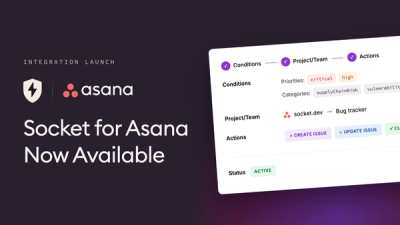
Create and manage Asana tasks directly from Socket alerts, with manual task creation, automated ticketing rules, and two-way sync.

Security News
Open VSX has removed three extension IDs from its malicious-extension list as the legitimate publishers they impersonated move to claim the names for themselves.