

Company News
AWS Security Hub Adds Socket for Supply Chain Security
Socket is now in the AWS Security Hub Extended plan. Adopt it through AWS, apply committed spend, and block malicious open source packages.
By Feross Aboukhadijeh - Aug 04, 2026
imperal-mcp
Advanced tools
Build, ship, and run real cloud apps on Imperal — straight from your AI agent.
imperal-mcp puts the app-building power of Imperal Cloud — the ICNLI AI Cloud OS that Webbee 🐝 runs on — inside any MCP-capable agent. Connect it to Claude, Claude Code, Codex, Cursor, Gemini CLI, Cline, Windsurf, or Goose, sign in with your own Imperal account, and your agent can design, deploy, and operate real cloud apps for you — data, logic, and UI included — without ever leaving the chat.
You describe what you want. Your agent builds it. Imperal runs it.
Tell your agent what you want — and it builds it on Imperal, end to end:
Apps your agent can build in a single flow:
Your client's own LLM authors the app; imperal-mcp gives it the rails. It reads the IR spec and worked examples, validates the draft against the live schema, smoke-tests it, and deploys it to the cloud — no hand-written deployment scripts, no YAML wrangling. The heavy lifting — orchestration, hosting, scaling, the kernel — is Imperal's. Your agent just describes the app; the kernel makes it real.
| Client | One-liner |
|---|---|
| Cursor |  |
| Claude Code | /plugin marketplace add imperalcloud/imperal-mcp then /plugin install imperal-mcp@imperal |
| Everything else | See per-client config |
Install
imperal-mcpand sign in first — see below.
pipx install imperal-mcp      # or: pip install --user imperal-mcp
imperal-mcp login             # opens your browser to sign in to Imperal
login stores credentials in ~/.imperal/credentials.json and auto-refreshes your access token — no manual token management. Sign out any time:
imperal-mcp logout
That's it — every supported client uses the same imperal-mcp binary and the same stored sign-in.
Install + imperal-mcp login (above), and add it to your agent.
Ask your agent, in plain language:
"Build me a habit tracker — I want to add habits, mark them done each day, and see today's summary. Then deploy it."
Your agent authors the app, validates it, smoke-tests a function, and deploys it to your Imperal account. It comes back with the live app and its tools — ready to use.
Want to iterate? Just keep talking: "add a weekly streak view", "now build me an expense tracker too."
All clients use the same installed binary — imperal-mcp — and the same credentials from imperal-mcp login.
Add to ~/Library/Application Support/Claude/claude_desktop_config.json (macOS) or %APPDATA%\Claude\claude_desktop_config.json (Windows):
{
  "mcpServers": {
    "imperal": { "command": "imperal-mcp" }
  }
}
/plugin marketplace add imperalcloud/imperal-mcp
/plugin install imperal-mcp@imperal
Or add directly to your project .mcp.json:
{
  "mcpServers": {
    "imperal": { "command": "imperal-mcp" }
  }
}
Click the Add to Cursor button above, or add to ~/.cursor/mcp.json:
{
  "mcpServers": {
    "imperal": { "command": "imperal-mcp" }
  }
}
Add to ~/.codex/config.toml:
[mcp_servers.imperal]
command = "imperal-mcp"
{
  "mcpServers": {
    "imperal": { "command": "imperal-mcp" }
  }
}
In VS Code, add to Cline's MCP server list:
{
  "imperal": { "command": "imperal-mcp", "disabled": false }
}
Add to ~/.codeium/windsurf/mcp_config.json:
{
  "mcpServers": {
    "imperal": { "command": "imperal-mcp" }
  }
}
Add a StandardIO extension in Goose settings:
{ "type": "stdio", "name": "imperal", "cmd": "imperal-mcp", "args": [] }
| Tool | What it does |
|---|---|
validate_ir(app_ir) | Validate an app.ir.json — envelope + every declarative step. Returns {valid, issues}. |
smoke_ir(app_ir, function, args?) | Run one function in an isolated store and report {ok, result, trace}. |
deploy_ir(app_ir, app_id) | Deploy an app into your account (creates the app record if needed) — live instantly. |
list_apps() | List your developer apps. |
get_app(app_id) | Get one app's manifest + tools. |
run_read_tool(app_id, function, args?) | Run one of a deployed app's read tools to fetch its data. |
| URI | Description |
|---|---|
imperal://ir-spec | The IR specification — structure, fields, action vocabulary. |
imperal://ui-catalog | All ui.* components usable in panels and render steps. |
imperal://examples | A worked app.ir.json (link-saver) to start from. |
build_imperal_app — step-by-step guidance for an LLM to go from intent to a deployed app: read the spec, author the IR, validate, smoke-test, deploy.
| Variable | Default | Purpose |
|---|---|---|
IMPERAL_API_URL | https://auth.imperal.io | Auth / API base URL |
IMPERAL_PANEL_URL | https://panel.imperal.io | Panel base URL |
IMPERAL_TOKEN | (not set) | Optional token for CI / headless use — set it to skip browser login |
For CI or headless environments, set IMPERAL_TOKEN to a token from panel.imperal.io → Developer → Access tokens.
You sign in with your own Imperal account (browser OAuth). Credentials live locally at ~/.imperal/credentials.json (0600) and refresh automatically — nothing is shared with third parties and there's no telemetry. Read responses are PII-masked before they reach the LLM. Full details: PRIVACY.md.
git clone https://github.com/imperalcloud/imperal-mcp
cd imperal-mcp
pip install -e '.[dev]'
python -m pytest
Built on Imperal Cloud — the AI Cloud OS. 🐝
FAQs
MCP server for building Imperal apps from any LLM/agent
We found that imperal-mcp demonstrated a healthy version release cadence and project activity because the last version was released less than a year ago. It has 1 open source maintainer collaborating on the project.
Did you know?

Socket for GitHub automatically highlights issues in each pull request and monitors the health of all your open source dependencies. Discover the contents of your packages and block harmful activity before you install or update your dependencies.
Company News
Socket is now in the AWS Security Hub Extended plan. Adopt it through AWS, apply committed spend, and block malicious open source packages.
Research
/Security News
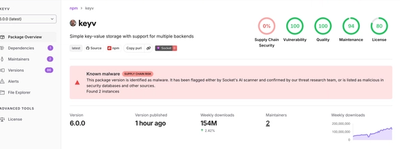
Popular npm packages keyv and cacheable compromised.

Security News
A misconfiguration gave three Anthropic models internet access, and one, believing it was in a simulation, shipped a credential-stealing package to PyPI.