

Product
PHP and Composer Support Is Now in Beta
Socket’s PHP and Composer support is now in Beta for all customers, with PHP reachability analysis generally available.
By Trevor Norris, Benjamin Barslev - Aug 21, 2026
keel-pentest
Advanced tools






Ten MCP tools. Operator-bound scope. Bounded traffic. Evidence states, not scanner claims.
Architecture · Installation · Operator setup · Clients · Tools · Proofs · Security
Keel is a local stdio MCP server for authorized web testing. It gives an AI a small control surface over ProjectDiscovery httpx and nuclei, normalizes their output into semantic finding cards, and admits only policy-bounded traffic.
Keel is designed around the difficult parts of agentic testing:
observed, hypothesis, corroborated, proven, and refuted states;It is not an autonomous exploit generator and does not make every scanner alert exploitable. Today, only the strict canary-based cross-account read invariant can promote an access-control card to proven.
The model talks to Keel, not directly to scanner CLIs or a shell. Network approval and credential material live in operator-controlled files outside the AI-writable workspace.
flowchart TD
    A[AI coding client] -->|stdio MCP| B[Keel]
    O[Operator approval manifest] --> C[Policy gate]
    V[Credential reference file] --> P[Proof broker]
    B --> C
    C --> W[Wave scheduler]
    W --> H[httpx: one target, one thread]
    W --> N[nuclei: operator-reviewed signed HTTP template IDs]
    C --> P
    P -->|GET only, exact budget| T[Approved tester resource]
    H --> S[Semantic card store]
    N --> S
    P --> S
    S --> Q[Triage and evidence states]
    B --> L[Persistent audit and health]
begin_engagement must fit inside that manifest. The legacy operator_confirmed argument is ignored and cannot grant permission.draft_waves creates an exact reachability wave and, for host-wide scope without path exclusions, a safe template wave. Drafting sends no traffic.execute_wave revalidates the manifest, selected template IDs, scope, cooldown, concurrency, and remaining budget before starting one external scanner process.execute_proof revalidates the manifest again and sends one or two brokered GET requests. A proof target must match the card URL, canary hash, playbook, and tester credential pair recorded by the operator.| Role | Name |
|---|---|
| PyPI distribution | keel-pentest |
| MCP stdio executable | keel-pentest |
| Python import / module | keel |
| Client server id | keel |
| MCP Registry name | io.github.lutfizp/keel |
Do not install the unrelated PyPI project named keel. Python 3.10 or newer is required.
For a persistent CLI application, use pipx or uv tool:
pipx install keel-pentest
# or
uv tool install keel-pentest

keel-pentest --version
Plain pip is supported inside a dedicated virtual environment:
python3 -m venv .venv
source .venv/bin/activate
python -m pip install --upgrade pip
python -m pip install keel-pentest
Keel also needs the ProjectDiscovery executables named httpx and nuclei. The Python package named httpx is a different program.
# macOS
brew install httpx nuclei
nuclei -update-templates

keel-pentest doctor
doctor checks Python, the MCP SDK, the writable state directory, scanner identity and required CLI flags, plus any configured approval or credential files. An old ProjectDiscovery build that lacks Keel's safety flags is rejected. Set KEEL_HTTPX_BIN and KEEL_NUCLEI_BIN to absolute paths when a GUI client has a reduced PATH.
Complete macOS, Linux, Windows, pipx, uv, pip, clone, upgrade, and uninstall instructions are in INSTALL.md.
git clone https://github.com/lutfizp/keel.git
cd keel
sh scripts/bootstrap.sh
python3 scripts/keel_mcp.py doctor
Windows uses scripts\bootstrap.ps1. The MCP Registry entry is discovery metadata; installation from the Registry is not universal across clients.
Network traffic is denied by default until KEEL_APPROVAL_FILE points to a valid operator-owned manifest. Keep both files outside any directory the AI client can edit.
install -m 600 examples/engagement-approval.json /safe/operator/path/keel-approval.json
install -m 600 examples/credentials.example.json /safe/operator/path/keel-credentials.json
Edit every placeholder, including nuclei_template_ids. Keel never runs the entire installed template collection: the engagement selects a subset of template IDs already reviewed and approved in the manifest. The credential file maps harmless names such as tester-a to an Authorization or Cookie value. MCP calls use only those names; raw secrets are never accepted as proof arguments.
For a proof, manually place a unique, non-secret canary in a disposable resource owned by tester A. Record the exact resource URL, allowed playbook, owner/peer credential refs, and SHA-256 of that canary in proof_targets:
python3 -c "import hashlib; print(hashlib.sha256(b'REPLACE_WITH_RANDOM_CANARY').hexdigest())"
Expose only the file paths to the Keel process:
export KEEL_APPROVAL_FILE=/safe/operator/path/keel-approval.json
export KEEL_CREDENTIALS_FILE=/safe/operator/path/keel-credentials.json
keel-pentest doctor
On POSIX systems, Keel rejects symlinked or group/world-writable approval files and rejects credential files accessible by group or other users. The manifest is hashed and revalidated before every wave and proof. If it changes, call begin_engagement again to resume under the new approval.
KEEL_ALLOW_UNAPPROVED_RECON=1 exists only for local development and tests. Do not use it for a real target or bug-bounty program.
| Rule | Meaning |
|---|---|
target.example | That exact host only; any HTTP(S) scheme, port, or path |
*.target.example | Subdomains only; it does not include the apex host |
https://target.example:8443/api | Exact scheme and effective port, with /api as a path prefix |
Exclusions always win. A host rule never matches target.example.evil.test, and engagement ids are restricted so they cannot escape the state directory.
Because external Nuclei requests are not yet mediated individually, Keel refuses template_scan and second_look when authorization is limited to a path or has a path-specific exclusion. Exact reachability and brokered proofs remain available. Use a host-wide rule only when the program actually authorizes the whole host.
Use the absolute executable path returned by command -v keel-pentest (Windows: where.exe keel-pentest):
claude mcp add --scope user --transport stdio keel -- /ABS/path/to/keel-pentest
codex mcp add keel -- /ABS/path/to/keel-pentest
gemini mcp add --scope user --transport stdio keel /ABS/path/to/keel-pentest
agy mcp add keel /ABS/path/to/keel-pentest
hermes mcp add keel --command /ABS/path/to/keel-pentest
Add KEEL_APPROVAL_FILE, KEEL_CREDENTIALS_FILE, and scanner path overrides to the server's environment rather than to prompts. OpenCode versions, VS Code, Cursor, Hermes, and other hosts use different configuration shapes; see clients/README.md for exact examples and verification commands.
Keel does not deduplicate solely by scanner template id. It derives a semantic key from the canonical vulnerability class, normalized host/route, HTTP method, and parameter. Numeric ids, UUIDs, and long hex tokens in routes collapse to stable placeholders, allowing compatible observations from different tools to merge.
| State | Meaning |
|---|---|
observed | One tool observed a condition; exploitability is not established |
hypothesis | The scanner or agent proposed an impact |
corroborated | Independent sources or a safe reachability check support the condition |
proven | A strict allowlisted safe-proof invariant succeeded |
refuted | The safe control test showed the alleged vulnerability was protected |
Agent-written impact text cannot by itself increase confidence to proof. A safe proof state cannot later be downgraded or overwritten by another scanner observation. Informational, hardening, and refuted cards are hidden by default but remain queryable.
Retry-After;For brokered proofs, the request count is exact. For external httpx and nuclei processes, Keel reserves a conservative budget and derives the scanner rate from budget / duration, but it does not intercept every internal scanner request. See Security boundaries.
| Playbook | Requests | Result that counts |
|---|---|---|
cross_account_read | exactly 2 GETs | Tester A reads its pre-planted canary, then tester B receives 2xx and the identical canary from the exact same A-owned URL |
own_session_marker | exactly 1 GET | Tester A reads a manually planted canary; this is only corroborated, never vulnerability proof |
For cross_account_read, a B response of 401, 403, or 404—or a 2xx without the canary—is classified protected and refutes the IDOR/BOLA card. A 5xx, redirect, missing A baseline, truncation that hides the marker, or other ambiguity is inconclusive, not protected and not proven.
Only access-control vulnerability classes can use cross_account_read. Keel stores status codes, canary presence booleans, truncation flags, and hashes of captured bytes; it does not persist bodies or secret header values.
| Tool | Role |
|---|---|
begin_engagement | Register exact scope and bounded traffic policy against operator approval |
draft_waves | Propose exact reachability and, only for host-wide scope, a template scan; no traffic |
execute_wave | Revalidate and run one admitted wave |
query_cards | Return prioritized semantic cards |
second_look | Re-run only the originating Nuclei template on one card URL |
state_impact | Record an impact hypothesis and preconditions |
draft_proof | Return an allowlisted proof plan; no traffic |
execute_proof | Run a target-bound proof through the request broker |
engagement_health | Show cooldowns, budgets, and pending waves |
engagement_audit | Return recent append-only application audit events |
begin_engagement arguments| Argument | Default / bound |
|---|---|
engagement_id | Stable id, 1–64 safe characters |
scope_hosts, exclude_hosts | Must exactly equal the manifest |
requests_per_second | 3.0, maximum 20, also bounded by manifest |
max_parallel_hosts | 1, maximum 4 |
max_wave_seconds | 120, range 10–600 |
max_wave_requests | 120, maximum 10,000 |
max_engagement_requests | 1,000, maximum 100,000 |
max_response_bytes | 65,536, range 1 KiB–1 MiB |
max_proof_requests | 2, range 1–10 and playbook-bound |
nuclei_template_ids | Reviewed subset of the manifest allowlist; empty means no template wave |
allow_safe_proof | Session-level opt-in; manifest approval is still mandatory |
operator_confirmed | Legacy compatibility argument; ignored |
execute_proof takes proof_target_ref and expected_marker. The optional legacy session_a and session_b values are credential-reference names only and, if supplied, must match the manifest binding. Never pass a raw token or cookie.
First, the human operator prepares the approval/credential files and, for a proof, the tester-A resource and canary. Then a useful recon/triage prompt is:
Use only Keel MCP tools; do not shell out to httpx, nuclei, curl, or exploit tools.

1. begin_engagement for bb-2026-01 with exactly the scope, traffic limits, and
   reviewed nuclei_template_ids in my operator manifest. Set allow_safe_proof false.
2. draft_waves for https://target.example.
3. Execute one wave at a time. Stop immediately on throttling or policy denial.
4. query_cards with include_noise false.
5. Treat scanner output as observed/hypothesis only. Use state_impact only when
   preconditions and concrete hunter impact can be stated.
6. For plausible cards, call draft_proof only. Do not execute a proof.
7. Summarize semantic duplicates, evidence state, preconditions, and remaining
   uncertainty. Do not claim exploitable unless Keel reports proven.
After the operator has enabled allow_safe_proof by resuming the same engagement and has supplied an approved target reference:
Execute only the drafted cross_account_read proof for card <card_id> using
proof_target_ref <operator-reference> and expected_marker <operator-canary>.
Omit session_a/session_b so Keel uses the manifest-bound tester credentials.
Stop after the result. Treat protected as refuted and any other failed invariant
as inconclusive.
The words “confirm” or operator_confirmed: true in a prompt do not authorize traffic. Only the external manifest does.
MCP server failed or import errors
python3 --version
keel-pentest --version
keel-pentest doctor
Use Python 3.10+ and a pipx/uv-tool environment or dedicated virtual environment.
httpx or nuclei not found
Set KEEL_HTTPX_BIN and KEEL_NUCLEI_BIN to the absolute ProjectDiscovery executables. Keel deliberately rejects the Python HTTP client's unrelated httpx command.
begin_engagement says approval is missing or mismatched
Verify that KEEL_APPROVAL_FILE reaches the Keel subprocess, the engagement id/scope/exclusions exactly match, requested limits do not exceed the manifest, and expires_at is still valid. After editing the manifest, call begin_engagement again.
execute_proof is denied
Check allow_safe_proof, the manifest's playbook and proof target, the exact card URL, credential refs, canary SHA-256, file permissions, and expiry. A raw header in session_a is intentionally rejected because it is not an approved reference.
Empty cards or retained wave
Use engagement_health and engagement_audit. Nonzero scanner exits, 429 responses, and parse/scope failures do not consume the pending wave; request reservations remain fail-closed. Scanner JSONL is atomic: if any non-empty line is malformed, is not a JSON object, or lacks the scanner's minimum identity fields, Keel records wave_parse_failed/wave_schema_failed and ingests none of that wave's rows.
Keel reduces agent freedom; it does not turn active testing into a risk-free activity.
KEEL_DATA_DIR outside the AI-writable workspace.proven currently has a narrow meaning: the approved cross-account canary invariant succeeded. Other vulnerability classes still require an operator-reviewed, class-specific safe playbook.See SECURITY_MODEL.md for invariants and known limitations.
git clone https://github.com/lutfizp/keel.git
cd keel
sh scripts/bootstrap.sh python
source .venv/bin/activate
pytest
Useful contributions include semantic parsers, deterministic validators, and narrow allowlisted proof playbooks with explicit harm and cleanup invariants. Do not add free-form command execution or an unbounded scanner surface.
Keel is released under the MIT License. See LICENSE.
Copyright (c) 2026 Lutfi Z.P.
PyPI: keel-pentest. MCP Registry: io.github.lutfizp/keel. Source: github.com/lutfizp/keel.
FAQs
Control plane MCP for scoped recon, triage, and bounded proofs.
We found that keel-pentest demonstrated a healthy version release cadence and project activity because the last version was released less than a year ago. It has 1 open source maintainer collaborating on the project.
Product
Socket’s PHP and Composer support is now in Beta for all customers, with PHP reachability analysis generally available.
Product
Socket is bringing experimental protection to Firefox, scanning 97,000+ extensions in Mozilla's official directory for malware and risky updates.
Research
/Security News
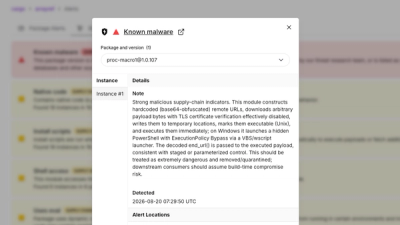
Three compromised Rust crates pulled in a malicious dependency that downloaded and executed cross-platform malware during Cargo builds.