
Research
/Security News
Popular npm Packages in the keyv and Cacheable Namespaces Compromised in Active Supply Chain Attack
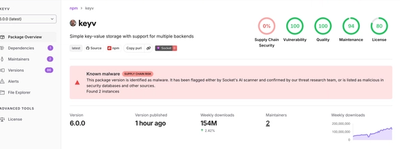
Popular npm packages keyv and cacheable compromised.
By Socket Research Team - Aug 04, 2026
mcp-memento
Advanced tools
Intelligent persistent memory for AI agents and IDEs via Model Context Protocol (MCP).




Intelligent memory management for MCP clients with confidence tracking, relationship mapping, and knowledge quality maintenance.
Memento is an MCP server that provides persistent memory capabilities across multiple platforms:
Build a personal or team knowledge base that grows smarter over time, accessible from all your development tools.
What is Memento? Imagine you're solving a complex bug, figuring out a tricky configuration, or establishing a new coding pattern. Usually, you'd forget the details in a few weeks. Memento is a "long-term memory drive" for your AI assistant. It allows your AI to save these solutions, decisions, and facts so it can recall them instantly across different projects, even months later.
💡 The Agentic Mindset: A Guide for Traditional Developers If you are used to deterministic software (where things happen automatically because a script says so), interacting with AI agents requires a slight mental shift.
Memento is not an autonomous agent that watches your screen and magically decides what to remember. Instead, Memento is a toolbelt provided to your AI assistant (like Claude, Cursor, or Gemini).
.cursorrules/CLAUDE.md files) so it knows to automatically save certain things, like bug fixes or architecture decisions.How to build the habit:
Alternatively, you can add custom instructions to your AI (see our Agent Configuration Guide) to make it automatically execute these steps without you having to ask every time.
confidence × importance| Profile | Tools | Best For |
|---|---|---|
| Core | 13 tools | All users - Essential operations |
| Extended | 17 tools | Power users - Statistics, contextual search, decay control |
| Advanced | 25 tools | Administrators - Graph analysis |
# Install with pipx (recommended for MCP servers)
pipx install mcp-memento

# Or with pip
pip install mcp-memento
Memento supports multiple configuration methods. For clarity, we recommend using one method consistently:
Method 1: CLI Arguments (recommended - most explicit)
{
  "mcpServers": {
    "memento": {
      "command": "memento",
      "args": ["--profile", "extended", "--db", "~/.mcp-memento/context.db"]
    }
  }
}
Method 2: Environment Variables
{
  "mcpServers": {
    "memento": {
      "command": "memento",
      "args": [],
      "env": {
        "MEMENTO_PROFILE": "extended",
        "MEMENTO_DB_PATH": "~/.mcp-memento/context.db"
      }
    }
  }
}
Method 3: YAML Configuration File
Create ~/.mcp-memento/config.yaml:
profile: extended
db_path: ~/.mcp-memento/context.db
Then use minimal JSON config:
{
  "mcpServers": {
    "memento": {
      "command": "memento",
      "args": []
    }
  }
}
CLI Agents (Gemini CLI):
gemini --mcp-servers memento
Note: The exact flag syntax depends on your Gemini CLI version. Refer to AGENT_CONFIGURATION.md for version-specific setup instructions.
Once configured, your AI assistant can now:
# Store solutions and knowledge
store_memento(
    type="solution",
    title="Fixed Redis timeout with connection pooling",
    content="Increased connection timeout to 30s and added connection pooling...",
    tags=["redis", "timeout", "production_fix"],
    importance=0.8
)

# Find knowledge later
recall_mementos(query="Redis timeout solutions")
📌 Note: The code above represents MCP tool calls — instructions you give your AI assistant (Claude, Cursor, Gemini, etc.) to invoke Memento's tools. This is not a Python library you can
import. For programmatic Python access see the Python Integration Guide.
💬 Natural Language: You can also interact with Memento through natural conversation. Just tell your AI assistant things like "Remember that..." or "Store this..." or "Memento..."- no code required.
For a deep dive into Memento's concepts (Confidence System, Tagging, Relationships), please read the comprehensive RULES.md and RELATIONSHIPS.md documentation.
Memento works with all major development tools:
| Platform | Configuration Guide | Notes |
|---|---|---|
| Zed Editor | IDE Integration | Native MCP support |
| Cursor | IDE Integration | AI-powered editor |
| Windsurf | IDE Integration | Modern code editor |
| VSCode | IDE Integration | Via MCP extension |
| Claude Desktop | IDE Integration | Desktop application |
| Gemini CLI | Agent Integration | Google's CLI agent |
| Claude CLI | Agent Integration | Anthropic's CLI agent |
| Python / MCP Client | Python Integration | Embed server or call via MCP client |
| Docker / CLI | API & Programmatic | MCP client, Docker, export/import |
See also: Integration Overview for guidance on choosing the right integration.
The examples below show the MCP tool calls that an AI assistant (Zed, Cursor, Claude, Gemini CLI, …) executes on your behalf when you ask it to remember or retrieve something. They are written in a Python-like pseudocode that mirrors the MCP tool interface — they are not a Python library you import directly.
To call these tools programmatically from Python, use the
mcpclient library. See Python Integration for a working example.
# Store a solution — the AI calls this tool when you say "remember this fix"
solution_id = store_memento(
    type="solution",
    title="Fixed memory leak in WebSocket handler",
    content="Added proper cleanup in on_close()...",
    tags=["websocket", "memory", "python"],
    importance=0.9
)

# Natural language search — called when you ask "what do you know about X"
results = recall_mementos(query="WebSocket memory leak", limit=5)

# Tag-based search — for precise filtering
redis_solutions = search_mementos(tags=["redis"], memory_types=["solution"])
# Find potentially obsolete knowledge
low_confidence = get_low_confidence_mementos(threshold=0.3)

# Boost confidence after verification
boost_memento_confidence(
    memory_id=verified_solution_id,
    boost_amount=0.15,
    reason="Verified in production deployment"
)
# Link solution to problem
create_memento_relationship(
    from_memory_id=solution_id,
    to_memory_id=problem_id,
    relationship_type="SOLVES",  # See all 35 types in docs/RELATIONSHIPS.md
    strength=0.9,
    context="Connection pooling resolved the timeout issue"
)

# Explore connected knowledge
related = get_related_mementos(
    memory_id=solution_id,
    relationship_types=["RELATED_TO", "USED_IN"],
    max_depth=2
)
Memento works through natural language conversations. The AI assistant interprets intent and calls the appropriate tools automatically.
Store information:
User: Remember that we solved Redis timeout with connection pooling
AI: ✅ Memento stored - "Redis timeout solution: connection pooling"
Retrieve knowledge:
User: What do you remember about Redis timeout?
AI: Found 2 solutions: 1) Connection pooling... 2) Query optimization...
Using the "Memento" keyword:
User: Memento the deployment script is in /scripts/deploy.sh
AI: ✅ Memento stored - "Deployment script location: /scripts/deploy.sh"
The AI can also store important information automatically when configured with the guidelines in AGENT_CONFIGURATION.md.
Memento supports multiple configuration sources (in order of precedence):
Command-Line Arguments (highest priority)
memento --profile advanced --db ~/custom/path/memento.db --log-level DEBUG
Environment Variables
export MEMENTO_PROFILE="advanced"
export MEMENTO_DB_PATH="~/custom/path/memento.db"
export MEMENTO_LOG_LEVEL="DEBUG"
export MEMENTO_ALLOW_CYCLES="false"   # Allow cycles in relationship graph
YAML Configuration Files
./memento.yaml in current directory (overrides global)~/.mcp-memento/config.yamlPriority Order: CLI Arguments > Environment Variables > Project YAML > Global YAML > Defaults
The following keys are read and applied by the configuration loader. Any other keys present in the YAML file are silently ignored.
| Key | Type | Default | Description |
|---|---|---|---|
db_path | string | ~/.mcp-memento/context.db | SQLite database file path |
profile | string | core | Tool profile (core, extended, advanced) |
logging.level | string | INFO | Log level (DEBUG, INFO, WARNING, ERROR) |
features.allow_relationship_cycles | bool | false | Allow cyclic relationships in the graph |
Note: The
memento.yamltemplate shipped with the project contains additional commented sections (confidence,search,performance,memory,fts,project). These are not yet implemented — they are aspirational placeholders for future releases and have no effect on the current server behaviour.
Project configuration (./memento.yaml):
db_path: ~/.mcp-memento/context.db
profile: extended
logging:
  level: INFO
features:
  allow_relationship_cycles: false
Global configuration (~/.mcp-memento/config.yaml):
db_path: ~/.mcp-memento/global.db
profile: extended
logging:
  level: INFO
Memento uses a unified SQLite schema accessible from all integrations:
nodes (memory storage), relationships (directed graph)nodes_fts — FTS5 virtual table for fast searching (falls back to LIKE-based search if FTS5 is unavailable)The system works identically across all platforms:
confidence × importanceMemento is a simplified, lightweight fork of MemoryGraph by Gregory Dickson, optimized for MCP integration across IDEs and CLI agents.
The fork focuses on portability and token efficiency: it removes heavy dependencies (NetworkX, multi-backend storage, bi-temporal tracking, multi-tenant architecture) in favor of a SQLite-only backend with confidence-based decay and guideline-driven storage.
Multiple users can share a SQLite database (e.g., on network storage) using tagging conventions (team:[name], author:[name]). Memento can also run as a remote MCP server, though all clients share the same database without tenant isolation. See Team Collaboration guidelines for details.
For true multi-tenancy, use the original MemoryGraph project.
Memento is built upon the solid foundation of Gregory Dickson's MemoryGraph project. We're grateful for his pioneering work in memory management systems.
This fork maintains compatibility with MemoryGraph's core concepts while adapting them for the specific needs of MCP integration and modern development tooling. For users requiring the full power of MemoryGraph's advanced features, we recommend exploring the original project.
mcp-webgate is in beta. Core functionality is stable and the server is used in production, but the configuration API may still change before 1.0.
Feedback is very welcome. If something doesn't work as expected, behaves oddly, or you have a use case that isn't covered:
Bug reports, configuration questions, and feature requests all help shape the roadmap.
Contributions are welcome! Please see CONTRIBUTING.md for detailed guidelines on:
| Version | Date | Highlights |
|---|---|---|
v0.2.37 | 2026-04-02 | Rename deploy.py to robot.py, update GitHub username to x-hannibal |
v0.2.36 | 2026-04-01 | Update GitHub username from annibale-x to x-hannibal |
v0.2.35 | 2026-03-24 | Promote to stable, Python 3.10 support, remove MCP Registry CI workflow |
v0.2.34 | 2026-03-24 | Promote to stable, Python 3.10 support, remove MCP Registry CI workflow |
Full history: https://github.com/x-hannibal/mcp-memento/blob/main/CHANGELOG.md
MIT License - see LICENSE for details.
Need help? Check the documentation or open an issue on GitHub.
FAQs
Intelligent persistent memory for AI agents and IDEs via Model Context Protocol (MCP).
We found that mcp-memento demonstrated a healthy version release cadence and project activity because the last version was released less than a year ago. It has 1 open source maintainer collaborating on the project.
Did you know?

Socket for GitHub automatically highlights issues in each pull request and monitors the health of all your open source dependencies. Discover the contents of your packages and block harmful activity before you install or update your dependencies.
Research
/Security News
Popular npm packages keyv and cacheable compromised.

Security News
A misconfiguration gave three Anthropic models internet access, and one, believing it was in a simulation, shipped a credential-stealing package to PyPI.

Security News
/Company News
Socket has joined the new Composer and Packagist sponsorship program as a launch sponsor, supporting the team that keeps PHP's package ecosystem secure.