MergenDB
The Ultra-Compact, High-Performance Embedded Columnar Database Engine & Vectorized SQL Processor for Python and Node.js





-success.svg?style=flat-square)
-brightgreen.svg?style=flat-square)

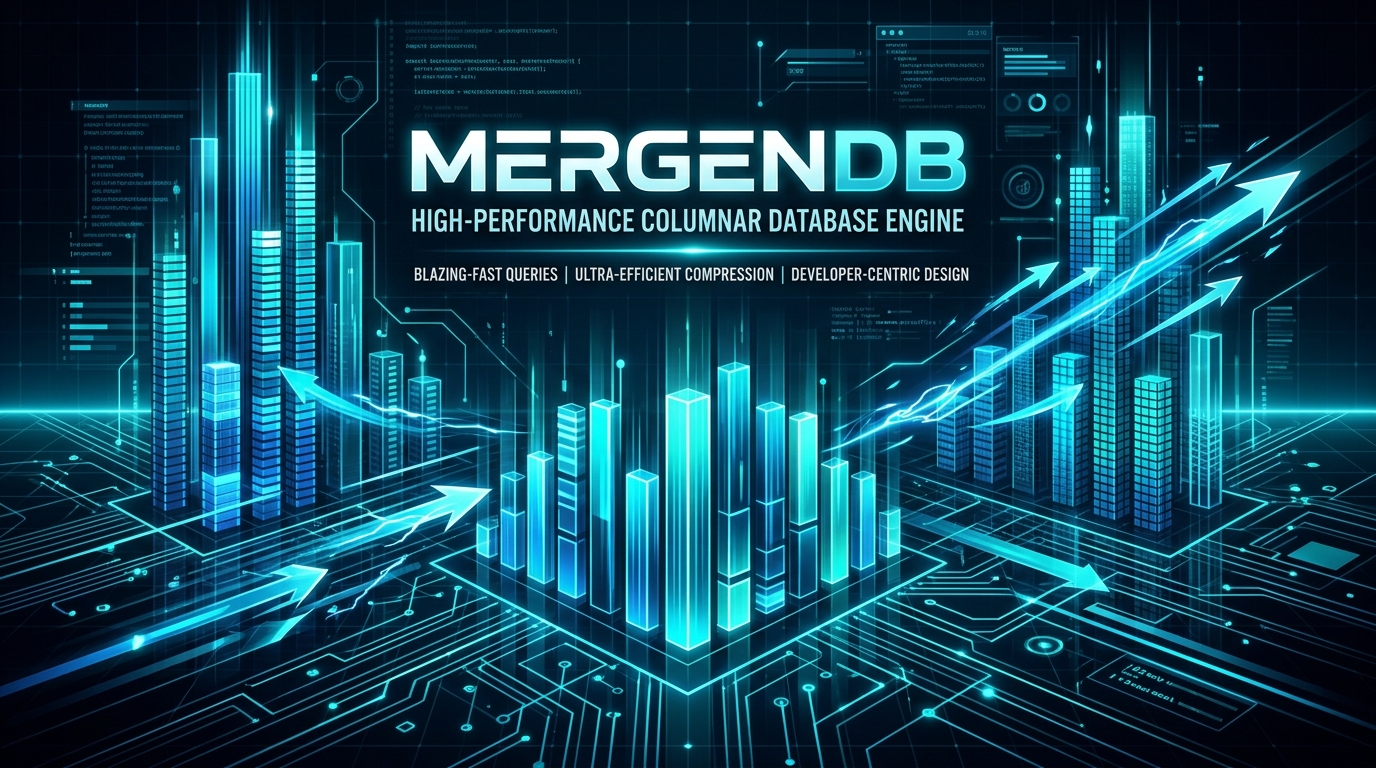
MergenDB is an ultra-compact, high-performance embedded columnar database engine engineered to process massive analytical workloads and multi-million row table scans on resource-constrained hardware. It delivers strict zero external runtime dependencies -- requiring no C compilers, no native C++ binaries, and no bulky runtimes across both Python and Node.js.
Whether scanning a 100-million row table on a 500 MB RAM VPS, streaming telemetry on an edge device, running real-time analytics in Node.js/TypeScript, or managing hierarchical databases through Mergen Studio, MergenDB provides columnar speed with bounded memory guarantees (< 20 MB peak RAM).
Key Highlights
- Sub-Second 100M+ Row Columnar Scans: Point lookups and scalar filters (e.g.
WHERE phone = '0532...' or WHERE device_id = 5821049) execute in < 100 milliseconds on 100M+ row tables, directly evaluating binary byte streams at C level (bytes.translate, mmap) with zero Python object allocation overhead.
- Lazy Metadata Initialization (
LazyBlockList): Table opening overhead on multi-million row tables dropped from 3.5s to 0.0001 seconds, deferring block parsing until individual blocks are accessed.
- Selective Late Materialization: Only matching rows decode dictionary values (
decode_dict_indices), bypassing decompression of thousands of unneeded rows and speeding up sparse queries by up to 25x.
- Fault-Tolerant Streaming Ingestion (> 5M rows/s): Robust parallel byte-range parser seamlessly processes ragged rows, escaped quotes, missing fields, null bytes (
\x00), and diverse encodings without dropping tables or crashing.
- Zero External Dependencies: Built purely on standard library primitives (
zlib, struct, mmap, json, http). Zero third-party runtime bloat in production environments.
- Strictly Bounded Memory (< 20 MB RAM): Data streams in configurable column blocks (1,024 to 65,536 rows). Peak memory never grows with database file size.
- Hierarchical Database Architecture: Organize data natively:
Databases -> Tables -> Nested Sub-tables (e.g. enterprise.orders.shipments) with dot-notation SQL queries.
- Zero-Memory Streaming Engine: Stream multi-gigabyte CSV, JSON, JSONL, and SQL dumps directly to disk or HTTP sockets in 64 KB chunks without buffering datasets into memory.
- Dual Query Paradigm: Full standard SQL engine (joins, multi-column
GROUP BY, HAVING, aggregations) alongside Pythonic and JavaScript document-style APIs (find, find_one, search, insert, update, delete, upsert).
- Adaptive Columnar Compression: Automatic per-column encoding pipeline (Bit-packed booleans, Delta/FoR integers, Block Dictionary, Run-Length Encoding, and secondary Zlib compaction) delivering up to 50:1 compression ratio.
- Dynamic Block Bloom Filters & ZoneMaps: Skips irrelevant blocks during point lookups with zero disk reads.
- Fine-Grained Concurrency (RWLock): Concurrent lock-free readers execute simultaneously while atomic writers stage changes with automatic rollback safety.
- Mergen Studio Web UI: Visual database explorer, interactive SQL console, schema inspector, and streaming transfer manager.
- Strict Zero-Emoji Policy: Clean, professional interface built with deterministic status tags (
[+], [-], [*], [!]).
Installation
Python SDK & Core Engine
pip install --upgrade mergendb
To include the optional web dashboard extension:
pip install --upgrade "mergendb[studio]"
Node.js & TypeScript SDK
npm install mergendb
Quickstart
Python Quickstart (Universal IoT Telemetry Example)
import mergendb
telemetry = mergendb.connect("iot_telemetry.mgdb")
if telemetry.row_count == 0:
telemetry.create_schema([
("device_id", "INT64"),
("station_code", "STRING"),
("temperature", "DOUBLE"),
("humidity", "DOUBLE"),
("is_active", "BOOLEAN")
])
telemetry.insert([
{"device_id": 101, "station_code": "US-EAST-01", "temperature": 21.4, "humidity": 48.2, "is_active": True},
{"device_id": 102, "station_code": "EU-WEST-02", "temperature": 18.9, "humidity": 55.0, "is_active": True},
{"device_id": 103, "station_code": "AP-SOUTH-01", "temperature": 31.2, "humidity": 72.1, "is_active": False}
])
res = telemetry.sql("""
SELECT station_code, AVG(temperature) AS avg_temp, MAX(humidity) AS max_hum
FROM iot_telemetry
WHERE is_active = true
GROUP BY station_code
ORDER BY avg_temp DESC;
""")
print(res.display())
active_stations = (
telemetry.query()
.select("station_code", "temperature")
.where("temperature > 20.0")
.order_by("temperature", desc=True)
.limit(10)
.to_dicts()
)
print("Active Stations:", active_stations)
Node.js & TypeScript Quickstart
import { connect } from 'mergendb';
const db = connect({
host: '127.0.0.1',
port: 8765,
user: 'root',
password: ''
});
async function main() {
const telemetry = await db.createTable('iot_telemetry', [
{ name: 'device_id', type: 'INT64' },
{ name: 'station_code', type: 'STRING' },
{ name: 'temperature', type: 'DOUBLE' },
{ name: 'humidity', type: 'DOUBLE' },
{ name: 'is_active', type: 'BOOLEAN' }
]);
await telemetry.insert([
{ device_id: 101, station_code: 'US-EAST-01', temperature: 21.4, humidity: 48.2, is_active: true },
{ device_id: 102, station_code: 'EU-WEST-02', temperature: 18.9, humidity: 55.0, is_active: true }
]);
const minTemp = 20.0;
const results = await db.sql`
SELECT station_code, AVG(temperature) AS avg_temp
FROM iot_telemetry
WHERE temperature >= ${minTemp} AND is_active = true
GROUP BY station_code;
`;
console.table(results.toObjects());
const highTemp = await telemetry.query()
.select('device_id', 'station_code', 'temperature')
.where('temperature > 20.0')
.orderBy('temperature', true)
.limit(5)
.toObjects();
console.log('High Temp Readings:', highTemp);
}
main().catch(console.error);
Complete Command & API Reference (Python vs JavaScript / TypeScript)
MergenDB maintains 100% feature symmetry across Python and Node.js/TypeScript:
1. Connection & Server Management
| Embedded Connection | db = mergendb.connect("data.mgdb") | (Runs via HTTP server / REST) | Connects or auto-creates a local embedded database table. |
| Remote Client | client = mergendb.connect("http://127.0.0.1:8765") | const client = connect({ host: "127.0.0.1", port: 8765 }) | Connects to a running MergenDB instance over HTTP/REST. |
| Server Diagnostics | client.status() | await client.status() | Retrieves hardware diagnostics, CPU info, and database metrics. |
| Scan Benchmark | client.benchmark() | await client.benchmark() | Measures device columnar scan throughput (rows/sec). |
2. Database Containers & Schema Management
| List Databases | mergendb.list_databases() | await client.listDatabases() | Discovers all database container directories. |
| Create Database | mergendb.create_database("finance") | await client.createDatabase("finance") | Creates an isolated database container directory. |
| Drop Database | mergendb.drop_database("finance") | await client.dropDatabase("finance") | Permanently deletes a database container. |
| Create Table | db.create_table("orders", [("id", "INT64")]) | await db.createTable("orders", [{ name: "id", type: "INT64" }]) | Creates a new columnar table. |
| List Tables | db.list_tables() | await db.listTables() | Lists tables in workspace or active database. |
| Drop Table | db.drop_table("orders") | await db.dropTable("orders") | Permanently drops a table. |
| Truncate Table | table.truncate() | await table.truncate() | Empties all rows while preserving schema. |
| Add Column | table.add_column("tax", "DOUBLE", default=0.0) | await table.addColumn("tax", "DOUBLE", 0.0) | Adds new column without data rewrite. |
| Drop Column | table.drop_column("tax") | await table.dropColumn("tax") | Prunes column definition from table. |
| Rename Column | table.rename_column("old_col", "new_col") | await table.renameColumn("old_col", "new_col") | Renames column identifier without data loss. |
3. Data Mutation (CRUD & Optimization)
| Single / Batch Insert | table.insert([{"id": 1, "sku": "A1"}]) | await table.insert([{ id: 1, sku: "A1" }]) | Ingests dictionary/object records into column blocks. |
| Chunked Batch Insert | table.batch_insert(rows, batch_size=5000) | await table.batchInsert(rows, 5000) | Memory-safe chunked insertion for massive datasets. |
| Atomic Upsert | table.upsert({"id": 1, "status": "shipped"}, key_column="id") | await table.upsert({ id: 1, status: "shipped" }, "id") | Updates row if primary key exists; inserts if absent. |
| Update Rows | table.update({"status": "archived"}, where="id > 100") | await table.update({ status: "archived" }, "id > 100") | Updates matching records. |
| Delete Rows | table.delete(where="status = 'cancelled'") | await table.delete("status = 'cancelled'") | Deletes matching records. |
4. Querying & Analytics
| Standard SQL | res = table.sql("SELECT * WHERE price > 50") | const res = await table.sql("SELECT * WHERE price > 50") | Executes SQL on table. |
| Find (Document Style) | rows = table.find(category="electronics", limit=10) | const rows = await table.find({ category: "electronics" }, { limit: 10 }) | Key-value matching filter. |
| Find One | record = table.find_one(sku="SKU-001") | const record = await table.findOne({ sku: "SKU-001" }) | Retrieves first matching record. |
| First Record | record = table.first(where="active = True") | const record = await table.first("active = true") | Retrieves first matching record. |
| Last Record | record = table.last(where="active = True") | const record = await table.last("active = true") | Retrieves last matching record. |
| Take N Rows | sample = table.take(5) | const sample = await table.take(5) | Retrieves the first N rows as dictionary list. |
| All Rows | all_rows = table.all(limit=100) | const all_rows = await table.all(100) | Retrieves all rows up to limit. |
| Check Exists (O(1)) | has_admin = table.exists(role="admin") | const hasAdmin = await table.exists({ role: "admin" }) | Fast early-exit boolean check. |
| Full-Text Search | matches = table.search("New York") | const matches = await table.search("New York") | Substring search across all STRING columns. |
| Pluck Columns | emails = table.pluck("email") | const emails = await table.pluck("email") | Extracts single column as flat array without overhead. |
| Distinct Values | regions = table.distinct("region") | const regions = await table.distinct("region") | Returns unique column values as set-based list. |
| Sum | table.sum("revenue", where="active = True") | await table.sum("revenue", "active = true") | Sums numeric column. |
| Average (Avg) | table.avg("latency") | await table.avg("latency") | Computes column arithmetic mean. |
| Min / Max | table.min("price") / table.max("price") | await table.min("price") / await table.max("price") | Computes minimum or maximum value. |
5. Fluent Query Builder (query() / builder())
Method-chaining syntax for readable analytical queries:
orders = (
table.query()
.select("order_id", "customer_id", "total_amount", "status")
.where("total_amount >= 150.00")
.filter(status="completed")
.order_by("total_amount", desc=True)
.limit(20)
.offset(40)
.to_dicts()
)
const orders = await table.query()
.select('order_id', 'customer_id', 'total_amount', 'status')
.where('total_amount >= 150.00')
.filter({ status: 'completed' })
.orderBy('total_amount', true)
.limit(20)
.offset(40)
.toObjects();
6. Zero-Memory Streaming File Transfers
Stream multi-gigabyte files directly to disk or network sockets without memory buffering:
| Export to CSV | table.export_csv("backup.csv") | await table.exportToFile("backup.csv", "csv") |
| Export to JSON | table.export_json("backup.json") | await table.exportToFile("backup.json", "json") |
| Export to JSON Lines | table.export_jsonl("backup.jsonl") | await table.exportToFile("backup.jsonl", "jsonl") |
| Export to SQL Dump | table.export_sql("backup.sql") | await table.exportToFile("backup.sql", "sql") |
| Import from CSV | table.import_csv("data.csv") | await table.importFile("data.csv", "csv") |
| Import from SQL Dump | table.import_sql("dump.sql") | await table.importFile("dump.sql", "sql") |
Interactive CLI REPL
Launch the interactive terminal shell:
mergen
mergen> SHOW TABLES;
mergen> USE iot_telemetry;
mergen[iot_telemetry.mgdb]> WHERE device_id = 101;
mergen[iot_telemetry.mgdb]> USE DATABASE analytics;
mergen(analytics)> SHOW TABLES;
mergen(analytics)> USE TABLE metrics;
mergen(analytics)[metrics.mgdb]> SELECT host, AVG(latency) FROM metrics GROUP BY host;
mergen(analytics)[metrics.mgdb]> EXPORT metrics TO CSV;
Mergen Studio Web Management Dashboard
Mergen Studio provides an interactive web-based graphical interface for database administration, visual table inspection, real-time query execution, and streaming file transfers.
mergen serve 8765
Navigate to http://localhost:8765/studio in any browser:
- Hierarchical Sidebar: Expand and inspect databases, tables, and nested sub-tables.
- SQL Console: Syntax highlighting, query history, and execution benchmarks.
- Data & Structure Browser: Dynamic grid rendering column data types even for empty tables.
- Streaming Transfer Hub: Real-time upload/download progress counters with chunked memory safety.
- Authentication: Role-based access control (default credentials:
root:).
Adaptive Columnar Compression
When persisting column blocks, MergenDB inspects data distributions and dynamically selects the optimal hardware encoding:
| Bit-Packed Booleans | Booleans | 1 bit per value (8 rows per byte) |
| Delta / FoR | Sequential & clustered integers | Frame-of-Reference offsets from block minimum |
| Block Dictionary | Low-cardinality text (status, category, country) | Stores unique values once; rows encoded as 1-byte indices |
| Run-Length (RLE) | Repeated consecutive values | Collapses sequences into (count, value) pairs |
| Secondary Zlib | Compressed payloads | Byte-level stream compaction |
Performance Benchmarks
Measured on standard hardware with 100,000 mixed records (12 columns: integers, floats, timestamps, statuses, long strings):
JSON Lines (.jsonl) | 19.5 MB | 0% (Baseline) | 19.5 MB | Unbounded |
SQLite 3 (.db) | 8.1 MB | 58.4% | 8.1 MB (reads full row) | ~30 MB |
MergenDB (.mgdb) | 1.6 MB | 91.5% | 0.29 MB (pruned) | < 15 MB RAM |
- Sub-Second Columnar Scan (100M+ Rows): < 100ms point lookups, ~400,000,000 - 500,000,000 rows/second analytical scan.
- Selective Late Materialization: ~30,000,000 - 50,000,000 rows/second on complex multi-column filters.
- Fault-Tolerant Parallel Import: ~5,300,000+ rows/second on standard NVMe SSDs.
- Streaming Table Export Speed: ~5,600,000+ rows/second directly to disk or network sockets.
Test Suite & Verification
MergenDB is verified with over 4,600 automated tests (2,600+ Python tests and 2,000+ Node.js tests) covering:
- Storage, block encoding, and adaptive compression roundtrips.
- Fault tolerance against ragged rows, corrupt headers, escaped SQL quotes, and zero-byte boundaries.
- Concurrency, thread safety, and RWLock staging verification.
- 100% pass rate across Windows, macOS, Linux, and Docker.
python -m unittest discover -s tests
node sdks/nodejs/test.js
License
Distributed under the MIT License. See LICENSE for details.