
Product
Socket Now Protects the Microsoft Edge Extension Ecosystem
Enterprise security teams can now detect malware, credential theft, suspicious network activity, and risky updates across Microsoft Edge extensions.
By John Tuckner - Aug 28, 2026
mockpost
Advanced tools
Local multi-channel message emulator for E2E testing, with an MCP server for LLM agents.
Your app thinks it's talking to Stripe, Telegram, Twilio and Gmail… but it's MockPost.

MockPost is a local, multi-channel message emulator for end-to-end testing. Point your app's outbound credentials at MockPost and it captures every email, Telegram message, WhatsApp message, SMS, push notification, Slack/Discord webhook, Stripe event and OAuth session — while simulating realistic inbound events back to your app. All local, all deterministic, zero real credentials.
Why? Real services mean accidental sends, third-party credentials, and agents that can't inspect what your app actually sent. MockPost makes message delivery observable.


pipx install mockpost # or: uv tool install mockpost
mockpost # starts the server on :8090
# MCP server, for any harness:
pipx install mockpost && mockpost-mcp # stdio MCP server
docker run -p 8090:8090 -p 1025:1025 -v mockpost-data:/app/data ghcr.io/reiarseni/mockpost
# panel:      http://localhost:8090
# SMTP:       localhost:1025 (no auth)
git clone https://github.com/reiarseni/mockpost
cd mockpost
uv venv && uv sync
uv run mockpost
60-second smoke test:
# send an email to your own machine
python -c "import smtplib; from email.mime.text import MIMEText; m=MIMEText('Your code is 123456'); m['Subject']='Verify'; m['From']='app@test.com'; m['To']='you@test.com'; smtplib.SMTP('localhost',1025).send_message(m)"
Then open http://localhost:8090 — the email is on the timeline, and get_latest_otp will find the code 123456.
| Channel | Point your app to | Typical env var |
|---|---|---|
| Email (SMTP) | localhost:1025 — AUTH PLAIN/LOGIN advertised, any credential accepted | SMTP_HOST=localhost, SMTP_PORT=1025 |
| Telegram | http://localhost:8090/telegram (bot token goes in the URL: /bot<TOKEN>/...) — JSON, form-urlencoded or multipart, GET or POST | TELEGRAM_API_BASE_URL |
http://localhost:8090/whatsapp/v21.0 (any Graph version works) | WHATSAPP_GRAPH_BASE_URL | |
| Web Push | POST /webpush/subscribe returns a browser-shaped subscription; send the encrypted push to its endpoint as pywebpush/web-push do | VAPID_PUBLIC_KEY from /config |
| SMS (Twilio) | http://localhost:8090/twilio/2010-04-01/Accounts/AC... (any SID works) | TWILIO_BASE_URL |
| FCM | http://localhost:8090/fcm/v1/projects/{id}/messages:send | FCM_ENDPOINT |
| APNs | http://localhost:8090/apns/3/device/{token} | APNS_ENDPOINT |
| Slack / Discord | http://localhost:8090/slack/webhook/{id} / .../discord/webhook/{id} | SLACK_WEBHOOK_URL |
| Stripe | API http://localhost:8090/stripe/v1, webhook secret whsec_... from /config | STRIPE_API_BASE, STRIPE_WEBHOOK_SECRET |
| OAuth (Google/GitHub/Facebook/X) | authorize/token/userinfo under http://localhost:8090/oauth/... (any client_id/secret works) | OAuth URLs |
| GitHub webhooks | create hook http://localhost:8090/github/repos/{owner}/{repo}/hooks, simulate .../github/simulate | X-GitHub-Event + X-Hub-Signature-256 (HMAC-SHA256, your secret) |
| Facebook webhooks | verify http://localhost:8090/facebook/webhook?hub.mode=subscribe&hub.verify_token=..., simulate .../facebook/simulate | hub.* challenge + X-Hub-Signature-256 (HMAC-SHA256, app secret) |
| X (Twitter) webhooks | register http://localhost:8090/x/webhook, CRC .../x/webhook/crc, simulate .../x/simulate | CRC response_token + X-Twitter-Webhooks-Signature (base64 HMAC-SHA256) |
| Google OAuth extras | tokeninfo + revoke under http://localhost:8090/oauth/google/... | real Google OAuth endpoints (no webhooks by design) |
| FTP / FTPS / SFTP | localhost:2121 (FTP), :2122 (FTPS explicit), :2123 (FTPS implicit), :2222 (SFTP) — log in with a registered app's name as the username, any password | MOCKPOST_FTP_PORT, MOCKPOST_FTPS_PORT, MOCKPOST_FTPS_IMPLICIT_PORT, MOCKPOST_SFTP_PORT |
The /config page shows exact values plus copy-paste snippets per channel.
Inbound webhooks (back to your app): register your app's webhook in the panel (/webhooks) or via MCP register_webhook. Simulated inbound messages, status changes and signed Stripe events are POSTed to your app's URL — and every delivery (including the app's response body, even when it was down) is recorded in the timeline.
MockPost exposes an MCP server over stdio. Any harness that speaks MCP gets tools to inspect the timeline, read OTPs, and fire simulated events — so your agent can verify end-to-end behavior autonomously.
Prerequisite: the MockPost HTTP service must be running (default
http://localhost:8090). The MCP server is a client of its internal API, so every tool call needs it up.
The MCP server ships with the repo and runs with python -m mcp_server.server (requires the Python deps from requirements.txt; MOCKPOST_URL defaults to http://localhost:8090).
Add to your project's .mcp.json (project-scoped) or ~/.claude.json / claude_desktop_config.json (user-scoped):
{
  "mcpServers": {
    "mockpost": {
      "command": "python",
      "args": ["-m", "mcp_server.server"],
      "env": { "MOCKPOST_URL": "http://localhost:8090" }
    }
  }
}
OpenCode supports MCP servers through its config (opencode.json / opencode.jsonc). Add the server under the mcp section:
{
  "$schema": "https://opencode.ai/config.json",
  "mcp": {
    "mockpost": {
      "type": "local",
      "command": ["python", "-m", "mcp_server.server"],
      "environment": { "MOCKPOST_URL": "http://localhost:8090" },
      "enabled": true
    }
  }
}
Some OpenCode versions use
"type": "stdio"instead of"type": "local"— use whichever your installed version accepts.
The universal contract is the same: run the server with command + args, pass env vars, done.
mcp add mockpost -e "python" "-m" "mcp_server.server" or configure in .vscode/mcp.json / user settings under mcp.servers.command, command python -m mcp_server.server.{
"mcpServers": {
"mockpost": {
"command": "python",
"args": ["-m", "mcp_server.server"],
"env": { "MOCKPOST_URL": "http://localhost:8090" }
}
}
}
On Windows, wrap the command:
"command": "cmd", "args": ["/c", "python", "-m", "mcp_server.server"].
| Tool | Purpose |
|---|---|
get_timeline_markdown() | Call this first. Full picture of a test run across all channels, in Markdown. |
list_sent_messages() / get_message_detail() | Inspect captured messages (full MIME/JSON payload). |
simulate_incoming_message() | Simulate a user messaging your app (Telegram/WhatsApp) — delivered to your webhook. |
simulate_delivery_webhook() | Fire delivered/read/failed status changes. |
simulate_stripe_event() | Send a signed Stripe event (Stripe-Signature) to your webhook. |
simulate_github_event() / simulate_facebook_event() / simulate_x_event() | Fire signed social webhooks (X-Hub-Signature-256 / X-Twitter-Webhooks-Signature). |
verify_facebook_webhook() | Returns the hub.* verification URL used by Meta. |
get_latest_otp() / generate_totp_secret() / get_totp_code() | Read OTP codes / TOTP for 2FA flows. |
set_oauth_fake_profile() / get_oauth_session() | Drive fake OAuth logins and inspect the resulting session. |
register_webhook() / trigger_webhook() / list_webhook_deliveries() | Manage and verify webhooks, including what the app returned (or that it was down). |
create_push_subscription() / list_push_subscriptions() / expire_push_subscription() | Hand your app a real Web Push subscription, then kill it to test the 410 cleanup path. |
simulate_push_token_unregistered() | Make an FCM or APNs token answer as uninstalled (404 / 410). |
set_app() / set_test_id() | Scope everything to one app / one test run. |
clear_channel() / clear_all() | Clean up between runs. |
Typical agent flow:
1. set_app("my-app")                          # scope to your app
2. (your test runs and sends emails/messages)
3. get_timeline_markdown()                    # what did my app actually send?
4. get_latest_otp("user@test.com")            # the login code, parsed for you
5. simulate_incoming_message("whatsapp", ...) # now test the reply path
6. get_timeline_markdown()                    # verify the round trip
Each app is identified by its fake credentials — it sends no extra headers, it never knows MockPost isn't the real service. Register the app once (panel /apps or MCP register_app):
| Fake credential | Channel it identifies |
|---|---|
| Telegram bot token | telegram |
| Twilio Account SID | sms |
Stripe sk_test_... | stripe |
| WhatsApp phone_id | whatsapp |
| FCM project_id | fcm |
SMTP port (MOCKPOST_APPS='app-a:1025,...') | mail |
| Login username (FTP/FTPS/SFTP) | ftp / sftp |
Consequences:
| Variable | Default |
|---|---|
MOCKPOST_HTTP_PORT | 8090 |
MOCKPOST_SMTP_PORT | 1025 |
MOCKPOST_HOST | 127.0.0.1 (localhost only — no auth by design) |
MOCKPOST_SMTP_HOST | 127.0.0.1 (localhost only) |
MOCKPOST_FTP_PORT | 2121 |
MOCKPOST_FTPS_PORT | 2122 (explicit AUTH TLS) |
MOCKPOST_FTPS_IMPLICIT_PORT | 2123 |
MOCKPOST_SFTP_PORT | 2222 |
MOCKPOST_FTP_PASSIVE_PORTS | 30000-30009 — map this range through Docker/NAT for passive FTP transfers |
MOCKPOST_FTP_DATA_DIR / MOCKPOST_SFTP_DATA_DIR | ./data/ftp / ./data/sftp |
MOCKPOST_ALLOWED_WEBHOOK_HOSTS | (empty — all http(s) except metadata/link-local) |
MOCKPOST_APPS | app-a:1025,app-b:1026 (per-app SMTP) |
MOCKPOST_DB_PATH | ./data/mockpost.db |
MOCKPOST_URL | http://localhost:8090 |
MOCKPOST_STRIPE_WEBHOOK_SECRET | whsec_<random> |
MOCKPOST_VAPID_CONTACT | mailto:mockpost@test.local |
MOCKPOST_OAUTH_JWT_KEY | <random> |
MOCKPOST_STRICT_AUTH | 0 — set to 1 and every channel enforces its real authentication, answering the 401/403/535 the live API would |
MOCKPOST_SMTP_USERNAME / MOCKPOST_SMTP_PASSWORD | (empty — any credential is accepted) |
Email (SMTP with AUTH, MailHog-style) · Telegram Bot API (13 methods, any body format) · WhatsApp Cloud API (any Graph version, messages + statuses) · Web Push (push service with real VAPID validation and payload decryption) · Twilio SMS (Messages.json + StatusCallback) · FCM · APNs · Slack · Discord · Stripe (checkout/payment_intents + signed Stripe-Signature events) · OTP (SMS/email/TOTP) · Fake OAuth2/OIDC for Google/GitHub/Facebook/X (JWT with local key) · Social webhooks (GitHub, Facebook, X) with per-provider signatures · FTP/FTPS/SFTP (per-app filesystem-backed roots, username-as-app-name login).
The goal is that an app points its real SDK at MockPost and notices nothing: no adapters, no client changes. That means matching more than the happy path.
payload field; OAuth token requests take
form or JSON.204 with no body unless
?wait=true; APNs answers 200 with an empty body and the id in the
apns-id header; Slack answers the literal ok.{ok, error_code, description}, Graph
{error: {message, type, code, fbtrace_id}}, Google FCM {error: {code, message, status, details}}, Stripe {error: {message, type, code}}, Twilio
{code, message, status}, OAuth {error, error_description}.wamid.…, SM+32 hex, cs_test_…, pi_test_… with
its client_secret, projects/{id}/messages/….410,
an uninstalled FCM token 404 UNREGISTERED, an APNs one 410 Unregistered,
and an oversized APNs payload 413 — the signals a backend uses to prune its
own tables.Set MOCKPOST_STRICT_AUTH=1 to also enforce authentication everywhere and get
the real 401/403/535 when a client forgets its credentials.
MIT — see LICENSE.
FAQs
Local multi-channel message emulator for E2E testing, with an MCP server for LLM agents.
The pypi package mockpost receives a total of 128 weekly downloads. As such, mockpost popularity was classified as not popular.
We found that mockpost demonstrated a healthy version release cadence and project activity because the last version was released less than a year ago. It has 1 open source maintainer collaborating on the project.
Product
Enterprise security teams can now detect malware, credential theft, suspicious network activity, and risky updates across Microsoft Edge extensions.

Research
/Security News
Socket researchers found 18 Chrome extensions and one Edge extension delivering a wallet drainer, credential theft, and other malicious payloads.
Product
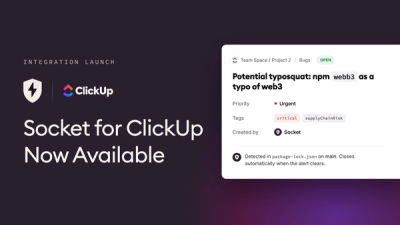
Create ClickUp tasks from Socket alerts, automate ticketing with custom rules, and keep alert and task status synchronized.