
Product
Socket Now Protects the Microsoft Edge Extension Ecosystem
Enterprise security teams can now detect malware, credential theft, suspicious network activity, and risky updates across Microsoft Edge extensions.
By John Tuckner - Aug 28, 2026
obsify
Advanced tools
Local, privacy-preserving PII toolkit over MCP — the model reasons on shape, deterministic local code touches substance, only masked results return.


Let an AI assistant work on sensitive files without their raw values ever entering the model's context.
obsify is a local, deterministic MCP server. The frontier model reasons over shape — schemas, synthetic twins, masked feedback — while deterministic local code touches the substance and returns only masked, aggregated results. No LLM calls, no network at runtime: detection is regex + checksums + dictionaries + Presidio's local NER.
It ships with Australian entity support (ABN / ACN / TFN, checksum-validated), credential/secret detection (cloud keys, API tokens, private keys, DB connection strings), and a label-driven routing layer that makes "when should the assistant avoid raw data" a deterministic, enforced decision rather than a judgement call.
Honest scope:
run_on_realexecutes model-written code in a best-effort local sandbox and masks its output best-effort. It is not a jail. ReadSECURITY.mdbefore pointing it at anything you cannot afford to leak. Return aggregates.
Feeding confidential documents to a hosted LLM means the substance leaves your perimeter. The usual answers are "don't use the LLM" or "trust the provider." obsify takes a third path — compute-to-data: bring the code to the data, not the data to the model.
The frontier model's reasoning is preserved. Only its eyes on raw values are removed.
| Tool | What it does | Returns |
|---|---|---|
scan_pii(path) | Scan a file/folder for PII | Types, locations, counts — never values |
make_synthetic_twin(path, out) | Faithful fake of an Excel workbook | Schema summary; twin written to out (values faked, leak-verified) |
run_on_real(code, data_path) | Compute-to-data: run your code locally against the real file (bound to DATA_PATH) | Only PII-masked, size-capped stdout/stderr — return aggregates |
redact_text(text) | Mask PII in a string to <TYPE> tokens | The redacted string |
verify_value_free(text, terms) | Fail-closed check that text leaks none of terms (or their variants) | {"value_free": bool} |
Supported documents: PDF (text + tables; complex-table fallback via obsify[tables]),
Excel .xlsx/.xlsm, and Word .docx (paragraphs + tables). Unreadable or unsupported files
are surfaced as explicit notes/blind spots, never silently dropped. (No OCR yet — scanned/image
pages are flagged as low-coverage, not transcribed.)
Known-entity masking (optional). Supply a local .obsify.entities list of names to hide;
scan_pii / redact_text deterministically catch them — and the suffix/abbreviation variants
NER misses (BRIGHTWATER HLDGS P/L for Brightwater Holdings Pty Ltd) — as KNOWN_ENTITY. The
list stays local and never enters the model's context. See docs/known_entities.md.
Poke at all five tools live against synthetic data with the official MCP Inspector:
python -m obsify.make_corpus --out ./corpus_demo
npx @modelcontextprotocol/inspector obsify-mcp
Call scan_pii on ./corpus_demo/ledger.xlsx and confirm it returns types / counts /
locations only — never values. See docs/verifying.md.
Generate a fake-but-realistic corpus (all synthetic; ABN/ACN/TFN are checksum-valid) spanning all three formats, then point a tool at it:
pip install "obsify[demo]"                 # reportlab, for the sample PDFs
python -m obsify.make_corpus --out ./corpus_demo
It writes a multi-sheet Excel ledger (a numeric false-positive minefield), a PDF engagement
letter (prose + trial-balance table), and a DOCX audit memo (paragraphs + vendor table). Great
for kicking the tyres on scan_pii / make_synthetic_twin without touching real data.
Requires Python 3.11+. obsify speaks MCP over stdio — the client launches it as a local subprocess; nothing is hosted remotely. Register it with any MCP-capable client (Claude Desktop, Claude Code, Cursor, VS Code, …) by adding one block to that client's config.
Recommended — zero-install via uvx:
{ "mcpServers": { "obsify": { "command": "uvx", "args": ["--from", "obsify", "obsify-mcp"] } } }
uvx fetches obsify from PyPI and runs it on demand — no permanent install. On first run,
obsify downloads the spaCy NER model (en_core_web_lg, ~560 MB) once and caches it; this
fetches a public model and sends no user data (set OBSIFY_AUTO_DOWNLOAD=0 to forbid it and
install the model yourself). Later runs are instant and fully offline.
Or install it (pip / pipx):
pipx install obsify # isolated, on PATH (or: pip install obsify)
Then point the client at the installed command:
{ "mcpServers": { "obsify": { "command": "obsify-mcp" } } }
Restart the client and the tools appear. Optional extras: obsify[tables] (complex-table PDF
fallback via camelot + Ghostscript), obsify[compute] (pandas, handy inside run_on_real code).
PATH gotcha (the #1 cause of "server won't connect"): the
commandmust resolve on the PATH the client sees. A GUI client may not share your venv's PATH. Fixes: useuvx/pipx(globally resolvable), or give an absolute path —"/path/to/.venv/bin/obsify-mcp"(macOS/Linux) or"C:\\path\\to\\.venv\\Scripts\\obsify-mcp.exe"(Windows).
From this repo (before it's on PyPI):
pip install "git+https://github.com/Formative-Sum41/obsify.git" # gets `obsify-mcp` + `obsify`
The hard part of "help me, but don't read the confidential file" is deciding when to protect. obsify moves that decision out of the model and into the environment:
.obsify.json — a label manifest classifying paths (public / confidential / restricted).obsify.guard (run as python -m obsify.guard) — a PreToolUse guard that blocks a direct read of a labelled file
(exit 2) and redirects the assistant to scan_pii / make_synthetic_twin / run_on_real.CLAUDE.md) so the assistant prefers obsify before it even hits the guard.Set it up with one command:
obsify init [--dir PATH] [--with-claude-md]
obsify init is non-destructive by design — it owns exactly one file and hands you snippets
for the rest:
.obsify.json — obsify owns this; init writes it (never overwritten without --force)..claude/settings.json — your file: init prints the PreToolUse hook block to paste,
never edits it (it runs code, so registering it is your call).CLAUDE.md — your file: the convention is opt-in. Default prints it; --with-claude-md
appends a marker-wrapped, idempotent block that never clobbers your content.Full convention: docs/obsify_routing.md.
CREDENTIAL by anchored patterns — vendor
prefixes (AKIA…, ghp_…) or a keyword-gated secret = <value>, never entropy heuristics
(which would flood on hex/base64 ledger columns). The whole BEGIN…END private-key block is
masked, not just its header, so no key body is left behind.obsify ships a scored evaluation harness (eval/ — labelled synthetic corpus + answer key +
scorer against the shipping detector, plus an independent third-party cross-check). Headline
on the synthetic corpus: 100% recall on expected-detect items, 0 false positives on a
numeric FP-torture sheet (with a grouped-number guard), bare context-gated IDs correctly
suppressed. Independent cross-check vs Microsoft presidio-research: EMAIL/IBAN 100%, PERSON 94%.
The harness earned its keep — it found real defects, which were then fixed: credit cards and
phone numbers were being silently suppressed by the numeric-noise filter (now exempt via checksum
validation / phone shape), and Medicare, IP, date-of-birth, AU passport and driver-licence had no
recognizer (now added, checksum- or context-gated). Full method, numbers, and remaining documented
gaps (SWIFT/BIC, non-DOB dates): eval/README.md.
pip install -e ".[dev]"
pytest tests/            # or run any file directly: python tests/test_obsify.py
Thirteen suites (88 tests), run in CI on Linux + Windows / Python 3.11 + 3.12:
scan_pii returning shape only, end to end.obsify init's non-destructive contract.verify_value_free.For interactive verification (MCP Inspector) and the live-client last-mile check, see
docs/verifying.md.
PRs welcome — see CONTRIBUTING.md for setup, the merge bar, and the
non-negotiable invariants (no LLM calls in the library, no runtime network, no real data,
shape-not-substance). Security issues: SECURITY.md (report privately).
MIT — see LICENSE.
FAQs
Local, privacy-preserving PII toolkit over MCP — the model reasons on shape, deterministic local code touches substance, only masked results return.
The pypi package obsify receives a total of 515 weekly downloads. As such, obsify popularity was classified as not popular.
We found that obsify demonstrated a healthy version release cadence and project activity because the last version was released less than a year ago. It has 1 open source maintainer collaborating on the project.
Product
Enterprise security teams can now detect malware, credential theft, suspicious network activity, and risky updates across Microsoft Edge extensions.

Research
/Security News
Socket researchers found 18 Chrome extensions and one Edge extension delivering a wallet drainer, credential theft, and other malicious payloads.
Product
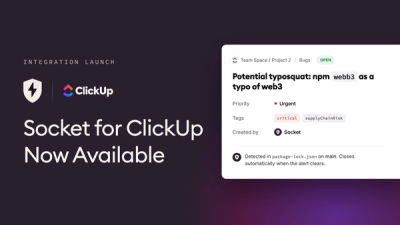
Create ClickUp tasks from Socket alerts, automate ticketing with custom rules, and keep alert and task status synchronized.