

Product
PHP and Composer Support Is Now in Beta
Socket’s PHP and Composer support is now in Beta for all customers, with PHP reachability analysis generally available.
By Trevor Norris, Benjamin Barslev - Aug 21, 2026
odoo-assistant
Advanced tools
An Odoo virtual employee via the Model Context Protocol (MCP). This server exposes Odoo's business logic, records, and workflows to LLMs, allowing them to query, create, update, and act on Odoo data safely.
Run the server directly:
uvx odoo-assistant
Or install it into your environment:
uv pip install odoo-assistant
Installing from source for development remains possible:
uv pip install git+https://github.com/singleflo/odoo-assistant-mcp
Two variables are required; everything else is discovered or has a default:
ODOO_BASE_URL: The base URL of your Odoo instance (e.g., https://mycompany.odoo.com).ODOO_API_KEY: The Odoo API key (Odoo 14+, generate under Settings > Users > API Keys > New). An account password is not accepted: a key is per-user, scoped and revocable on its own.Optional configuration:
ODOO_DB: The database name. Discovered automatically when the instance serves exactly one database; required when it serves several — the error names them all.ODOO_USER: The login. Discovered from the key at the cost of up to 59 extra round trips; discovery fails if the key owner's uid is 60 or higher. Setting it saves the probe.ODOO_MCP_MAX_LEVEL: The highest safety level this server may execute, 0 to 4 (default: 3). This is how you make the server read-only or let it delete — see Choosing the ceiling.ODOO_MCP_PROTECTED_HOSTS: Comma-separated hosts this server refuses to write to (empty by default — no host is baked into the package). A listed host still allows reads; writing needs ODOO_ALLOW_PROD_WRITE=yes as a deliberate override.Every write and action passes through a dynamic safety classifier before reaching Odoo. Operations are classified into levels L0 to L5:
| Level | Name | Description | Default Status |
|---|---|---|---|
| L0 | L0_READ | Read-only queries (search_read, read, search_count). | Allowed |
| L1 | L1_WRITE | Single record writes and creations. | Allowed |
| L2 | L2_BATCH | Batch writes affecting multiple records. | Allowed |
| L3 | L3_STATE_CHANGE | Workflow state transitions (e.g., confirming orders, posting invoices). | Allowed |
| L4 | L4_DESTRUCTIVE | Destructive operations (e.g., unlink, action_cancel, archiving). | Blocked |
| L5 | L5_PRIVATE / L5_UNKNOWN | Private methods or unknown operations. | Blocked |
ODOO_MCP_MAX_LEVEL sets the highest level this server may execute. Each value
is cumulative — it permits its own level and everything below:
| Value | What it permits |
|---|---|
0 | Reads only. |
1 | + single-record writes and creations. |
2 | + batches above 5 records. |
3 | Default. + confirming orders, posting invoices, sending mail. |
4 | + unlink, action_cancel, archiving. |
5 | Accepted, but identical to 4 in effect — see below. |
Two behaviours are worth knowing before you pick a number:
5 does not unlock L5. Both L5 variants are refused before the ceiling is
ever read. L5_PRIVATE is refused because Odoo itself rejects every method
starting with _, so no ceiling could deliver it; L5_UNKNOWN is refused
because a method nobody classified has, by definition, unreviewed effects. The
way to allow such a method is to add it to WRITE_L1/L3/L4 in
safety_layer.py — in code, reviewed — never through configuration.ODOO_MCP_MAX_LEVEL="O" raises rather
than falling back to the default, because the fallback is write-capable: a
typo must not hand you a writing server you believed was read-only.The ceiling is set out of band, by a human, and read from the process environment at startup. The model running against this server cannot raise it; when a call exceeds the ceiling the refusal names the level required, so the agent can explain what the operation would change and leave the decision to you.
Note that this is the authority of this server, not of the account. An agent with shell access can always bypass an MCP server by invoking Odoo directly. A limit that must hold regardless of the client belongs in the Odoo access rights of the user the API key belongs to, where the Odoo server enforces it.
Odoo 14.0 is the absolute minimum supported version because this server authenticates using API keys only, which do not exist in Odoo 13 or earlier.
| Odoo Version | API Keys | XML-RPC | Officially Maintained (Aug 2026) | Support Level / Notes |
|---|---|---|---|---|
| ≤ 13.0 | No | Yes | No | Unsupported. Cannot authenticate with this server. |
| 14.0 | Yes | Yes | No | Protocol-compatible. Untested against a live instance. |
| 15.0 | Yes | Yes | No | Protocol-compatible. Untested against a live instance. |
| 16.0 | Yes | Yes | No | Protocol-compatible. Untested against a live instance. |
| 17.0 | Yes | Yes | Yes (until Sep 2026) | Protocol-compatible. Untested against a live instance. |
| 18.0 | Yes | Yes | Yes (until Sep 2027) | Primary target. Verified and fully supported against a live instance. |
| 19.0 | Yes | Yes | Yes (until Sep 2028) | Protocol-compatible. Untested against a live instance. API keys require description and expiry (max 3 months). |
To generate an API key, log in to your Odoo instance and navigate to: Preferences / My Profile → Account Security → New API Key
The client automatically detects if the native JSON-2 API is available at /json/2/<model>/<method> (which uses Authorization: bearer <API_KEY>) and falls back to XML-RPC if it is not. Please note that XML-RPC and JSON-RPC are deprecated in Odoo 19 and scheduled for removal in Odoo 22.
The server exposes 19 tools and 2 resource types:
search_read: Search and read records in one call (Odoo search_read).read_record: Read one record by id, always with named fields.count_records: Count the records matching a domain (Odoo search_count).instance_overview: Summarise the connected instance: version, companies, volumes per area, in-house modules, anomalies.required_fields: List what Odoo demands before a create on a model, the default it would apply, and how existing records actually use it.create_record: Create a record, reusing an existing match when unique_on is given.write_record: Write field values to one record and report what actually changed.run_action: Run a workflow method and report the state it left behind.cancel_record: Cancel a record through action_cancel, following the wizard it returns.notify_user: Notify users on a record's chatter. Internal by default.create_activity: Schedule an activity: the only notification that carries a deadline.download_docs: Save every document of a record to disk, chatter files included.generate_pdf: Render the PDF of a record and return where it was saved.list_message_targets: List who can be messaged and where — internal users with presence (online/away/offline) and the caller's open conversations. Ask this before sending.read_conversation: Read a Discuss conversation, newest first.send_direct_message: Send a 1-to-1 Discuss message that appears in the user's chat systray in real time — no email, reaches them whatever their notification setting says.send_channel_message: Post to an existing Discuss channel, refusing a room that holds a non-employee.explore_module: Discover a module's structure by interrogating the live instance.list_known_modules: List the modules this server has learned: name, generation date, records.Tools 10-11 (notify_user, create_activity) notify ABOUT a record and land
in the Inbox bell; tools 14-17 are Discuss conversations that land in the chat
systray. "Message user X" is the second kind — send_direct_message, not
notify_user.
odoo://skill: Access the Odoo assistant skill instructions.odoo://ref/*: Access generated reference documentation for explored modules.Every example below carries only what matters: the two required variables, and
the ceiling — the one setting that decides whether this server can write, made
visible in the file the human owns. The database and the login are discovered,
and 3 is the ceiling's default. Note the quotes: environment values are
strings.
Add this to your claude_desktop_config.json:
{
  "mcpServers": {
    "odoo-assistant": {
      "command": "uvx",
      "args": [
        "odoo-assistant"
      ],
      "env": {
        "ODOO_BASE_URL": "https://mycompany.odoo.com",
        "ODOO_API_KEY": "your-api-key-here",
        "ODOO_MCP_MAX_LEVEL": "3"
      }
    }
  }
}
Add this to your .cursor/mcp.json or configure it in the Cursor settings UI:
{
  "mcpServers": {
    "odoo-assistant": {
      "command": "uvx",
      "args": [
        "odoo-assistant"
      ],
      "env": {
        "ODOO_BASE_URL": "https://mycompany.odoo.com",
        "ODOO_API_KEY": "your-api-key-here",
        "ODOO_MCP_MAX_LEVEL": "3"
      }
    }
  }
}
Add this to your VS Code settings.json:
{
  "mcp.servers": {
    "odoo-assistant": {
      "command": "uvx",
      "args": [
        "odoo-assistant"
      ],
      "env": {
        "ODOO_BASE_URL": "https://mycompany.odoo.com",
        "ODOO_API_KEY": "your-api-key-here",
        "ODOO_MCP_MAX_LEVEL": "3"
      }
    }
  }
}
Add this to opencode.json or .opencode/opencode.json in your project, or to
~/.config/opencode/opencode.json to make the server available everywhere:
{
  "$schema": "https://opencode.ai/config.json",
  "mcp": {
    "odoo-assistant": {
      "type": "local",
      "enabled": true,
      "command": [
        "uvx",
        "odoo-assistant"
      ],
      "timeout": 120000,
      "environment": {
        "ODOO_BASE_URL": "https://mycompany.odoo.com",
        "ODOO_API_KEY": "your-api-key-here",
        "ODOO_MCP_MAX_LEVEL": "3"
      }
    }
  }
}
opencode's shape differs from the hosts above in ways it rejects outright: the
key is mcp (not mcpServers), type is required, command is a single array
holding the program and its arguments (there is no separate args), and the
environment block is environment (not env).
Set timeout deliberately. It defaults to 5000 ms, and the first call of a
session pays for authentication plus, for instance_overview, dozens of XML-RPC
round trips — comfortably past five seconds against a real instance.
opencode reads its config once at startup and does not hot-reload it, so quit and restart after editing. Anything you change here — the ceiling included — takes effect only on the next launch.
To connect this server to ChatGPT via Custom Connectors:
Add the server using the Hermes CLI:
hermes mcp add odoo-assistant \
  --env ODOO_BASE_URL=https://mycompany.odoo.com \
  --env ODOO_API_KEY=your-api-key-here \
  --env ODOO_MCP_MAX_LEVEL=3 \
  --args run odoo-assistant
The examples omit the optional variables. Set ODOO_DB when the instance serves several databases, ODOO_USER to skip the uid probe, and ODOO_MCP_MAX_LEVEL to change the ceiling from its default of 3.
This project is licensed under the MIT License. See the LICENSE file for details.
FAQs
An Odoo virtual employee via MCP: query, create, modify records, run workflows
We found that odoo-assistant demonstrated a healthy version release cadence and project activity because the last version was released less than a year ago. It has 1 open source maintainer collaborating on the project.
Product
Socket’s PHP and Composer support is now in Beta for all customers, with PHP reachability analysis generally available.
Product
Socket is bringing experimental protection to Firefox, scanning 97,000+ extensions in Mozilla's official directory for malware and risky updates.
Research
/Security News
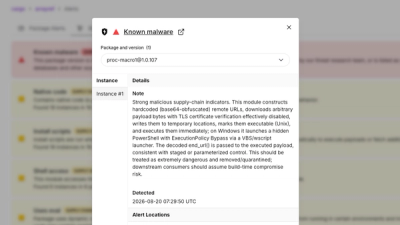
Three compromised Rust crates pulled in a malicious dependency that downloaded and executed cross-platform malware during Cargo builds.