
Research
/Security News
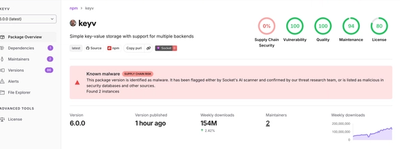
Popular npm Packages in the keyv and Cacheable Namespaces Compromised in Active Supply Chain Attack
Popular npm packages keyv and cacheable compromised.
By Socket Research Team - Aug 04, 2026
openzim-mcp
Advanced tools
OpenZIM MCP - ZIM MCP Server that enables AI models to access and search ZIM format knowledge bases offline

Transform static ZIM archives into dynamic knowledge engines for AI models






✨ Highlights. A lean 8-tool advanced surface (
zim_query,zim_search,zim_get,zim_get_section,zim_browse,zim_metadata,zim_links,zim_health) with a schema small enough for small-model dispatch — or one-tool Simple mode for natural-language queries. Archive-type presets auto-tune retrieval per source (Wikipedia, Stack Exchange, …), inbound link discovery answers "what links here," and native libzim introspection validates and inspects any archive. Available on Smithery and the official MCP Registry. Release notes → Docs →
OpenZIM MCP is a modern, secure, high-performance Model Context Protocol server that gives AI models structured, offline access to ZIM format knowledge archives — Wikipedia, Wiktionary, Stack Exchange, and the rest of the Kiwix Library.
Built for research assistants, knowledge chatbots, and content-analysis systems that need intelligent access to vast knowledge repositories — not just a raw text dump. Smart navigation by namespace (articles, metadata, media), structure-aware retrieval (sections, tables of contents, related articles), full-text search with suggestions and multi-archive search, and link-graph extraction to map content relationships. Cached, paginated operations keep things responsive across massive archives; comprehensive input validation and path-traversal protection keep things safe.
Streamable HTTP transport, per-entry MCP resources with subscriptions, and dual Simple / Advanced modes are all built in.
# uv (recommended — isolated CLI tool)
uv tool install openzim-mcp

# pip
pip install openzim-mcp

# Docker (multi-arch image, ghcr.io) — runs as a local stdio MCP server
docker pull ghcr.io/cameronrye/openzim-mcp
docker run -i --rm -v /path/to/zim/files:/data ghcr.io/cameronrye/openzim-mcp
The container defaults to stdio transport, so docker run -i speaks MCP over stdin/stdout — wire it into an MCP client the same way as the binary (see Quick start). For the long-running HTTP service (bearer auth, CORS, health endpoints), opt in at runtime with -e OPENZIM_MCP_TRANSPORT=http -e OPENZIM_MCP_HOST=0.0.0.0 -e OPENZIM_MCP_AUTH_TOKEN=… -p 8000:8000; see HTTP & Docker deployment.
Verify the install:
openzim-mcp --help
Download ZIM files from the Kiwix Library into a directory of your choice before running the server.
OpenZIM MCP is listed on the Smithery registry and the official MCP Registry (as io.github.cameronrye/openzim-mcp). Add it to your MCP client with the Smithery CLI:
npx @smithery/cli mcp add rye/openzim-mcp --client claude
For a one-click Claude Desktop extension, download the openzim-mcp-<version>.mcpb asset (and its .sha256) from the latest release and double-click it. The bundle launches the version-pinned uvx openzim-mcp@<version> (so the host needs uv) and prompts for your ZIM directory. Maintainer runbook: docs/distribution.md.
Run the server in Simple mode (default — exposes one natural-language tool, zim_query):
openzim-mcp /path/to/zim/files
Wire it into your MCP client. Example for Claude Desktop's claude_desktop_config.json (any MCP client that speaks stdio works the same way):
{
  "mcpServers": {
    "openzim-mcp": {
      "command": "openzim-mcp",
      "args": ["/path/to/zim/files"]
    }
  }
}
Once the client connects, ask your LLM: "summarize the article on Photosynthesis" — zim_query dispatches to the right underlying tool automatically.
For full control, run in Advanced mode to expose all 8 specialized tools:
{
  "mcpServers": {
    "openzim-mcp-advanced": {
      "command": "openzim-mcp",
      "args": ["--mode", "advanced", "/path/to/zim/files"]
    }
  }
}
For HTTP transport (long-running service with bearer auth, CORS, and health endpoints) see HTTP & Docker deployment.
zim_query, zim_search, zim_get, zim_get_section, zim_browse, zim_metadata, zim_links, zim_health. Down from 22; advanced-mode schema drops from ~36KB to ~23.5KB, clearing the MCP Tax pain band. API reference →zim://{name}/entry/{path} with native MIME types; clients subscribe and receive notifications/resources/updated when archives change. Resources, prompts & subscriptions →zim_query — one natural-language tool that dispatches to the right operation, tuned for small-model deployment targets. Quick start →OPENZIM_MCP_PRESETS_OVERRIDE_PATH).zim_health(zim_file_path=...) validates an archive's integrity (Archive.check() + checksum), and zim_metadata reports archive identity, full-text / title index capabilities, and an M/Counter mimetype breakdown. API reference →zim_links(direction="inbound") returns pages that link to an entry, ranked by linker importance. Requires a pre-built sidecar: openzim-mcp build link-graph <archive>.zim (writes <archive>.zim.linkgraph.sqlite next to the archive). API reference →OpenZIM MCP ships two modes; pick one per client.
Simple mode (default) exposes a single intelligent tool, zim_query, that parses natural-language requests and dispatches to the right underlying operation. Built for small-model deployment targets — the wire footprint is minimal and the dispatch happens server-side, not in the LLM context. Start here unless you have a specific reason not to.
Advanced mode exposes all 8 specialized tools (zim_query, zim_search, zim_get, zim_get_section, zim_browse, zim_metadata, zim_links, zim_health) plus 3 MCP prompts (/research, /summarize, /explore) and per-entry resources. Built for larger models that can reliably dispatch over the full schema, and for clients that want fine-grained control over pagination, namespace browsing, and link-graph extraction.
Rule of thumb: models ≤ 13B parameters benefit from Simple mode; larger models (Claude Sonnet/Opus, GPT-4o-class, Llama 70B+) can dispatch Advanced mode directly. See LLM integration patterns for guidance on choosing.
Full documentation lives at https://cameronrye.github.io/openzim-mcp/docs/.
| Group | Pages |
|---|---|
| Get started | Introduction · Installation · Quick start |
| Reference | API reference · Configuration · Resources, prompts & subscriptions |
| Guides | LLM integration patterns · Smart retrieval · HTTP & Docker deployment · Performance optimization · Security best practices · Worked examples |
| Operations | Troubleshooting · FAQ · Architecture overview |
v2.5.1 is the current release (2026-06-22); v2.0.0 GA shipped 2026-05-27. Per the published support policy — v1.x fixes accepted "until v2.5.0 ships, whichever comes first" — the v1.x maintenance window closed when v2.5.0 shipped (2026-06-18); all active development is now on the 2.x line. Full release history: CHANGELOG.md.
See CONTRIBUTING.md for development setup, test commands, code style, and the release process.
See SECURITY.md for the vulnerability disclosure policy. No known CVEs.
MIT. See LICENSE.
Made with ❤️ by Cameron Rye
FAQs
OpenZIM MCP - ZIM MCP Server that enables AI models to access and search ZIM format knowledge bases offline
The pypi package openzim-mcp receives a total of 353 weekly downloads. As such, openzim-mcp popularity was classified as not popular.
We found that openzim-mcp demonstrated a healthy version release cadence and project activity because the last version was released less than a year ago. It has 1 open source maintainer collaborating on the project.
Did you know?

Socket for GitHub automatically highlights issues in each pull request and monitors the health of all your open source dependencies. Discover the contents of your packages and block harmful activity before you install or update your dependencies.
Research
/Security News
Popular npm packages keyv and cacheable compromised.

Security News
A misconfiguration gave three Anthropic models internet access, and one, believing it was in a simulation, shipped a credential-stealing package to PyPI.

Security News
/Company News
Socket has joined the new Composer and Packagist sponsorship program as a launch sponsor, supporting the team that keeps PHP's package ecosystem secure.