

Product
PHP and Composer Support Is Now in Beta
Socket’s PHP and Composer support is now in Beta for all customers, with PHP reachability analysis generally available.
By Trevor Norris, Benjamin Barslev - Aug 21, 2026
pain001-mcp
Advanced tools
Model Context Protocol (MCP) server exposing the pain001 ISO 20022 Customer Credit Transfer Initiation library as agent tools.

Model Context Protocol server exposing the pain001 ISO 20022 payment library as 17 first-class agent tools.







Getting started
Library reference
Operational
The Model Context Protocol (MCP) is
an open standard that lets AI agents discover and call external tools in
a uniform way. pain001-mcp is the MCP server that turns the
pain001 ISO 20022
payment library into 17 first-class agent tools — so an assistant can
generate and validate pain.001 Customer Credit Transfer Initiation
and pain.008 Customer Direct Debit Initiation messages (the
standardised payment instructions behind SEPA and cross-border credit
transfers) directly from a conversation.
Every tool is a thin, typed wrapper over the pain001 public API
(validators, schema loaders, generate_xml_string, parsers, the version
mapper, the ISO 20022 charset sanitiser), so all interfaces behave
identically to the CLI, REST API, and in-tree MCP server. Tools return
JSON-serialisable data; on a validation error they return an
{"error": ...} payload rather than raising.
| Concern | How pain001-mcp handles it |
|---|---|
| Transport | stdio (FastMCP default); zero config beyond the client manifest |
| Schema fidelity | Tools delegate to pain001's XSD-validated generator |
| Identifier validation | validate_identifier checks IBAN (ISO 13616 / mod-97) and BIC |
| Cross-version mapping | migrate_records round-trips data between pain.001.001.03 and .12 |
| Charset compliance | sanitize_to_iso20022_charset transliterates outside-set characters |
| Message-type aliases | Bare family names pain.001 / pain.008 resolve to pain.001.001.09 / pain.008.001.02 |
| Error surface | Failures return structured {"error": ...}, never tracebacks — listing every missing or invalid field at once |
| Channel | Command | Notes |
|---|---|---|
| PyPI | pip install pain001-mcp | Pulls in pain001 >= 0.0.54 + MCP SDK |
| Source | git clone https://github.com/sebastienrousseau/pain001-mcp && cd pain001-mcp && poetry install | For development |
| Docker (GHCR) | docker pull ghcr.io/sebastienrousseau/pain001-mcp:latest | Multi-arch (linux/amd64, linux/arm64); runs pain001-mcp over stdio |
Requires Python 3.10 or later. Works on macOS, Linux, and Windows.
python -m venv venv
source venv/bin/activate        # macOS/Linux
venv\Scripts\activate           # Windows
python -m pip install -U pain001-mcp
Register the server with any MCP client (Claude Desktop shown):
{
  "mcpServers": {
    "pain001": { "command": "pain001-mcp" }
  }
}
That's it. Restart the client and the 17 tools are available to the agent. To check the server starts cleanly before wiring an editor:
pain001-mcp --help
# -> usage: pain001-mcp [-h] ...
The server speaks LSP-style JSON-RPC over stdin/stdout — it is meant to be launched by an MCP client, not used interactively.
All 17 tools delegate to the pain001 public API, so they behave
identically to the CLI and REST API.
list_message_types — List the supported pain.001 / pain.008 message typesget_required_fields — Required input fields for a message typeget_input_schema — Full input JSON Schema for a message typeinspect_template — Template metadata + accepted formats for a message typevalidate_records — Validate flat records against a message typevalidate_payment_scheme — Run a scheme rulebook (sepa-sct, sepa-sdd, sepa-inst, sepa-b2b, xborder-ct)validate_identifier — Validate an IBAN or BICvalidate_xml_against_schema — Validate an XML payload against its bundled XSD without writing to diskgenerate_message — Generate a validated XML message and return the stringgenerate_message_async — Async variant of generate_message for long batchesgenerate_message_from_file — Render directly from a CSV path on disklist_supported_formats — List the data formats pain001 can load (CSV, SQLite, JSON, JSONL, Parquet)parse_camt053 — Parse a camt.053 bank statement XML into structured dataparse_pain002 — Parse a pain.002 payment-status report XML into structured datamigrate_records — Migrate flat records between pain.001 schema versionssanitize_to_iso20022_charset — Transliterate text to the ISO 20022 Latin setconvert_mt101 — Convert a legacy SWIFT MT101 (Request for Transfer) into pain.001 records (one per transaction)Plus one resource and one prompt:
pain001://schema/{message_type} — Read-only access to the bundled XSD for any supported message typebuild_payment_batch — Guided multi-step prompt that walks an agent through building a valid batchThe generate path is designed so an agent's first natural call succeeds:
records parameter of
generate_message / generate_message_async carries a field-by-field
guide in its inputSchema description (key fields, accepted aliases,
defaults, computed totals), so an agent can build a correct call
without a discovery round-trip.pain.001 and
pain.008 are accepted wherever a message_type is, resolving to
pain.001.001.09 and pain.008.001.02; an invalid type error lists
every accepted value.validate_records canonicalizes
alias keys (amount, currency, lower-case IBAN/BIC spellings)
exactly as generate_message does, so a record that generates cleanly
also validates cleanly. Values keep their JSON types; only key names
are rewritten.{"error": ...} payload (never a traceback) that lists every
missing or invalid field at once, with row numbers; XSD failures
report each violation as element path plus reason (via
pain001 >= 0.0.54).nb_of_txs / ctrl_sum are
computed from the records and may be omitted; payment_method
defaults to TRF and charge_bearer to SLEV. IBAN and BIC values
are strictly validated and never coerced.You can invoke the tools in-process — without a transport — straight through the FastMCP instance. This mirrors what an agent receives over stdio:
import asyncio

from pain001_mcp.server import server

# A single flat payment record satisfying pain.001.001.09.
record = [
    {
        "id": "MSG-0001",
        "date": "2026-01-15T10:30:00",
        "nb_of_txs": 1,
        "ctrl_sum": 100.00,
        "initiator_name": "Acme Embedded Finance Ltd",
        "payment_information_id": "PMT-INFO-0001",
        "payment_method": "TRF",
        "batch_booking": False,
        "service_level_code": "SEPA",
        "requested_execution_date": "2026-01-20",
        "debtor_name": "Acme Embedded Finance Ltd",
        "debtor_account_IBAN": "DE89370400440532013000",
        "debtor_agent_BIC": "DEUTDEFFXXX",
        "charge_bearer": "SLEV",
        "payment_id": "PAY-0001",
        "payment_amount": 100.00,
        "currency": "EUR",
        "creditor_agent_BIC": "NWBKGB2LXXX",
        "creditor_name": "National Westminster Bank",
        "creditor_account_IBAN": "GB29NWBK60161331926819",
        "remittance_information": "Invoice 0001",
    }
]


async def main() -> None:
    async def call(name, args):
        result = await server.call_tool(name, args)
        # mcp 2.x returns a CallToolResult (read .content); 1.x
        # returns the content list, or a (content, meta) tuple.
        content = getattr(result, "content", None)
        if content is None:
            # mcp 2.x returns a CallToolResult (read .content); 1.x
            # returns the content list, or a (content, meta) tuple.
            content = getattr(result, "content", None)
            if content is None:
                content = result[0] if isinstance(result, tuple) else result
        return content[0].text if content else ""

    # 1. Validate an identifier.
    print(await call("validate_identifier",
                     {"kind": "iban", "value": "DE89370400440532013000"}))
    # -> {"kind": "iban", "value": "DE89370400440532013000", "valid": true}

    # 2. Sanitise text to the ISO 20022 Latin set.
    print(await call("sanitize_to_iso20022_charset",
                     {"value": "Café Müller"}))
    # -> {"value": "Café Müller", "sanitised": "Cafe Muller",
    #     "was_valid": false, "changed": true}

    # 3. Generate a validated Customer Credit Transfer Initiation.
    xml = await call("generate_message",
                     {"message_type": "pain.001.001.09", "records": record})
    print(xml[:46])
    # -> <?xml version="1.0" encoding="UTF-8"?>
    #    <Document ...


asyncio.run(main())
The runnable version of this snippet lives in
examples/01_mcp_tools.py. See the
examples/ folder for a validation pipeline
(02_validate_pipeline.py) and a
bank-reply parser walkthrough
(03_parse_bank_replies.py).
pain001-mcp is part of a set of independently installable packages
built around the pain001
library — pick whichever ones your stack needs:
| Package | Role |
|---|---|
pain001 | Core library + CLI + FastAPI REST API |
pain001-mcp | MCP server for AI agents (this package) |
pain001-lsp | Language Server Protocol server for editors |
flowchart LR
    A["MCP client<br/>(Claude Desktop, IDE, agent)"] -->|stdio| B["pain001-mcp"]
    B -->|delegates to| C["pain001"]
    C -->|render + validate| D["ISO 20022 pain.001 XML"]
pain001 …) or the REST API (pain001 serve) directly — both expose
the same surface with less indirection.pain001-lsp — it speaks
the Language Server Protocol to VS Code, Neovim, Helix, Emacs, etc.pain001[mcp] extra
exposes the same FastMCP instance and is easier to fork inside an
organisation's pain001 install.pain001-mcp uses Poetry and
mise.
git clone https://github.com/sebastienrousseau/pain001-mcp.git
cd pain001-mcp
mise install
poetry install
A Makefile orchestrates the quality gates (kept in lockstep with CI):
| Target | What it runs |
|---|---|
make check | All gates (REQUIRED before commit) |
make test | pytest --cov=pain001_mcp --cov-branch --cov-fail-under=100 |
make lint | ruff check + black --check |
make type-check | mypy --strict |
make docs | interrogate --fail-under=100 (docstring coverage) |
Current state (v0.0.57): 71 tests passing, 100% line + branch
coverage against a 100% enforced floor, mypy --strict clean,
interrogate 100%.
generate_message and
generate_message_from_file return the XML as a string; no tool
writes to disk.camt.053 and pain.002 is routed through
defusedxml (via the core pain001 library); XXE and entity
expansion are rejected.{"error": ...}
payloads — never as stack traces — so the agent never sees an
internal path leak.poetry.lock and audited by
pip-audit and Bandit in CI.To report a vulnerability, please use GitHub private vulnerability reporting rather than a public issue.
examples/Contributions are welcome — see the
contributing instructions.
Thanks to all the
contributors
who have helped build pain001-mcp.
Part of the ISO 20022 MCP Suite — open-source, Apache-2.0 licensed MCP servers for banking and financial-services AI agents:
| Server | Purpose |
|---|---|
pacs008-mcp | Generate, validate, parse & scheme-check ISO 20022 pacs.008 FI-to-FI credit transfers + Nov-2026 address linting |
camt053-mcp | Parse & reconcile ISO 20022 camt.053 bank-to-customer statements — CBPR+/HVPS+ ready |
acmt001-mcp | Generate & validate ISO 20022 acmt account-management messages |
bankstatementparser-mcp | Parse bank statements (BAI2, MT940/MT942, CAMT.053, OFX, CSV) into structured transactions |
noyalib-mcp | Lossless YAML 1.2 parsing, formatting & validation (Rust, 100% spec compliance) |
mcp-name: io.github.sebastienrousseau/pain001-mcp
Licensed under the Apache License, Version 2.0. Any contribution submitted for inclusion shall be licensed as above, without additional terms.
pain001.com · PyPI · GitHub
FAQs
Model Context Protocol (MCP) server exposing the pain001 ISO 20022 Customer Credit Transfer Initiation library as agent tools.
We found that pain001-mcp demonstrated a healthy version release cadence and project activity because the last version was released less than a year ago. It has 1 open source maintainer collaborating on the project.
Product
Socket’s PHP and Composer support is now in Beta for all customers, with PHP reachability analysis generally available.
Product
Socket is bringing experimental protection to Firefox, scanning 97,000+ extensions in Mozilla's official directory for malware and risky updates.
Research
/Security News
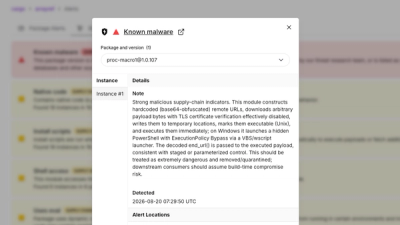
Three compromised Rust crates pulled in a malicious dependency that downloaded and executed cross-platform malware during Cargo builds.