

Product
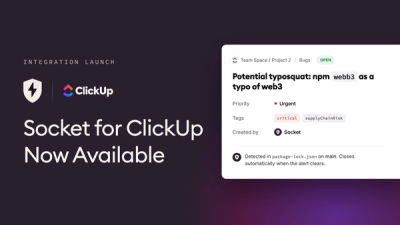
Socket for ClickUp Is Now Available
Create ClickUp tasks from Socket alerts, automate ticketing with custom rules, and keep alert and task status synchronized.
By Jeppe Hasseriis - Aug 26, 2026
perseus-ledger
Advanced tools
Perseus Ledger: verifiable, hash-chained provenance for autonomous-system events and resource allocation.
Perseus resolves. Vault remembers. Ledger proves.




Run it: docker pull ghcr.io/perseus-computing-llc/ledger:latest · Docs
Perseus Ledger is the verifiable event and provenance layer for autonomous systems. It records what happened, under what authority and evidence, and whether the history can be independently verified.
It is deliberately not an AI-spend dashboard. Ledger provides an append-only, hash-chained record that ties activity to its actor, boundary, evidence, configuration, action, result, and optional resource allocation. It works independently with any agent runtime, application, internal tool, or offline deployment.
For each recorded event, the stable ledger captures the operational facts already available to the system:
The current ingestion contract is deliberately stable during the product transition: ledger_agent, the ledger CLI, /v1/usage, existing database paths, and deployed integrations remain supported compatibility surfaces. Stripe is an optional settlement adapter, not the product boundary.
AI systems need more than observability. They need a defensible answer to:
What did the system know, what did it do, under which model and policy, what did it consume, and can we prove it later?
Perseus Ledger provides the evidentiary layer for that answer. It can work beside any agent framework, application, internal tool, offline environment, or federated deployment.
This is a product and architecture position, not a claim of handling CUI or satisfying a particular compliance regime.
| Product | Question it answers |
|---|---|
| Perseus | What verified workspace state should be available before an agent acts? |
| Perseus Vault | What durable, time-valid knowledge did the system have? |
| Perseus Ledger | What happened, under what authority and evidence, and can we prove it? |
Each product is useful on its own and integrates through documented, runtime-neutral contracts. Ledger does not require Perseus, Vault, or any specific agent runtime.
For the governance bridge between durable memory decisions, recall posture, and hash-only Ledger evidence, see Memory governance and Ledger provenance. For a copy-pasteable local setup, see Local Perseus + Vault + Ledger integration.
pip install perseus-ledger
ledger demo
# → opens the local Ledger console on http://localhost:8420
The canonical GHCR image is ghcr.io/perseus-computing-llc/ledger:
docker pull ghcr.io/perseus-computing-llc/ledger:latest
docker run --rm -p 8420:8420 ghcr.io/perseus-computing-llc/ledger:latest
The perseus-ledger package, ledger CLI, and LEDGER_* environment variables
are the canonical interfaces.
ledger mcp serves a curated 5-tool MCP surface (record / query / verify /
receipt / health) over stdio so agents can meter themselves:
pip install perseus-ledger
claude mcp add ledger -- ledger mcp
See docs/mcp.md for the tool table, action-provenance contract, remote mode, and the official-registry listing.
from ledger_agent import Meter

ledger = Meter(org="Acme Autonomous Systems")
ledger.track(
    provider="anthropic",
    model="claude-opus-4-8",
    task_type="evidence_review",
    workspace="mission-analysis",
    input_tokens=8200,
    output_tokens=2400,
)
This writes an immutable event into the local SQLite-backed hash chain. Existing hosted ingestion continues to use POST /v1/usage; refer to the API reference for the compatibility contract.
Ledger integrity is not a marketing assertion. It is checked from the recorded chain and can be exposed through the existing admin verification endpoint in a controlled deployment.
/v1 routes, deployed domains, and keys remain supported until a separately announced migration.MIT — see LICENSE. © Perseus Computing LLC.
FAQs
Perseus Ledger: verifiable, hash-chained provenance for autonomous-system events and resource allocation.
We found that perseus-ledger demonstrated a healthy version release cadence and project activity because the last version was released less than a year ago. It has 1 open source maintainer collaborating on the project.
Product
Create ClickUp tasks from Socket alerts, automate ticketing with custom rules, and keep alert and task status synchronized.
Product
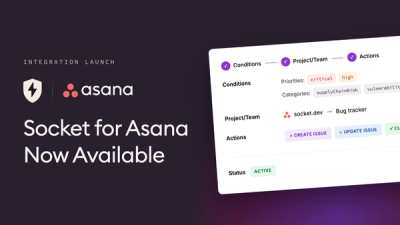
Create and manage Asana tasks directly from Socket alerts, with manual task creation, automated ticketing rules, and two-way sync.

Security News
Open VSX has removed three extension IDs from its malicious-extension list as the legitimate publishers they impersonated move to claim the names for themselves.