

Company News
AWS Security Hub Adds Socket for Supply Chain Security
Socket is now in the AWS Security Hub Extended plan. Adopt it through AWS, apply committed spend, and block malicious open source packages.
By Feross Aboukhadijeh - Aug 04, 2026
release-gate
Advanced tools
AI agent release decision engine - readiness scoring, regression gate, eval runner, trace validation, and evidence packs for CI/CD.
The pre-deploy release gate for AI agents. It renders an evidence-based PROMOTE / HOLD / BLOCK verdict — catching the agent-layer risks that SAST, guardrails, and evaluators structurally miss.




v0.9.4 — a lean, three-dependency CLI (
pip install release-gateno longer pulls a web/SaaS stack) and a reproducible 79-case benchmark that covers every rule (≥2 vulnerable + ≥2 clean look-alikes each), so the zero-false-positive claim can be checked, not just read. Both sit on top of the v0.9.0 agent-safety catalog (9 new rules + 2 precision upgrades), holding the precision bar at 0 false positives on that labeled benchmark and a framework dogfood (llama_index / crewAI / langgraph / open-interpreter): indirect prompt injection from RAG/tool/HTTP provenance (RG-PROMPT-002), model-driven SSRF / filesystem / SQL sinks (RG-ACTION-002/003/004), secret/PII → prompt data-egress to the provider (RG-SECRET-002, an agent-aware egress path conventional SAST lacks context to model), taint-aware deserialization (RG-EXEC-004), unvalidated model-output parses (RG-PARSE-001), and tool blast-radius + irreversibility gates (RG-TOOL-001/RG-GATE-001) — plus confirmed taint through the canonicalresp.choices[0].message.contentextraction and a reproducible PR-gate demo. See the catalog below. Builds on 0.8.5'srelease-gate pr, the AI-change review gate: one PROMOTE/HOLD/BLOCK on what a pull request introduced (net-new agent risk + lockfile/behaviour drift), plus a GitHub Actioncommand: pr; 0.8.4's security-hardened MCP server (pip install 'release-gate[mcp]'); and 0.8.0–0.8.2's AST-based evidence-citing analysis, deserialization calibration, and team-adoption workflow (--mode/--baseline/--pr-comment).
Why it's not SonarQube: a SAST tool sees eval(x) and asks "is x tainted by SQL/HTTP?" — it has no concept of "x is the model's reply." That blind spot is the entire agent layer: eval/pickle of model output (the CVE-2025-51472 RCE class), user input reaching a system prompt, LLM loops with no cost ceiling. Guardrails filter one input; evaluators score one output; neither blocks a release. release-gate is the gate.
pip install release-gate

# ── The wedge: gate a pull request on what IT introduced ──
# One PROMOTE / HOLD / BLOCK on net-new agent risk only (inherited debt is
# shown, never gated) + prompt/model drift. Runs in CI on the PR branch.
git checkout my-feature-branch
release-gate pr --base origin/main
release-gate pr --base origin/main --comment   # GitHub-ready PR comment

# ── Or audit a whole repo (the broader lens) ──
release-gate audit . --mode ci                                    # your repo, in CI
release-gate audit https://github.com/org/repo --mode public-advisory  # any public repo, advisory
Lean by design.
pip install release-gatepulls three small, well-audited libraries —pyyaml,jsonschema,cryptography— and nothing else. No web framework, no database driver, no auth stack in the CLI's dependency tree. The release-gate.com server stack is an opt-in extra (pip install 'release-gate[api]'), and the MCP server is another ('release-gate[mcp]').
Output:
  Repo    https://github.com/your-org/your-ai-agent
  Agents  OpenAI / Agents SDK (4 files), LangChain (12 files)

  Readiness Score   42 / 100   ████░░░░░░

  Agent Code Safety  28/100  BLOCK   4 high · 18 med · 0 low
     Driving the score: Dangerous execution sink ×4; LLM call with no token ceiling ×18
  Governance         50/100  Partial   4/8 safeguards declared

  Decision:  ✗  BLOCK
Two axes, on purpose:
exec/shell sinks fed by model output, LLM calls with no token ceiling,
hardcoded keys. It moves per repo and doesn't depend on adopting anything. These are
the agent-layer risks generic SAST/SonarQube don't model — release-gate is the layer
on top, not a replacement.Run --full for the per-finding breakdown, or scaffold a ready-to-commit governance
config from the scan:
release-gate audit . --emit-config -o governance.yaml
# Fill in the TODO lines, then gate every deploy:
release-gate score governance.yaml
release-gate sits between your tests and your deployment. It scans your agent code for the failure modes that only exist once an LLM is in the loop, runs evals, validates execution traces, checks cost budgets — then gives you two honest scores and one decision: PROMOTE / HOLD / BLOCK.
SonarQube checks your code. release-gate checks whether your agent change meets its release policy. They're complementary — keep your SAST suite; release-gate covers the agent layer it was never built to see (prompt-injection surfaces, cost-runaway loops, missing kill switches).
$ release-gate score governance.yaml --evals evals.yaml

  release-gate  |  Readiness Scorer  v0.9.4

  Project          customer-support-agent  v1.0.0
  Checks run       5  (5 pass, 0 warn, 0 fail)
  Evals run        7  (7 pass, 0 fail)  pass rate 100%
  Traces checked   1  (0 violations)

  Score            94 / 100   confidence: high

  Dimension Breakdown:
    safety          100  ██████████  (wt 30%)
    cost             90  █████████░  (wt 20%)
    access_control  100  ██████████  (wt 20%)
    fallback        100  ██████████  (wt 15%)
    eval_quality     85  ████████░░  (wt 10%)
    observability    80  ████████░░  (wt 5%)

  Critical failures  none

  Decision:  ✓  PROMOTE  (score 94/100)  exit 0
Every finding carries a stable, citable rule id (RG-EXEC-001) that never changes when we
reword a title, a one-line rationale, and a mapping to the frameworks you already answer to
(OWASP LLM Top 10, NIST AI RMF). "Why did this block my release?" resolves to a rule, not a code
dive. Full catalog with fixes and compliance tags: docs/RULES.md.
Two disciplines run through every rule:
Precision over recall — we don't cry wolf. When the analyzer can't prove a real risk it
stays quiet. Zero false positives on the current labeled benchmark and framework dogfood set —
the 79-case corpus now carries ≥2 vulnerable and ≥2 clean look-alikes for
every rule (including the v0.9.0 catalog), so that result is reproducible per rule (run
python benchmark/run.py), not just asserted; and the engine stayed correctly silent across a
framework dogfood (llama_index, crewAI, langgraph, open-interpreter).
Three evidence tiers — a HIGH is watertight or it isn't a HIGH. The tier is decided by provenance we can point at, never by how a variable is spelled. CI can gate on confirmed-only.
| Tier | Max severity | What it requires |
|---|---|---|
confirmed | high | A traced origin visible in the file, with a citable chain |
inferred | medium | Real dangerous structure, origin guessed from a name — "confirm the source" |
heuristic | low | Pattern present in agent code; no flow established |
Every HIGH carries the chain a reviewer can open and check —
request.json (L7) -> payload -> os.system() (L8) — and the benchmark
machine-checks that every HIGH in the corpus is confirmed and
provenance-backed (HIGH-tier integrity violations: 0). This came out of a real
failure: a variable named payload used to be enough to assert confirmed RCE,
and in AutoGPT that variable was its own HMAC-signed cache. One bad HIGH costs
more trust than ten missed MEDIUMs, so a name can no longer produce one.
How far taint reaches, and where it stops. A value is followed across a local function
call, across module boundaries (a whole-program summary index resolves from x import f,
and the chain names the defining file), and through the filesystem — model output written to
a script that is later executed. Labeled corpus: 100% precision, 100% recall.
It also resolves methods on classes (ai.start(...) → AI.start → AI.next →
self.llm.invoke, transitively and across modules), clients held on attributes
(self.llm = ChatOpenAI(...)), and container mutation (messages.append(reply)).
Where it still stops, measured: a client built by a factory method, and model output
marshalled through project-specific container/store classes — which is why gpt-engineer
(a ten-hop chain) stays silent. Across the 20-repo deployed-agent corpus
the taint rules produce 0 confirmed HIGHs (72 findings, all medium/low); the rule that
does fire there is blast
radius (RG-GATE-001) — irreversible tools with no code-level gate. Following the rest needs
whole-program type inference, which we'd rather disclose than fake. We publish the numbers that
didn't move, not just the ones that did.
| Rule | Detects | Severity |
|---|---|---|
RG-EXEC-001 | Model/user output → eval/exec/os.system/a shell/subprocess — the CVE-2025-51472 RCE class | HIGH |
RG-EXEC-002 | pickle/marshal/dill deserialization of unverified data | MED |
RG-EXEC-003 | A dynamic exec/shell call in agent code, reachability unproven | LOW |
RG-PROMPT-001 | Untrusted text interpolated into a system prompt (OWASP LLM01) | HIGH |
RG-PROMPT-002 | Indirect prompt injection — retrieval/RAG, an HTTP body, or a tool return reaching the system/instruction channel, keyed on real provenance | HIGH |
RG-ACTION-002 | SSRF / egress — a model-controlled URL into an HTTP client | HIGH |
RG-ACTION-003 | Filesystem write/delete from model output (irreversible) | HIGH |
RG-ACTION-004 | SQL built by interpolating model output (agent-driven SQLi) | HIGH |
RG-SECRET-001 | Hardcoded secret / API key in source | HIGH |
RG-SECRET-002 | Secret/PII → prompt → third-party model — an agent-aware data-egress path (a secret in prompt content, distinct from a key used as auth) that conventional SAST often lacks the context to model | HIGH |
RG-COST-001/002 | LLM call / param dict with no max_tokens ceiling | LOW |
RG-LOOP-001 | Unbounded loop around an LLM call — the AutoGPT runaway | HIGH |
RG-PARSE-001 | Unvalidated model-output parse (json.loads with no try/except) — reliability | LOW |
RG-TOOL-001 | An agent tool's irreversible blast radius is undeclared | LOW |
RG-GATE-001 | An irreversible tool action with no confirmation / dry-run / human-in-loop gate | MED |
Why a SAST tool can't do this: SonarQube sees eval(x) and asks "is x tainted by SQL/HTTP?"
— it has no concept of "x is the model's reply." That blind spot is the entire agent layer:
eval/pickle of model output, a retrieved document reaching the system role, a model-chosen URL
or SQL query, a secret leaking into a prompt. Guardrails filter one input; evaluators score one
output; neither blocks a release. release-gate is the gate.
examples/demo-code-risk/ is a runnable before/after: a data-analysis
agent that does expr = resp.choices[0].message.content; eval(expr, {"df": df}) vs. an allowlisted-
aggregation fix.
pip install release-gate
git clone https://github.com/VamsiSudhakaran1/release-gate && cd release-gate
./examples/demo-code-risk/build_demo.sh            # print the demo
./examples/demo-code-risk/build_demo.sh --check    # …and assert every claim below
It builds a throwaway git repo and runs the real gate on the PR:
🔴 release-gate — AI-change review: BLOCK

Agent Code Safety: 100 → 76 (▼ -24)

Introduced by this change (not pre-existing):
  HIGH (high · confirmed)  Dangerous execution sink   agent.py:25
    ↳ eval() executes `expr`, which we traced to the model's own output at line 17.
Then it scans the same service to show both tiers side by side — the point of the product:
  • HIGH    high confidence · confirmed   Dangerous execution sink        agent.py:25
     Evidence: client.chat.completions.create() (L17) -> `expr` -> eval() (L25)

  • MEDIUM  medium confidence · inferred  Deserialization of unverified data   cache.py:26
     Evidence: `payload` -> pickle.loads() (L26) — origin unknown (name suggests external input)
Same danger shape, two different claims. The HIGH names the line the value came from, so you can
open it and check us. cache.py's pickle.loads(payload) is where a name-matching scanner asserts
confirmed RCE — we won't, because payload is a bare parameter and a name is not evidence
(in AutoGPT that same variable held the cache's own HMAC-signed bytes).
No mockup: --check asserts every line quoted here, and CI runs it on every push,
so the published demo can't drift from the engine. Live walkthrough: release-gate.com/demo.html.
release-gate prAI writes the diff in seconds. Then a human burns an hour deciding whether to trust it — reading every changed file, hunting for the one dangerous line, wondering if a prompt or model changed under the hood. That verification tax is where the productivity goes. Token usage is at an all-time high; shipping velocity isn't keeping up, because reviewing and trusting generated code is now the bottleneck, not writing it.
release-gate pr pays that tax down. It runs in CI on the pull request and
answers one question, from evidence, not vibes: what did this change
introduce that a reviewer would otherwise have to find by hand?
release-gate pr --base origin/main            # in CI, on the PR branch
release-gate pr --base origin/main --comment  # GitHub-ready markdown comment
release-gate pr --base origin/main --json     # machine output for a bot
🔴 release-gate — AI-change review: BLOCK
this change made things net-worse — see reasons

Agent Code Safety: 100 → 88 (▼ -12)

Introduced by this change (not pre-existing):
- ⚠ HIGH (high · confirmed): Dangerous execution sink   src/agent/tools.py:88
  ↳ eval() executes `reply` — the model's own output.
- ⚠ prompt changed `prompts/system.txt` — release-gate.lock not updated

Context (advisory, not blocking):
- 11 source file(s) changed, 0 test files touched
- agent code-safety -12

Inherited debt ignored (not this change's fault): 4 finding(s).

exit 1   (0 PROMOTE · 10 HOLD · 1 BLOCK)
This is a security tool; it's held to the standard it audits. Four properties make the verdict trustworthy on its own:
eval() with model output; this prompt changed without
a lockfile update. Facts don't cry wolf.confirmed vs inferred). We validated it against 18
popular agent frameworks and spent as much effort killing false positives as
finding bugs — because one bad flag is how a scanner loses your trust.What it does NOT do: it is not an AI reviewer, debugger, or fixer, and it does not add 40 inline comments. It gives one decision and the short list of things worth your attention. It's release discipline, not more noise.
Drop it into GitHub Actions — either the raw CLI:
- uses: actions/checkout@v4
  with: { fetch-depth: 0 }        # full history so the diff can be scoped
- run: pip install release-gate
- run: release-gate pr --base origin/${{ github.base_ref }} --comment >> $GITHUB_STEP_SUMMARY
…or the published Action, which also posts a sticky PR comment:
- uses: actions/checkout@v4
  with: { fetch-depth: 0 }
- uses: VamsiSudhakaran1/release-gate@v0.9.4
  with:
    command: pr
    base: origin/${{ github.base_ref }}
    pr-comment: true            # create/update one sticky comment on the PR
The sections above are the whole story a new visitor needs: the problem, one
command, one real finding, one GitHub Action, and how it's different. Everything
else — the complete command reference, MCP server, AIBOM/drift gate, loop
verification, live agent scoring, governance checks, CI recipes, evidence packs,
the impact simulator, cryptographic governance, and supported model profiles —
lives in docs/REFERENCE.md, so this page stays a
landing page, not a manual.
git clone https://github.com/VamsiSudhakaran1/release-gate
cd release-gate
pip install -e ".[dev]"
pytest tests/
594 tests · all passing.
Found a bug? Have a feature request? Open an issue.
MIT — See LICENSE
Contact: vamsi.sudhakaran@gmail.com · GitHub · Website
FAQs
AI agent release decision engine - readiness scoring, regression gate, eval runner, trace validation, and evidence packs for CI/CD.
The pypi package release-gate receives a total of 671 weekly downloads. As such, release-gate popularity was classified as not popular.
We found that release-gate demonstrated a healthy version release cadence and project activity because the last version was released less than a year ago. It has 1 open source maintainer collaborating on the project.
Did you know?

Socket for GitHub automatically highlights issues in each pull request and monitors the health of all your open source dependencies. Discover the contents of your packages and block harmful activity before you install or update your dependencies.
Company News
Socket is now in the AWS Security Hub Extended plan. Adopt it through AWS, apply committed spend, and block malicious open source packages.
Research
/Security News
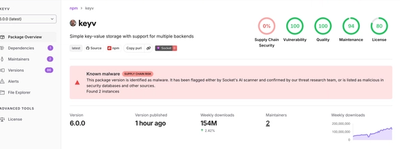
Popular npm packages keyv and cacheable compromised.

Security News
A misconfiguration gave three Anthropic models internet access, and one, believing it was in a simulation, shipped a credential-stealing package to PyPI.