
Research
/Security News
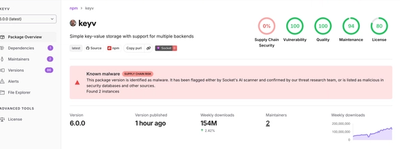
Popular npm Packages in the keyv and Cacheable Namespaces Compromised in Active Supply Chain Attack
Popular npm packages keyv and cacheable compromised.
By Socket Research Team - Aug 04, 2026
shadow-mcp
Advanced tools
Discover and risk-grade the MCP servers actually present on this machine. Local-first shadow-MCP inventory.
Discover and risk-grade the MCP servers actually present on this machine.
Most MCP security tooling assumes you already have a list of servers to audit.
On a real developer machine you don't: servers are scattered across Claude Code,
Codex, Claude Desktop, project-local .mcp.json files, DXT extensions, and live
processes that bind no port. shadow-mcp finds them first, then grades them.
This is the local-first answer to OWASP MCP09:2025 — Shadow MCP Servers.
discover -> inventory -> risk-grade -> report
~/.claude.json, user + project scope), claude mcp list
(catches remote + plugin servers no file contains), Codex
(~/.codex/config.toml + profiles), project .mcp.json, Claude Desktop
config + DXT extension manifests, and the live process table.personal-ops vs
personal_ops), tracking every provenance.The risk model and its OWASP mapping live in docs/risk-model.md.
uv sync # installs deps incl. MCPAudit as a local editable engine
shadow-mcp grades against your local checkouts of MCPAudit (../MCPAudit) and
mcp-trust (../mcp-trust/registry.db). Override with SHADOW_MCP_MCPTRUST_DB
or --registry-db.
uv run shadow-mcp scan                      # full pipeline, terminal report
uv run shadow-mcp scan --json out.json      # machine-readable inventory
uv run shadow-mcp scan --format markdown    # markdown report
uv run shadow-mcp discover                  # inventory only, no grading
uv run shadow-mcp sources                   # per-collector counts
uv run shadow-mcp grade-missing             # A-F for servers the registry hasn't scanned
uv run shadow-mcp deep-scan cost-tracker    # connect to a server, grade its real tools
Useful flags: --no-processes (skip the live process scan), --no-cli (skip
claude mcp list), --no-mcpaudit (inventory + mcp-trust only), --home PATH
(point discovery at a fixture tree).
By default grading is static (config-only): no server is spawned, so grades reflect what's visible in the config. That's safe but coarse — a server's real capability only shows once you connect and list its tools.
shadow-mcp scan --connect (or deep-scan [names...]) spawns each stdio
server and enumerates its real tools, delegating to MCPAudit's connected engine
for a capability grade that actually differentiates (a filesystem server jumps
from a static A to a connected D). This is opt-in because connecting
executes the server; remote endpoints are never spawned (that's the network-scan
tier), and a server that needs real secrets to start falls back to its static
grade.
uv sync                       # dev tools + grading engines (the default groups)
uv run pytest                 # full suite (61 + engine-backed tests)
uv run ruff check .           # lint
The grading engines are an optional engines dependency-group, resolved to your
local checkouts of ../MCPAudit and ../mcp-trust via [tool.uv.sources]. The
tool degrades to discovery-only without them (engine-backed tests skip cleanly),
so CI installs without them:
uv sync --no-group engines # discovery + local OWASP layer only (what CI runs)
--connect/deep-scan is the one path that
executes servers, and only when you explicitly ask.)*.inventory.json as private (it is
git-ignored by default).shadow-mcp can serve its own inventory tools as an MCP server so an agent can query your local MCP surface without leaving the conversation.
| Tool | Description |
|---|---|
scan_local | Full pipeline (discover → inventory → grade → report). Returns JSON. |
discover_local | Inventory every MCP server without grading. Returns JSON. |
deep_scan | Grade only the named servers (static, no spawning). Accepts names: list[str]. Returns JSON. |
list_sources | Per-collector source counts from a discover run. Returns JSON. |
# directly from a local checkout
shadow-mcp mcp-serve

# via uvx (once published to PyPI)
uvx shadow-mcp mcp-serve
LOCAL only. The MCP server never connects to hosted MCP endpoints — all
grading is static (config-based). connect=False is enforced unconditionally;
no server is ever spawned from an MCP tool call.
This is the local-first tool: it inventories one machine from its configs
and processes. A later network-scan expansion (probing hosts/ports for remote
MCP endpoints, org-wide fleet inventory, typosquat-distance provenance checks)
is deliberately out of scope here — see the bottom of docs/risk-model.md and
the project notes for what that would add.
FAQs
Discover and risk-grade the MCP servers actually present on this machine. Local-first shadow-MCP inventory.
We found that shadow-mcp demonstrated a healthy version release cadence and project activity because the last version was released less than a year ago. It has 1 open source maintainer collaborating on the project.
Did you know?

Socket for GitHub automatically highlights issues in each pull request and monitors the health of all your open source dependencies. Discover the contents of your packages and block harmful activity before you install or update your dependencies.
Research
/Security News
Popular npm packages keyv and cacheable compromised.

Security News
A misconfiguration gave three Anthropic models internet access, and one, believing it was in a simulation, shipped a credential-stealing package to PyPI.

Security News
/Company News
Socket has joined the new Composer and Packagist sponsorship program as a launch sponsor, supporting the team that keeps PHP's package ecosystem secure.