

Product
PHP and Composer Support Is Now in Beta
Socket’s PHP and Composer support is now in Beta for all customers, with PHP reachability analysis generally available.
By Trevor Norris, Benjamin Barslev - Aug 21, 2026
tokentrust-cli
Advanced tools
Vendor-neutral CLI and MCP server that verifies the token and cost savings AI-coding-agent context-reduction proxies (rtk, headroom) actually deliver, measured against a real 23-task labeled corpus with a local tokenizer instead of the proxy's own claimed number.
Vendor-neutral CLI that independently verifies the token and cost savings AI-coding-agent context-reduction proxies actually deliver, by running the proxy for real against a labeled task corpus instead of trusting the maintainer's own number.
This is the Python port of the tokentrust-cli npm package.
Same CLI surface (tokentrust verify --proxy <name>), same TT01-TT05 verification categories, same
bundled 23-task corpus, same cl100k_base local tokenizer, ported from the TypeScript source at
RudrenduPaul/TokenTrust-CLI so Python-first
teams can pip install instead of pulling in Node.js.


Context-reduction proxies for AI coding agents (rtk, headroom, and others) publish their own
compression and cost-savings numbers, measured on the maintainer's own workload, with nobody
outside the project checking the math. That's not an accusation, it's just how every proxy in
this space currently reports its own numbers, and a maintainer benchmarking their own tool isn't
running an adversarial test.
The gap shows up in the proxies' own issue trackers: an open, 5-repo, 2,100-measurement empirical
benchmark thread asking how rtk's actual savings compare to what it claims
(rtk#839), a report that rtk's own gain command
hallucinates token usage and savings (rtk#1935),
and a cost regression a maintainer's own test suite didn't catch on its own
(rtk#582, "RTK Hook Increases Claude Code Costs by
18%"). TT05 exists specifically to catch that last class of regression before a user does.
TokenTrust doesn't compete with these proxies, it verifies them: a real local tokenizer
(tiktoken, cl100k_base), a real, bundled, labeled 23-task corpus, and a real subprocess
invocation of the proxy binary itself, not a re-run of the vendor's own benchmark script. Every
category run prints the claimed number right next to the measured one, so the comparison is never
hidden or averaged away. This package is the Python port of that same verification logic, for
teams that don't want a Node.js dependency in their pipeline just to run it.
pip install tokentrust-cli
tokentrust verify --proxy rtk
TokenTrust ships as two first-class distributions of the same tool: tokentrust-cli on npm (Node.js)
and tokentrust-cli on PyPI (this package). Both install a tokentrust command with an identical
CLI surface, the same TT01-TT05 verification categories, and the same bundled task corpus. Pick
whichever matches your existing toolchain:
npx tokentrust-cli verify --proxy rtk needs no install step.requirements.txt / pyproject.toml?
pip install tokentrust-cli gives you the same verification logic without adding a Node.js
dependency to your pipeline.Both distributions are maintained from the same verification methodology and read the same
tokentrust-tasks.yml corpus schema, so a report produced by one is directly comparable to a
report produced by the other.
tiktoken, cl100k_base), against every task in the corpus.--live mode verifies the estimate against a real,
provider-billed sample (opt-in, your own API key, gated behind --confirm-cost, capped at 5
tasks by default).--proxy more than once and TokenTrust runs
the identical task corpus through every named proxy side by side.See docs/concepts.md for how each category's methodology works.
tokentrust verify --proxy <name> [options]
| Flag | Description |
|---|---|
--proxy <name> | Proxy to verify. Repeatable, pass it more than once to run TT04's cross-tool comparison. Supported: rtk, headroom. Required. |
--repo <path> | Repo to measure against. Defaults to the current directory. |
--tasks <file> | Task corpus YAML file. Defaults to the bundled 23-task corpus. |
--live | Sample real, provider-billed tokens for the first proxy instead of estimating from pricing tables. Requires --confirm-cost. |
--confirm-cost | Confirms the estimated spend --live prints before any real API call is made. |
--live-max-tasks <n> | Max tasks sampled in --live mode. Defaults to 5. |
--format <terminal|json> | Report output format. Defaults to terminal. |
-h, --help | Show the help message and exit. |
Exit code is 0 when the run completes with no gated failure, non-zero otherwise.
tokentrust-cli ships in the same dual CLI + MCP-server mode on both distributions: one binary,
one underlying verification engine (run_verify()), and a second, thin front door for agents
that speak MCP (Model Context Protocol) instead of a shell.
tokentrust mcp starts an MCP server over stdio, exposing a single tool, verify_proxy_savings,
that calls straight into the same run_verify() engine tokentrust verify uses -- no
verification logic is duplicated, and the tool returns the exact structured JSON report
--format json already produces.
tokentrust mcp
pip install tokentrust-cli puts a real tokentrust console script on PATH, so point the
client's server config straight at it with the mcp argument. For Claude Code, Claude Desktop,
or any other client that reads an mcpServers block:
{
  "mcpServers": {
    "tokentrust": {
      "command": "tokentrust",
      "args": ["mcp"]
    }
  }
}
If you'd rather not install into an environment already on PATH, uvx or pipx run both work
against the same published package without a separate install step first:
{
  "mcpServers": {
    "tokentrust": {
      "command": "uvx",
      "args": ["--from", "tokentrust-cli", "tokentrust", "mcp"]
    }
  }
}
| Field | Description |
|---|---|
verify_proxy_savings | Tool name. Mirrors verify's flags one-for-one, minus --format -- an MCP call is always machine-facing, so the tool always returns the structured JSON report. |
proxy (required) | A single proxy name ("rtk") or an array (["rtk", "headroom"]) to run the TT04 cross-tool comparison in one call. Supported: rtk, headroom. |
repo | Same as --repo. Defaults to the MCP server process's current working directory. |
tasks | Same as --tasks. Defaults to the bundled task corpus. |
live / confirmCost | Same --live/--confirm-cost safety gate as the CLI: no live, provider-billed API call is made unless BOTH are explicitly true in the same call. Neither has a default of true. |
liveMaxTasks | Same as --live-max-tasks. Defaults to 5. |
The wire-level field names (proxy, repo, tasks, live, confirmCost, liveMaxTasks) are
deliberately camelCase, even though the rest of this Python port uses snake_case internally --
this is the tool's contract with an MCP client, and it's byte-identical to the npm package's
verify_proxy_savings tool, so a real client sees the same tool regardless of which language's
server it's talking to. This is the tool's real, unedited tools/list schema, captured from a
running tokentrust mcp server (inputSchema trimmed of per-field descriptions here for
length; the live server returns them in full):
{
  "name": "verify_proxy_savings",
  "title": "Verify proxy token/cost savings",
  "inputSchema": {
    "type": "object",
    "properties": {
      "proxy": { "anyOf": [{ "type": "string", "enum": ["rtk", "headroom"] }, { "type": "array", "items": { "type": "string", "enum": ["rtk", "headroom"] }, "minItems": 1 }] },
      "repo": { "type": "string" },
      "tasks": { "type": "string" },
      "live": { "type": "boolean" },
      "confirmCost": { "type": "boolean" },
      "liveMaxTasks": { "type": "integer", "exclusiveMinimum": 0 }
    },
    "required": ["proxy"]
  }
}
A real tools/call against this repo, {"name": "verify_proxy_savings", "arguments": {"proxy": "rtk"}}, returns the same shape as the CLI's --format json output (trimmed here; the live
call returns the full records array with TT01/TT02/TT05 entries):
{
  "content": [
    {
      "type": "text",
      "text": "{\n  \"run_id\": \"tt_2026-07-18_b9c042\",\n  \"repo\": \"...\",\n  \"task_corpus_size\": 23,\n  \"proxies\": [\"rtk\"],\n  \"records\": [ /* TT01, TT02, TT05 -- same shape as `verify --format json` */ ],\n  \"tt03\": { \"rtk\": { \"pass\": false, \"regressed_count\": 2, \"task_corpus_size\": 23 } },\n  \"tt05\": { \"rtk\": { \"pass\": true, \"message\": \"No regression vs. last-verified rtk 0.43.0 baseline (stored 2026-07-18).\", \"prior_run_id\": \"tt_2026-07-18_b90a1e\", \"degraded\": false } }\n}"
    }
  ],
  "isError": false
}
isError is true (with no report) whenever the underlying run_verify() call itself would
have exited non-zero on the CLI -- a missing proxy binary, an invalid task corpus, or the
--live safety gate refusing an under-confirmed call. Progress output and the trace log
tokentrust verify normally prints to stdout are rerouted to stderr in MCP mode, since stdout is
the live JSON-RPC wire once a stdio transport is connected -- verified with a real spawned
tokentrust mcp subprocess talking real stdio to a real MCP client session (see
python/tests/test_mcp_server.py).
| What it does | Ongoing / self-serve | Verifies a specific claim | |
|---|---|---|---|
| TokenTrust | Runs a named proxy against a labeled task corpus, measures real compression, cost, and output-quality regression, prints claimed vs. measured | Yes, runs in your own CI, on your own repo, every time a proxy version bumps | Yes, that's the whole point |
| tokbench | Independent pilot benchmark of rtk and headroom on one real agentic SDLC task, with raw transcripts and a pre-registered protocol | No, a single-repo, N=1 pilot report, replication in progress | Yes, and rigorously: credit where it's due |
| Langfuse, Vantage, Finout, Amnic, Revenium | LLM/AI cost observability and FinOps. Track your actual API spend across models and providers, allocate it across teams | Yes, hosted or self-hosted, ongoing | No, these track what you spent; they don't check whether a specific proxy's specific savings claim holds up |
tokbench is the closest prior art and deserves real credit, though its pilot scope is narrower than a first read suggests: one repository, one task, N=1 per arm, replication runs in progress. See the project README's "How it compares" for the full writeup, including tokbench's own published numbers.
| Proxy | Status |
|---|---|
rtk | Fully supported: real subprocess-based verification (rtk pipe --filter <name> for stdin-shaped tasks, rtk read -l aggressive <files> for file-based tasks). |
headroom | Recognized (--proxy headroom is a valid flag value), not yet supported. headroom is an HTTP proxy server, not a one-shot compression CLI, so this version's subprocess-based harness can't drive it. tokentrust verify --proxy headroom prints a message and skips it instead of failing silently. |
This port uses tiktoken, OpenAI's own Python tokenizer
package, with the cl100k_base encoding: the same encoding the npm package's js-tiktoken
dependency uses. Token counts were verified identical between the two libraries on real sample
text before this port shipped (see CONTRIBUTING.md).
One real behavioral difference: js-tiktoken bundles the cl100k_base rank data inside the npm
package, so the Node CLI works fully offline from its very first run. tiktoken downloads and
caches that same public rank data from OpenAI's servers on its first use in a given environment
(set TIKTOKEN_CACHE_DIR to control where); every run after that first one uses the local cache
and needs no network. See docs/getting-started.md for details.
There's no bundled GitHub Action for the Python package (the npm package has one, see the
project README). Wire it into any CI
system as a plain step, and use --format json plus the exit code to gate a build:
# .github/workflows/tokentrust.yml
name: TokenTrust verify
on: [pull_request]

jobs:
  verify:
    runs-on: ubuntu-latest
    steps:
      - uses: actions/checkout@v4
      - uses: actions/setup-python@v5
        with:
          python-version: "3.12"
      - run: pip install tokentrust-cli
      - run: curl -fsSL https://rtk-ai.app/install.sh | sh
      - run: tokentrust verify --proxy rtk --format json > tokentrust-report.json
      - uses: actions/upload-artifact@v4
        with:
          name: tokentrust-report
          path: tokentrust-report.json
tokentrust verify exits 0 on a completed run with no gated failure (a --live cost-gate
refusal, a task-schema error, or a corpus mismatch) and non-zero otherwise. A TT03 or TT05 FAIL is
reported in the JSON output but does not by itself fail the process exit code, so to hard-fail CI
on a version-drift regression specifically, gate on the report's tt05 entries instead, the same
way the npm package's bundled GitHub Action does, see
examples/02-json-report-ci-gate for a complete, runnable
version of exactly that check against this package's run_verify() API. Full walkthrough,
including caching the tiktoken tokenizer download between CI runs, is in
docs/integrations/ci.md.
TokenTrust shells out to the rtk and headroom proxy binaries as unprivileged child processes
using Python's subprocess.run with an argument list (never shell=True), so proxy output and
task/fixture content can't reach a shell. It never sends task content, repo data, or measurement
results anywhere by default, and makes exactly one network call outside of opt-in --live
mode: tiktoken fetching the public, non-sensitive cl100k_base rank data from OpenAI's servers
on first use in a fresh environment (see docs/getting-started.md),
cached locally after that.
The one credential this package ever handles is your own Anthropic API key for opt-in --live
mode, which verifies TT02's cost estimate against a real, provider-billed sample. That key is read
only from the TOKENTRUST_LIVE_API_KEY environment variable, never accepted as a CLI flag (so it
never lands in shell history or a process list), and used for nothing but the single billed
request --live makes per sampled task, capped at 5 tasks by default and always gated behind an
explicit --confirm-cost before any call is made.
Security reports involving credential handling, command injection through task/fixture input, or
JSON report parsing are especially high priority. Vulnerabilities in the third-party proxy
binaries (rtk, headroom) themselves are out of scope for this repository, report those
directly to the respective project. To report a vulnerability privately, see
SECURITY.md for the disclosure process, or use
GitHub Security Advisories.
Honest note: this project does not currently publish SLSA provenance, Sigstore signatures, or
an SBOM, and has no OpenSSF Scorecard badge set up, for either distribution. CI runs npm audit --audit-level=high on every pull request touching the npm package; there is no equivalent
automated dependency-audit step wired into CI for the Python package yet, its dependencies are
pinned to bounded version ranges (tiktoken>=0.7,<1, PyYAML>=6.0,<7) in
pyproject.toml instead.
What is TokenTrust, and how is it different from a context-reduction proxy like rtk or headroom?
TokenTrust is not a proxy itself and does not compress anything. It is a vendor-neutral
verification layer: it runs a proxy like rtk or headroom as a real subprocess against a
fixed, labeled 23-task corpus, measures the actual token and dollar savings with a local
tokenizer, and prints that measured number next to the number the proxy's own README claims.
Is this Python package a wrapper around the npm/Node.js version?
No. This is a genuine, independently maintained Python port under
python/src/tokentrust/, with its own pytest suite, not a subprocess wrapper
around the Node CLI. Both distributions expose the same tokentrust command, the same TT01-TT05
verification categories, the same bundled 23-task corpus, and the same cl100k_base tokenizer
encoding, verified to produce identical token counts on real sample text.
Do I need my own API keys to run TokenTrust?
Only if you use --live --confirm-cost to verify TT02's cost estimate against a real,
provider-billed sample. That key is read only from the TOKENTRUST_LIVE_API_KEY environment
variable, never accepted as a CLI flag, and used for nothing but the capped, explicitly-confirmed
--live sample. Without --live, TokenTrust makes no billed API calls at all.
Is it safe to run against my own repo and proxy binaries?
Yes. TokenTrust shells out to the rtk/headroom binaries as unprivileged child processes via
subprocess.run with an argument list (never shell=True), so proxy output and fixture content
can't reach a shell, and it never modifies your repo or the proxy's compressed output.
Does TokenTrust work with AI agents directly, not just from a shell?
Yes. tokentrust mcp starts an MCP (Model Context Protocol) server over stdio exposing one tool,
verify_proxy_savings, backed by the same run_verify() engine the CLI uses — see the
"Agent-native / MCP" section above.
pip install -e ".[dev]"
pytest
See CONTRIBUTING.md for the project layout, how to add a verification category or fixture task, and the coverage bar every category change is held to.
Apache-2.0. See LICENSE.
FAQs
Vendor-neutral CLI and MCP server that verifies the token and cost savings AI-coding-agent context-reduction proxies (rtk, headroom) actually deliver, measured against a real 23-task labeled corpus with a local tokenizer instead of the proxy's own claimed number.
We found that tokentrust-cli demonstrated a healthy version release cadence and project activity because the last version was released less than a year ago. It has 2 open source maintainers collaborating on the project.
Product
Socket’s PHP and Composer support is now in Beta for all customers, with PHP reachability analysis generally available.
Product
Socket is bringing experimental protection to Firefox, scanning 97,000+ extensions in Mozilla's official directory for malware and risky updates.
Research
/Security News
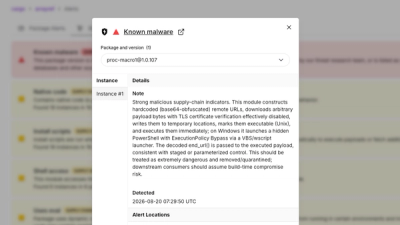
Three compromised Rust crates pulled in a malicious dependency that downloaded and executed cross-platform malware during Cargo builds.