




Company News
AWS Security Hub Adds Socket for Supply Chain Security
Socket is now in the AWS Security Hub Extended plan. Adopt it through AWS, apply committed spend, and block malicious open source packages.
By Feross Aboukhadijeh - Aug 04, 2026
universal-connector-mcp
Advanced tools
A security-first, local-first MCP server that connects any API (OpenAPI/GraphQL/gRPC/SOAP) to AI agents through a single normalized operation model.
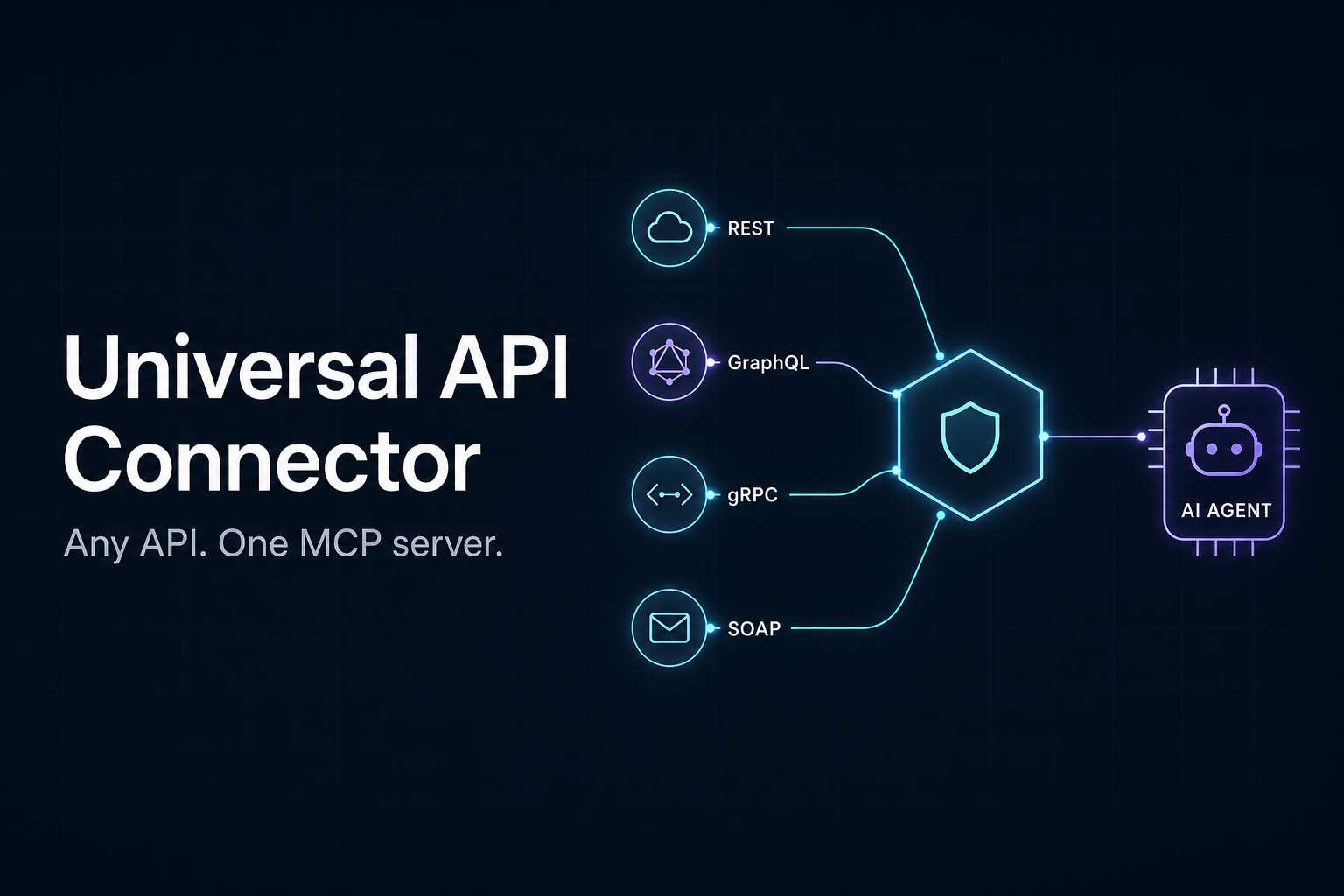
Stop installing a new MCP server for every service: point this one at any OpenAPI/Swagger, GraphQL,
gRPC or SOAP spec - or pick one from the built-in catalog of 2500+ public APIs - and your AI agent
can call it. Securely, in fewer steps, with fewer tokens.


Installation · Meta-tools · API catalog · Examples · Configuration · Security
Most "universal API" MCP servers only speak REST/OpenAPI. This project is built around three differentiators:
Operation model with pluggable spec adapters (OpenAPI, GraphQL, gRPC, SOAP). Tools and executors never care which protocol produced an operation.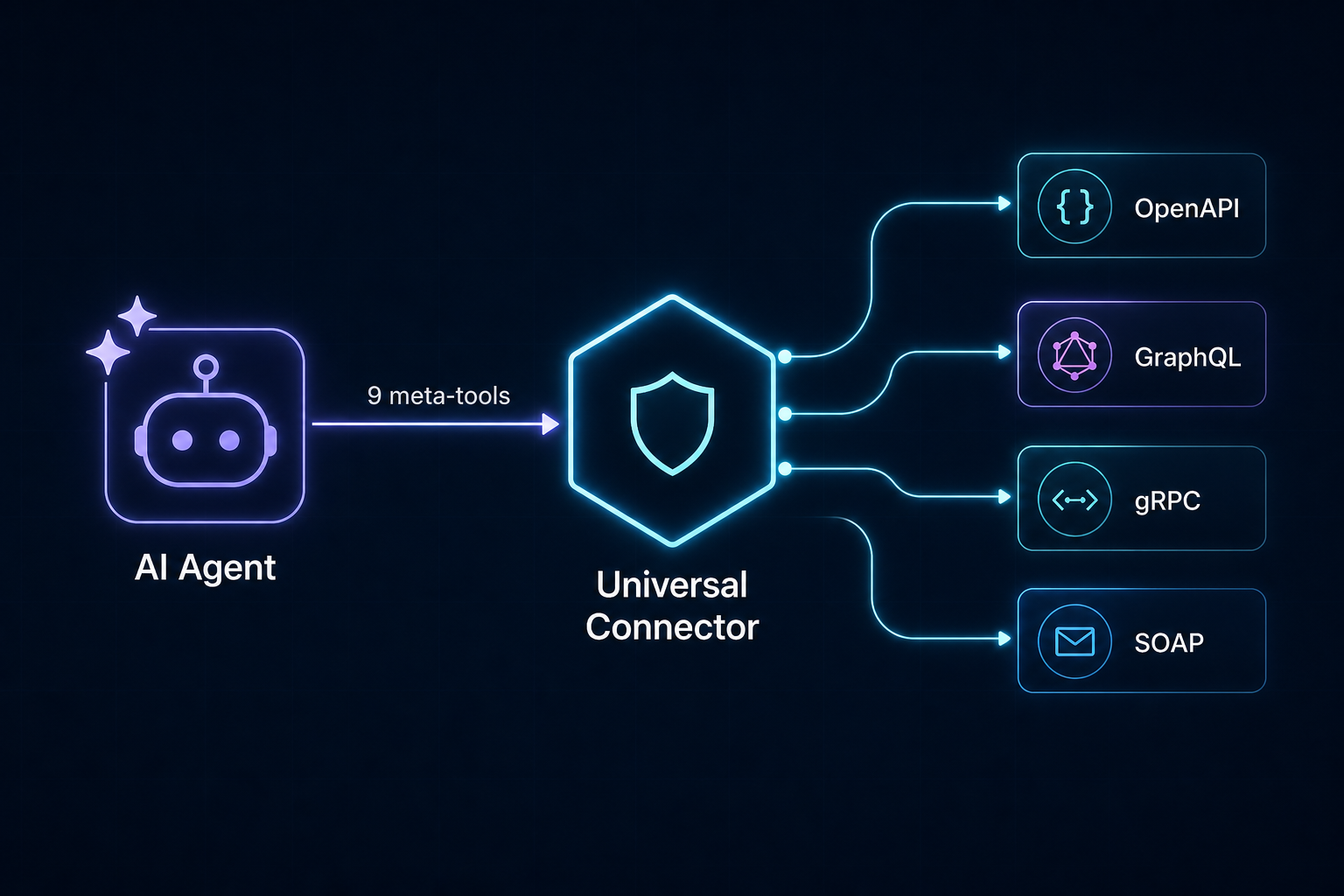
The agent explores APIs like a filesystem instead of loading hundreds of tools at once (which would blow up the context window on large APIs like Stripe). It searches for operations, inspects the ones it needs, then executes them.
flowchart TD
    Agent["AI Agent"] -->|"MCP stdio"| Server["FastMCP Server"]
    Server --> Tools["Meta-tools"]
    Tools --> Registry["Operation Registry (normalized)"]
    Adapters["Spec Adapters"] --> Registry
    Tools --> Guard["Security Guard"]
    Guard --> Executor["Protocol Executors"]
    Executor --> Auth["Auth Manager"]
    Executor --> UpstreamAPI["Upstream API"]
| Tool | Purpose |
|---|---|
search_catalog | Find ready-to-load public APIs (curated list + APIs.guru directory, 2500+ specs) |
load_api | Register an API from a spec URL/file (protocol auto-detected) |
list_apis | List loaded APIs |
search_operations | Fuzzy-search operations across loaded APIs |
get_operation | Full parameter/response schema for one operation |
execute | Call an operation (auth + security guard applied); extract returns only the fields you ask for |
execute_chained | Run a sequence of operations in one call, piping results between steps; nested lists run in parallel |
execute_graph | Run a dependency graph of operations; order is inferred from ${id.path} references and independent nodes run in parallel automatically |
unload_api | Remove a loaded API |
audit_log | Recent outbound calls (method, host, path, status) |
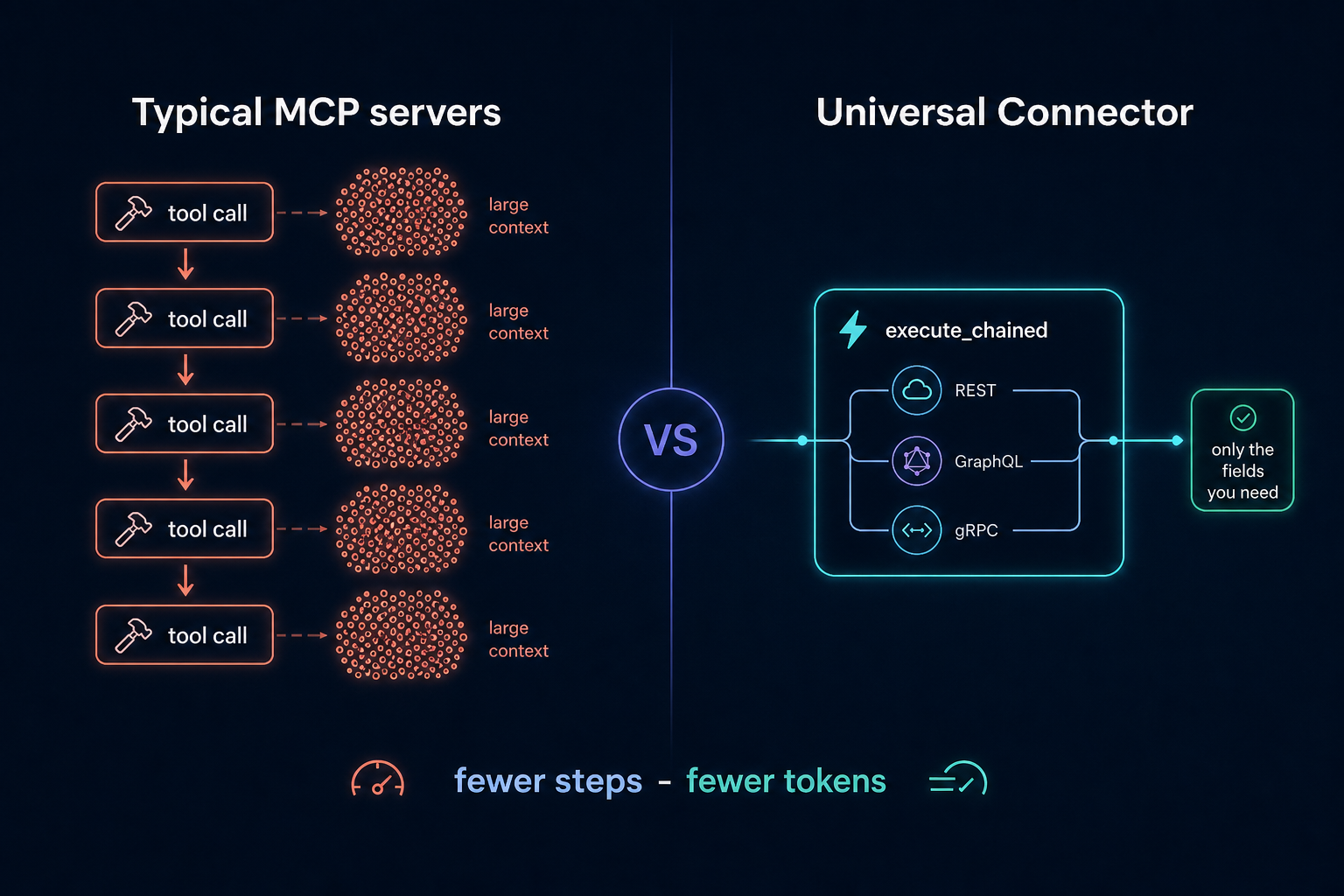
Where a per-API MCP server needs one tool round-trip per call - each returning a full JSON payload into the agent's context - this server collapses whole workflows:
extract - execute(..., extract=["items.*.name", "total_count"]) returns just those fields instead of a multi-kilobyte response. * fans out over arrays.execute_chained pipes step results into later params via ${save_as.path} references: one tool call instead of N.execute_chained(steps=[
[
{"operation_id": "github.repos_get", "params": {"owner": "o", "repo": "r"},
"save_as": "gh", "extract": ["stargazers_count"]},
{"operation_id": "open_meteo.get_v1_forecast", "params": {"latitude": 52.5, "longitude": 13.4},
"save_as": "weather", "extract": ["current_weather.temperature"]}
],
{"operation_id": "github.issues_list_for_repo",
"params": {"owner": "o", "repo": "r"}, "extract": ["*.title"]}
])
UCMCP_CACHE_TTL seconds (default 60), so repeated lookups are instant and free; pass fresh: true to bypass. Successful mutations invalidate that API's cached reads.You don't need to hunt for spec URLs. search_catalog searches two sources:
search_catalog(query="weather forecast")
  -> [{"name": "open_meteo", "spec": "https://...forecast.yml", "base_url": "https://api.open-meteo.com", ...}]
load_api(spec="https://...forecast.yml", name="open_meteo", base_url="https://api.open-meteo.com")
execute(operation_id="open_meteo.get_v1_forecast", params={"latitude": 52.52, "longitude": 13.41, "hourly": "temperature_2m"})
The catalog is discovery-only: it returns spec URLs, never loads or executes anything itself, so the security guard still applies to everything you load from it.
The server runs in any MCP host via uvx - no manual install needed, the package is fetched from PyPI automatically (add [all] for GraphQL/gRPC/SOAP support):
{
  "mcpServers": {
    "universal-connector": {
      "command": "uvx",
      "args": ["universal-connector-mcp"],
      "env": { "UCMCP_ALLOWED_HOSTS": "api.github.com" }
    }
  }
}
From source (development): pip install -e ".[all,dev]" and use "command": "universal-connector-mcp" instead. Extras: graphql, grpc, soap, keyring, all, dev; the core install supports OpenAPI/REST only.
One click via the badge above, or add the JSON block to .cursor/mcp.json in your project (shared with your team) or ~/.cursor/mcp.json (personal, all projects). See examples/mcp.json for a full config with credentials.
Add the same mcpServers block to claude_desktop_config.json (Settings > Developer > Edit Config).
claude mcp add universal-connector -- uvx universal-connector-mcp
Add the server under "servers" in .vscode/mcp.json:
{
  "servers": {
    "universal-connector": { "command": "uvx", "args": ["universal-connector-mcp"] }
  }
}
All major MCP hosts accept the same mcpServers block shown above in their respective config files (~/.codeium/windsurf/mcp_config.json, Cline's MCP settings, etc.).
AI agents installing this server for a user: follow llms-install.md.
Point UCMCP_APIS_CONFIG at a YAML file to auto-load APIs at startup - see examples/apis.example.yaml.
You never edit config files to manage APIs - just tell your agent:
list_apis shows them.unload_api removes it (and from the remembered state).When an API needs credentials, load_api tells the agent exactly which environment variable to set (e.g. STRIPE_API_KEY), whether it is already configured, and the agent relays copy-pasteable instructions - you add the variable to the env block of your MCP config and restart. Secrets are never typed into the chat.
The server remembers which APIs you loaded (their spec locations - never credentials or response data) in UCMCP_STATE_FILE and restores them automatically on the next start, so the agent can pick up right where it left off. Set UCMCP_STATE_FILE=off to disable.
| Protocol | Spec source | Notes |
|---|---|---|
| OpenAPI / Swagger | OpenAPI 3.x or Swagger 2.0 (JSON/YAML), URL/file/raw | Core install. Local $ref resolution, all HTTP methods. |
| GraphQL | Introspection JSON or SDL | pip install '.[graphql]'. Auto-generates selection sets; execute accepts a fields override. |
| gRPC | Server reflection (grpc://host:port) | pip install '.[grpc]'. Unary-unary methods; reflection must be enabled server-side. |
| SOAP | WSDL (URL/file/raw) | pip install '.[soap]'. One body object parameter per operation. |
Each loaded operation gets an id namespaced as <api>.<operation> (e.g. github.repos_get).
More walkthroughs (weather, GitHub with auth, GraphQL, parallel multi-API workflows, internal APIs): docs/EXAMPLES.md
search_catalog(query="github")
load_api(spec="https://raw.githubusercontent.com/github/rest-api-description/main/descriptions/api.github.com/api.github.com.json", name="github")
search_operations(query="list repositories for user", api="github")
get_operation(operation_id="github.repos_list_for_user")
execute(operation_id="github.repos_list_for_user", params={"username": "torvalds"},
        extract=["*.name", "*.stargazers_count"])
GraphQL with field selection:
load_api(spec="https://countries.trevorblades.com/", protocol="graphql", name="countries")
execute(operation_id="countries.country", params={"code": "US", "fields": "name capital currency"})
Chaining (feed one result into the next; wrap steps in a nested list to run them in parallel):
execute_chained(steps=[
  {"operation_id": "github.repos_list_for_user", "params": {"username": "torvalds"}, "save_as": "repos"},
  {"operation_id": "github.repos_get", "params": {"owner": "torvalds", "repo": "${repos.data.0.name}"},
   "extract": ["description", "stargazers_count"]}
])
All settings are environment variables prefixed with UCMCP_:
| Variable | Default | Description |
|---|---|---|
UCMCP_ALLOWED_HOSTS | (empty) | Comma-separated extra hosts allowed for outbound calls. Prefix with . for suffix matches. |
UCMCP_DENIED_HOSTS | (empty) | Comma-separated hosts always blocked (wins over allow). |
UCMCP_ALLOW_ALL_HOSTS | false | Disable the allowlist entirely (not recommended). Does not disable private-IP blocking. |
UCMCP_BLOCK_PRIVATE_IPS | true | Block outbound calls that resolve to private/loopback/link-local/cloud-metadata IPs (SSRF protection). |
UCMCP_MAX_REDIRECTS | 5 | Max HTTP redirects to follow; every hop is re-checked against the guard. |
UCMCP_MAX_RESPONSE_BYTES | 100000 | Response body cap sent back to the agent. |
UCMCP_HTTP_TIMEOUT | 30 | Per-request timeout (seconds). |
UCMCP_MAX_RETRIES | 2 | Retries on transient HTTP failures (429/502/503/504). |
UCMCP_CACHE_TTL | 60 | Seconds to cache successful GET/query responses (0 disables). |
UCMCP_AUDIT_ENABLED | true | Toggle audit logging. |
UCMCP_AUDIT_FILE | (none) | Append audit entries to this file (JSON lines). |
UCMCP_USE_KEYRING | false | Also resolve secrets from the OS keyring. |
UCMCP_APIS_CONFIG | (none) | Path to a YAML file of APIs to preload at startup. |
UCMCP_STATE_FILE | ~/.universal-connector-mcp/state.json | Where loaded APIs are remembered between restarts (spec locations only - never secrets or data). Set to off to disable. |
Credentials are looked up by convention from <API_NAME>_TOKEN, <API_NAME>_API_KEY, <API_NAME>_CLIENT_ID / <API_NAME>_CLIENT_SECRET (OAuth2 client credentials), etc.
pip install -e ".[all,dev]"
pytest          # run the test suite
ruff check .    # lint
The test suite (60+ tests) and lint run in CI on Ubuntu and Windows with Python 3.10 and 3.12 on every push (.github/workflows/ci.yml); tagging v* builds and publishes to PyPI via trusted publishing (.github/workflows/release.yml).
Contributions welcome - see CONTRIBUTING.md. Security reports go through private reporting.
Releases are automated: tagging v* publishes to PyPI via trusted publishing (see docs/RELEASING.md).
UCMCP_ALLOWED_HOSTS / UCMCP_DENIED_HOSTS.UCMCP_ALLOWED_HOSTS entry.MIT
FAQs
A security-first, local-first MCP server that connects any API (OpenAPI/GraphQL/gRPC/SOAP) to AI agents through a single normalized operation model.
We found that universal-connector-mcp demonstrated a healthy version release cadence and project activity because the last version was released less than a year ago. It has 1 open source maintainer collaborating on the project.
Did you know?

Socket for GitHub automatically highlights issues in each pull request and monitors the health of all your open source dependencies. Discover the contents of your packages and block harmful activity before you install or update your dependencies.
Company News
Socket is now in the AWS Security Hub Extended plan. Adopt it through AWS, apply committed spend, and block malicious open source packages.
Research
/Security News
Popular npm packages keyv and cacheable compromised.

Security News
A misconfiguration gave three Anthropic models internet access, and one, believing it was in a simulation, shipped a credential-stealing package to PyPI.