
Product
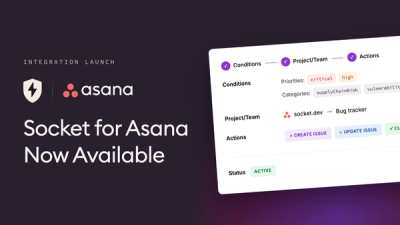
Socket for Asana Is Now Available
Create and manage Asana tasks directly from Socket alerts, with manual task creation, automated ticketing rules, and two-way sync.
By Jeppe Hasseriis - Aug 25, 2026
winrdp-mcp
Advanced tools
Zero-config MCP server to provision and fully administer any Windows RDP box (Win10/11/Server) — built for Claude & Claude Code.
A zero-config MCP server that provisions and fully administers any Windows RDP box — Windows 10/11 and Server 2016–2025 — for Claude and Claude Code.




You give it a host and admin credentials. It makes the box remotely manageable by itself — turning on WinRM, opening the Windows firewall, and fixing local-admin token filtering — regardless of the box's starting state or Windows version. Claude then gets 144 tools: shell, files, registry, services, processes, scheduled tasks, users, firewall, event logs, software, networking, live RDP control, screenshots, GUI automation, real UAC elevation, one-call health/security reports, and on-demand tool staging — plus 5 guided workflows (prompts) and live host resources.
Nothing is pre-installed on the target. The controller reaches boxes over WinRM / SSH / SMB from wherever Claude Code runs, and manages one box or a whole fleet from a single server.
provision_host climbs a ladder — WinRM → SSH → SMB/WMI cold-start → paste-once bootstrap — and makes a fresh, locked-down box manageable with no manual WinRM setup.SYSTEM Scheduled Task. as_user=True runs inside the interactive RDP desktop.readOnlyHint / destructiveHint safety annotations so MCP clients can gate destructive actions automatically. Narrow the surface to a focused set with a tool profile (WINRDP_PROFILE=admin|rdp|core).provision_and_harden, diagnose_box, security_audit, setup_dev_box, open_service_locally) turn a whole operation into one click, and resources (winrdp://hosts, winrdp://host/{alias}/info) hand the model the inventory and a live box summary without spending a tool call.run_python finds or installs Python, pip-installs deps, runs your code, and cleans up — same for Node, PowerShell, cmd, and batch. stage_tool pulls Sysinternals (or any URL/local file) onto the box mid-task.health_report (OS/CPU/RAM/disk/services/errors/updates/Defender in one read), apply_baseline (high-perf power plan, no sleep, long paths), whoami_priv, failed_logons, list_open_ports.| Mode | Command | Runs where | Reaches the box via |
|---|---|---|---|
| Controller (default) | winrdp-mcp serve | wherever Claude Code lives | WinRM / SSH / SMB+DCOM |
| Agent | winrdp-mcp agent | on the box itself | local PowerShell |
Both build the same server; python -m winrdp_mcp serve is equivalent to the console script.
Python 3.10+ on the operator machine (Windows, macOS, or Linux). Targets are Windows.
pipx install winrdp-mcp              # isolated, recommended — gives you the `winrdp-mcp` command
uvx winrdp-mcp serve                 # zero-install run via uv
pip install winrdp-mcp               # plain pip
Optional extras and a local dev checkout:
pip install "winrdp-mcp[bootstrap]"  # + impacket, for SMB/WMI cold-start of boxes with WinRM AND SSH off
pip install "winrdp-mcp[agent-ui]"   # + on-box interactive-desktop UI agent (click/type/OCR)
pip install -e ".[dev]"              # from a checkout of this repo (tests + ruff)
Claude Desktop, one click: grab winrdp-mcp.dxt from Releases and open it (Settings → Extensions → Install from file), or build it yourself with pwsh dxt/build.ps1.
Drop a project .mcp.json at your repo root:
{
  "mcpServers": {
    "winrdp": {
      "command": "winrdp-mcp",
      "args": ["serve"],
      "env": { "WINRDP_VAULT_KEY": "change-me", "WINRDP_PROFILE": "full" }
    }
  }
}
Or register from the CLI:
claude mcp add winrdp -- winrdp-mcp serve
Set WINRDP_VAULT_KEY to a strong passphrase — it encrypts stored credentials at rest (see Configuration). Set WINRDP_PROFILE to admin, rdp, or core to expose a focused tool set instead of all 144.
Ask Claude to run these tools (arguments shown inline). Every tool takes an optional host= alias; omit it to hit the active host.
add_host  alias="vps1"  host="203.0.113.10"  username="Administrator"  password="…"
provision_host                        # climbs the ladder → box is now manageable
system_info                           # OS, build, CPU, RAM, disks, IPs
run_powershell  script="Get-Service | Where Status -eq Running"
run_python  code="import platform; print(platform.platform())"
If the box has only RDP open, provision_host returns a bootstrap_oneliner to paste once into an RDP session — see Preparing a box.
144 tools across fifteen modules. The full catalog — every signature, parameter, default, and safety class — is in docs/TOOLS.md.
| Group | Module | # | What it covers |
|---|---|---|---|
| Hosts & Fleet | hosts.py | 8 | add_host, list_hosts, use_host, remove_host, test_host, provision_host, run_on_hosts (parallel fan-out), reboot_and_wait |
| Provisioning / UAC / Tooling | provisioning.py | 10 | enable_winrm, enable_ssh, run_elevated, uac_get/uac_set, stage_tool, stage_script, list_staged_tools, cleanup_staged, deploy_ui_agent |
| System | system.py | 8 | run_powershell, run_cmd, system_info, performance, event_log, screenshot, reboot, power_action |
| Scripting | scripting.py | 6 | run_python, run_python_file, pip_install, run_script (auto-interpreter), run_node, ensure_runtime |
| Files | files.py | 21 | list/read/write/search/upload/download/delete, make_dir, copy/move, file_hash, zip/unzip, ACL, download_file, tail_file, edit_file, sync_folder, transfer_between_hosts |
| Admin | admin.py | 25 | registry, services (service_control/service_create/service_delete), processes, scheduled tasks, users/groups, firewall, clipboard, event-log write/clear |
| RDP | rdp.py | 12 | rdp_status/rdp_enable/rdp_disable/rdp_set_port, sessions, disconnect/logoff, rdp_connect_to_console (tscon), rdp_connection_file, rdp_open, install_rdp_wrapper, rdp_allow_multiple_sessions |
| Software | software.py | 4 | install_software (winget/choco/MSI/EXE-url), uninstall_software, list_installed_software, ensure_package_manager |
| Network | network.py | 8 | net_info, ping, port_check, net_connections, port_proxy_add/list/delete (tunneling), set_dns |
| Windows | windows.py | 11 | cim_query (any WQL), windows_features, windows_update, hotfixes, Defender (status/realtime/exclusion_add/scan), env_get/env_set, list_startup |
| GUI | gui.py | 15 | windows/keyboard/mouse (send_keys, type_text, mouse_click, mouse_drag), UI Automation (ui_find/ui_invoke/ui_set_text), ocr_screen, find_and_click, wait_for_window, record_screen, gui_script |
| Waiters | waiters.py | 4 | wait_for_port, wait_for_service, wait_for_process, wait_for_file — block until a condition holds |
| Scheduling | scheduling.py | 4 | schedule_command, run_at_startup, persist_as_service (NSSM auto-restart), unpersist_service |
| Tunnel | tunnel.py | 3 | port_forward, port_forward_stop, port_forward_list — SSH local-forward a box's service to your machine |
| Ops | ops.py | 5 | health_report, apply_baseline, whoami_priv, failed_logons, list_open_ports — one-call health & security reads |
Safety classification across all 144: 49 read-only, 23 destructive, 72 mutating. Read-only tools are safe to auto-run; destructive tools carry destructiveHint=True so clients gate them behind confirmation.
Beyond tools, the server exposes MCP prompts (user-invoked, one-click operations that steer the model through the right tool sequence) and resources (bounded read-only context the client can hand the model for free):
| Kind | Name | What it does |
|---|---|---|
| Prompt | provision_and_harden(host, username, password, alias) | Bring a new box under management and lock it down, step by step |
| Prompt | diagnose_box(host) | Gather health evidence and give a prioritized root-cause summary |
| Prompt | security_audit(host) | Read-only posture review → risk-ranked findings + remediations |
| Prompt | setup_dev_box(host, runtimes) | Install runtimes/tools and verify a working dev environment |
| Prompt | open_service_locally(host, remote_port, note) | Reach a box's loopback service from your machine over an SSH tunnel |
| Resource | winrdp://hosts | The registered inventory (passwords redacted) + active host |
| Resource | winrdp://host/{alias}/info | A compact live summary of one box (OS, build, CPU/RAM, disks, uptime) |
WINRDP_PROFILE selects which modules to expose, so the model's tool list stays focused:
| Profile | Tools | Includes |
|---|---|---|
full (default) | 144 | everything |
admin | 117 | systems administration (no GUI/RDP-desktop, no bare tunnel) |
rdp | 104 | RDP + desktop/GUI focus |
core | 87 | the essential subset (hosts, provisioning, system, scripting, files, admin, ops, waiters) |
The controller needs the target reachable on one management transport. In the best case (WinRM already up) provision_host does everything. The only two things you may have to do by hand on a brand-new cloud box are:
Print the paste-once one-liner any time:
winrdp-mcp bootstrap # prints the -EncodedCommand one-liner + the readable script
Full walkthrough — provider-firewall specifics (AWS/Azure/GCP/Hetzner/…), the cold-start rungs, RDP hardening, verification, and a "new box in 3 minutes" runbook — in docs/PREPARE-SERVER.md.
provision_host tries the best rung first and stops at the first that works (winrdp_mcp/provision.py):
ADMIN$ and trigger it fire-and-forget over WMI ([bootstrap] extra), then switch to WinRM.bootstrap_oneliner to paste once; then everything is remote.The enable script opens the WinRM firewall rule, flips a Public network profile to Private, and sets LocalAccountTokenFilterPolicy=1 so a non-builtin local admin gets a full token over the network.
run_powershell  script="Stop-Service W3SVC"  elevated=true     # full unfiltered token
run_powershell  script="Add-Type -AssemblyName System.Windows.Forms; …"  as_user=true   # interactive RDP desktop
Over WinRM a full-token admin runs elevated=True directly (fast path); a filtered token (SSH / non-elevated local) falls back to a one-shot SYSTEM Scheduled Task. as_user=True runs inside the visible desktop session — needed for GUI, clipboard, and screenshots.
run_python  code="import psutil; print(psutil.cpu_percent())"  pip="psutil"   # auto-installs Python + psutil
run_script  content=<any code>  interpreter="auto"                            # python | node | powershell | cmd | vbscript
run_node    code="console.log(process.version)"
ensure_runtime  runtime="python"                                             # or "node"
run_python with ensure_python=True (default) locates Python or installs it detached (winget → choco → python.org), resolving the concrete python.exe by glob so it works the same session. Long installs run as a Scheduled Task and poll a done-marker, so a mid-install WinRM disconnect doesn't fail them.
add_host  alias="web1"  host="10.20.0.11"  username="Administrator"  password="…"  tags="prod,web"
run_on_hosts  script="(Get-CimInstance Win32_OperatingSystem).LastBootUpTime"  tag="prod"
run_on_hosts runs one script across many boxes concurrently (default max_parallel=8) and returns per-host {stdout, stderr, rc} keyed by alias. Select by aliases (CSV), by tag, or omit both to hit every box.
rdp_status                            # enabled? NLA? port? firewall?
rdp_enable  nla=true
rdp_sessions                          # id / user / state via qwinsta
screenshot                            # live RDP desktop as a PNG
rdp_open                              # launch mstsc pre-authenticated (operator = Windows)
rdp_connection_file generates a .rdp and stores the password via cmdkey on the operator machine — it is never returned to the model or written into the .rdp file. install_rdp_wrapper enables concurrent sessions on client SKUs.
stage_tool  source="psexec"                       # preset (Sysinternals), a URL, or a local file
stage_tool  source="https://example.com/tool.exe"
list_staged_tools
cleanup_staged
Presets: psexec, handle, procdump, autoruns, tcpview, pslist, accesschk, sigcheck. Everything caches under C:\ProgramData\winrdp-mcp\tools; URLs and presets download on the box, local files are uploaded.
All configuration is via environment variables (set them in the env block of your .mcp.json).
| Variable | Purpose |
|---|---|
WINRDP_VAULT_KEY | Passphrase (or raw Fernet key) that encrypts stored passwords. A passphrase is SHA-256-derived into a key. If unset, a machine-local vault.key (owner-only) is generated. Set it. |
WINRDP_HOME | Override the data directory holding inventory.json and vault.key (default %APPDATA%\winrdp-mcp). |
WINRDP_DEBUG | 1/true/yes → verbose DEBUG logging to stderr (equivalent to --debug). |
WINRDP_PROFILE | Tool profile to expose: full (default, 144), admin (117), rdp (104), or core (87). |
WINRDP_ENABLED_TOOLS | CSV allowlist — if set, only these tools are registered. |
WINRDP_DISABLED_TOOLS | CSV blocklist — these tools are skipped (e.g. reboot,file_delete). |
WINRDP_WINRM_OP_TIMEOUT | WinRM per-operation timeout in seconds (default 180; read timeout is derived as +30). |
Logging goes to stderr only — on the stdio transport, stdout is the MCP JSON-RPC channel. Known secrets are redacted from logs by exact match plus structural patterns.
winrdp-mcp is admin tooling for boxes you own or are authorized to manage. It is a remote code-execution surface by design.
winrm_cert_validation="ignore" and ssh_host_key_policy="auto" (trust-on-first-use). On an untrusted network this allows an on-path attacker to MITM. For production, register with add_host(..., use_ssl=true, winrm_port=5986, winrm_cert_validation="validate", ssh_host_key_policy="reject") and restrict the firewall to your operator IP.winrm_auth="ntlm" seals the message body even without TLS. The enable script deliberately does not turn on Basic/AllowUnencrypted/TrustedHosts=* (0.1.1+) — NTLM needs none of them, and they'd only weaken the box.user_create / service_create stage the new password to an admin-only file read on the box (kept off the process command line / Event 4688); cmdkey stores the RDP password on the operator machine. None are ever returned to the model, and logs redact known secrets.WINRDP_ENABLED_TOOLS / WINRDP_DISABLED_TOOLS, and keep destructive-action confirmation on in your client.Full threat model, credential-vault internals, log redaction, argument-injection defenses, and a hardening checklist: docs/SECURITY.md.
| Doc | Contents |
|---|---|
| docs/PREPARE-SERVER.md | Taking a fresh cloud/VDS/dedicated box from locked-down to managed: provider firewalls, cold-start options, RDP hardening, verification, sizing. |
| docs/PRODUCTION.md | Running safely at scale: install options, vault, transport hardening, allow/block lists, observability, reliability, fleet management, background-service setup, checklist. |
| docs/SECURITY.md | Threat model, trust boundary, credential handling, transport/MITM, the enable-WinRM script, argument-injection defense, hardening checklist. |
| docs/TROUBLESHOOTING.md | Symptom → cause → fix for the failure modes you actually hit (provision failures, connection drops, slow elevation, Python/Node install, SSH banner, 5986 certs, MCP registration). |
| docs/ARCHITECTURE.md | Internal map for contributors: transports → PowerShell marshaling → provisioning → elevation → context → vault → tooling → server assembly. |
| docs/TOOLS.md | The complete reference for all 144 tools — signatures, parameters, defaults, and safety class. |
winrdp-mcp is a FastMCP server: tools call a shared Context that resolves the target host from an encrypted vault, hands the PowerShell body to a cached Transport (WinRM / SSH / Local / SMB+WMI), and marshals delimited JSON back — nothing above the transport layer knows how the command reached the box. Full internals in docs/ARCHITECTURE.md.
Built on and gratefully crediting two MIT-licensed projects — see NOTICE:
deploy_ui_agent interactive-desktop path.winrdp-mcp's own additions: the zero-config provisioning ladder, real UAC/elevation via one-shot Scheduled Tasks, on-demand tool staging, the encrypted multi-host inventory, and first-class RDP control.
FAQs
Zero-config MCP server to provision and fully administer any Windows RDP box (Win10/11/Server) — built for Claude & Claude Code.
The pypi package winrdp-mcp receives a total of 65 weekly downloads. As such, winrdp-mcp popularity was classified as not popular.
We found that winrdp-mcp demonstrated a healthy version release cadence and project activity because the last version was released less than a year ago. It has 1 open source maintainer collaborating on the project.
Product
Create and manage Asana tasks directly from Socket alerts, with manual task creation, automated ticketing rules, and two-way sync.

Security News
Open VSX has removed three extension IDs from its malicious-extension list as the legitimate publishers they impersonated move to claim the names for themselves.

Product
Socket’s PHP and Composer support is now in Beta for all customers, with PHP reachability analysis generally available.