
Product
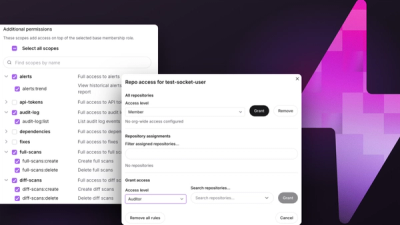
Introducing Repository Access Permissions and Custom Roles
Socket now supports Custom Roles and Repository Access Permissions so organizations can control who can access specific repositories and actions.
By Joe Werle - Jun 19, 2026
@agentick/react
Advanced tools
React bindings for Agentick. Provides hooks around @agentick/client for building chat interfaces and real-time AI applications.
pnpm add @agentick/react
import { AgentickProvider, useSession, useStreamingText, useContextInfo } from "@agentick/react";

function Chat() {
  const { send } = useSession({ sessionId: "my-session", autoSubscribe: true });
  const { text, isStreaming } = useStreamingText();
  const { contextInfo } = useContextInfo();

  return (
    <div>
      <div className="response">
        {text}
        {isStreaming && <span className="cursor">|</span>}
      </div>

      {contextInfo && (
        <div className="context-bar">
          <span>{contextInfo.modelName}</span>
          <span>{contextInfo.utilization?.toFixed(1)}% context used</span>
        </div>
      )}

      <button onClick={() => send("Hello!")}>Send</button>
    </div>
  );
}

export function App() {
  return (
    <AgentickProvider clientConfig={{ baseUrl: "/api" }}>
      <Chat />
    </AgentickProvider>
  );
}
useSession(options?)Session management hook. Returns methods for sending messages and managing subscriptions.
const {
  sessionId, // Current session ID
  isSubscribed, // Whether subscribed to session events
  subscribe, // Subscribe to session events
  unsubscribe, // Unsubscribe from session events
  send, // Send a message
  abort, // Abort current execution
  close, // Close the session
  accessor, // Direct SessionAccessor for advanced use
} = useSession({
  sessionId: "my-session", // Optional - creates ephemeral session if omitted
  autoSubscribe: true, // Auto-subscribe on mount
});

// Send a simple text message
await send("Hello!");

// Send with full message structure
await send({
  message: {
    role: "user",
    content: [{ type: "text", text: "Hello!" }],
  },
});
useStreamingText(options?)Subscribe to streaming text from model responses. Automatically accumulates text deltas.
const {
  text, // Accumulated text from current response
  isStreaming, // Whether currently receiving text
  clear, // Clear accumulated text
} = useStreamingText({
  enabled: true, // Enable/disable subscription
});

// Display with typing indicator
<div>
  {text}
  {isStreaming && <span className="cursor">|</span>}
</div>;
useContextInfo(options?)Subscribe to context utilization information. Updated after each model response with token usage and model capabilities.
const {
  contextInfo, // Latest context info (null before first response)
  clear, // Clear context info
} = useContextInfo({
  sessionId: "my-session", // Optional - filter by session
  enabled: true, // Enable/disable subscription
});

if (contextInfo) {
  console.log(contextInfo.modelId); // "gpt-4o" | "claude-3-5-sonnet" | etc.
  console.log(contextInfo.modelName); // Human-readable name
  console.log(contextInfo.provider); // "openai" | "anthropic" | etc.
  console.log(contextInfo.contextWindow); // Total context window size
  console.log(contextInfo.inputTokens); // Input tokens this tick
  console.log(contextInfo.outputTokens); // Output tokens this tick
  console.log(contextInfo.totalTokens); // Total tokens this tick
  console.log(contextInfo.utilization); // Context utilization % (0-100)
  console.log(contextInfo.maxOutputTokens); // Max output tokens for model
  console.log(contextInfo.supportsVision); // Model supports vision
  console.log(contextInfo.supportsToolUse); // Model supports tools
  console.log(contextInfo.isReasoningModel); // Extended thinking model

  // Cumulative usage across all ticks in execution
  console.log(contextInfo.cumulativeUsage?.inputTokens);
  console.log(contextInfo.cumulativeUsage?.outputTokens);
  console.log(contextInfo.cumulativeUsage?.ticks);
}
interface ContextInfo {
  modelId: string; // Model identifier (e.g., "gpt-4o")
  modelName?: string; // Human-readable name
  provider?: string; // Provider name
  contextWindow?: number; // Context window size in tokens
  inputTokens: number; // Input tokens this tick
  outputTokens: number; // Output tokens this tick
  totalTokens: number; // Total tokens this tick
  utilization?: number; // Context utilization % (0-100)
  maxOutputTokens?: number; // Max output tokens
  supportsVision?: boolean; // Vision capability
  supportsToolUse?: boolean; // Tool use capability
  isReasoningModel?: boolean; // Extended thinking capability
  tick: number; // Current tick number
  cumulativeUsage?: {
    inputTokens: number;
    outputTokens: number;
    totalTokens: number;
    ticks: number;
  };
}
useEvents(options?)Subscribe to raw stream events. Use for advanced event handling.
const {
  event, // Latest event
  clear, // Clear current event
} = useEvents({
  sessionId: "my-session", // Optional - filter by session
  filter: ["tool_call", "tool_result"], // Optional - filter by event type
  enabled: true,
});

useEffect(() => {
  if (event?.type === "tool_call") {
    console.log("Tool called:", event.name);
  }
}, [event]);
useConnection()Connection state for the SSE transport.
const {
  state, // "disconnected" | "connecting" | "connected"
  isConnected, // Convenience boolean
  isConnecting, // Convenience boolean
} = useConnection();

<div className={`status ${isConnected ? "online" : "offline"}`}>
  {isConnected ? "Connected" : "Disconnected"}
</div>;
useConnectionState()Alias for useConnection(). Returns just the connection state string.
const state = useConnectionState(); // "disconnected" | "connecting" | "connected"
useClient()Direct access to the underlying AgentickClient for advanced use cases.
const client = useClient();

// Direct client access
const session = client.session("my-session");
const channel = session.channel("custom");
channel.publish("event", { data: "value" });
AgentickProviderWraps your app to provide the Agentick client context.
<AgentickProvider
  clientConfig={{
    baseUrl: "https://api.example.com", // Required - API base URL
    token: "auth-token", // Optional - auth token
  }}
>
  <App />
</AgentickProvider>
All hooks are fully typed. Import types from the package:
import type {
  // Provider types
  AgentickProviderProps,
  AgentickContextValue,
  TransportConfig,

  // Hook types
  UseConnectionOptions,
  UseConnectionResult,
  UseSessionOptions,
  UseSessionResult,
  UseEventsOptions,
  UseEventsResult,
  UseStreamingTextOptions,
  UseStreamingTextResult,
  UseContextInfoOptions,
  UseContextInfoResult,
  ContextInfo,

  // Re-exported from @agentick/client
  AgentickClient,
  ConnectionState,
  StreamEvent,
  SessionAccessor,
  SendInput,
  ClientExecutionHandle,
  SessionStreamEvent,
  ClientTransport,
} from "@agentick/react";
MIT
FAQs
React hooks and components for Agentick applications
The npm package @agentick/react receives a total of 259 weekly downloads. As such, @agentick/react popularity was classified as not popular.
We found that @agentick/react demonstrated a healthy version release cadence and project activity because the last version was released less than a year ago. It has 2 open source maintainers collaborating on the project.
Did you know?

Socket for GitHub automatically highlights issues in each pull request and monitors the health of all your open source dependencies. Discover the contents of your packages and block harmful activity before you install or update your dependencies.
Product
Socket now supports Custom Roles and Repository Access Permissions so organizations can control who can access specific repositories and actions.
Product
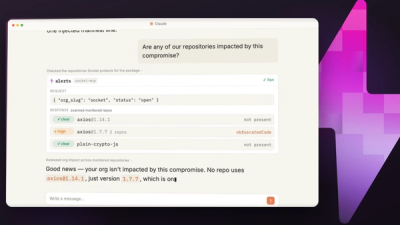
Socket MCP now lets AI assistants review org alerts, investigate threats using the Socket threat feed, and inspect package files in addition to dependency scoring.
Product
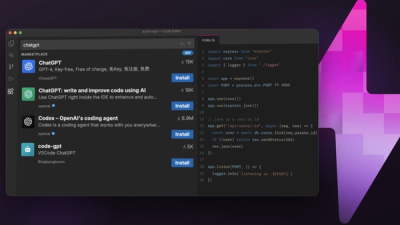
Socket Firewall blocks malicious VS Code and Open VSX extensions before install, protecting developers from compromised editor marketplaces.