
Product
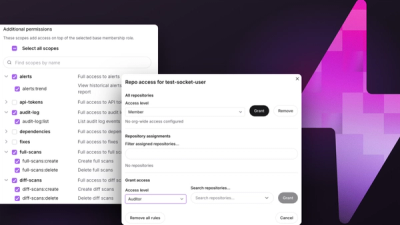
Introducing Repository Access Permissions and Custom Roles
Socket now supports Custom Roles and Repository Access Permissions so organizations can control who can access specific repositories and actions.
By Joe Werle - Jun 19, 2026
@airlst/live-event-qanda-queue-manager
Advanced tools
This component provides queue functionality with pre-configured AirLST styles.
Install it as package using either yarn or npm:
yarn add @airlst/live-event-qanda-queue-manager
// or
npm install @airlst/live-event-qanda-queue-manager
Import chat styles to your project's styles
@import '@airlst/live-event-qanda-queue-manager/dist/chat.css';
Additionally, you also need to install @airlst/live-events-headless-components package:
yarn add @airlst/live-events-headless-components
// or
npm install @airlst/live-events-headless-components
Import component in any page you want to use chat component.
Queue manager includes 3 components
This component is used to apply AirLST specific styles to queue manager with a header, footer and content sections.
To use it, you need to create a new layout file in Nuxt.js project in /layouts file, like /layouts/airlst.vue and import it
Important: Because queue manager components are still part of headless components, they require to be wrapper inside
BaseComponentfrom headless component. Since we are using dedicated layout file, it is a good practice to wrapper whole layout withinBaseComponent.
Component requires single profile property. This is an object used to display queue manager's profile information. If you use BaseComponent on the same page/layout, it already exposes profile slot property, you can pass it down to Layout component.
Layout header includes "Logout" button. When clicked it fires logout event. You need to catch this event to logout current user.
<template>
  <div>
    <base-component v-slot="{ profile }">
      <layout :profile="profile" @logout="logout">
        <Nuxt />
      </layout>
    </base-component>
  </div>
</template>

<script>
import BaseComponent from '@airlst/live-events-headless-components'
import { Layout } from '@airlst/live-event-qanda-queue-manager'

export default {
  components: {
    BaseComponent,
    Layout
  },
  methods: {
    logout() {
      // do logout logic here
      // for example, remove auth token and redirect user to login page
    },
  }
}
</script>
This component is used to display all queue items (pending, satisfied, declined). To use it, simply create a page, for example in /pages/queue/index.vue and import it.
You need to instruct the page to use your dedicated layout page.
Queue manager components need to have alias. If you don't pass an alias, default "default" alias will be used.
<template>
  <div>
      <queue alias="my-queue" />
  </div>
</template>

<script>
import { Queue } from '@airlst/live-event-qanda-queue-manager'

export default {
  components: {
    Queue
  },
  layout: 'airlst'
}
</script>
This component is used to single queue item. To use it, simply create a page, for example in /pages/queue/_id.vue and import it.
You need to instruct the page to use your dedicated layout page.
Queue manager components need to have alias. If you don't pass an alias, default "default" alias will be used.
Because this component needs to load and interact with single queue item, you need to pass queue ID to it. If you use Nuxt.js's dynamic pages, you can get queue ID from URI parameter.
<template>
  <div>
      <queue-item alias="my-queue" :queue-id="queueId" />
  </div>
</template>

<script>
import { QueueItem } from '@airlst/live-event-qanda-queue-manager'

export default {
  components: {
    QueueItem
  },
  layout: 'airlst',
  computed: {
    queueId() {
      return parseInt(this.$route.params.id)
    }
  }
}
</script>
FAQs
Q&A queue manager for Live Events
The npm package @airlst/live-event-qanda-queue-manager receives a total of 5 weekly downloads. As such, @airlst/live-event-qanda-queue-manager popularity was classified as not popular.
We found that @airlst/live-event-qanda-queue-manager demonstrated a not healthy version release cadence and project activity because the last version was released a year ago. It has 6 open source maintainers collaborating on the project.
Did you know?

Socket for GitHub automatically highlights issues in each pull request and monitors the health of all your open source dependencies. Discover the contents of your packages and block harmful activity before you install or update your dependencies.
Product
Socket now supports Custom Roles and Repository Access Permissions so organizations can control who can access specific repositories and actions.
Product
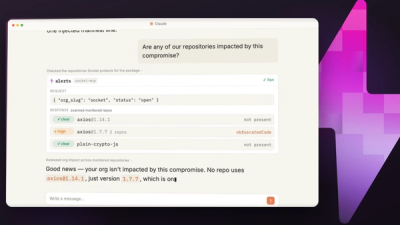
Socket MCP now lets AI assistants review org alerts, investigate threats using the Socket threat feed, and inspect package files in addition to dependency scoring.
Product
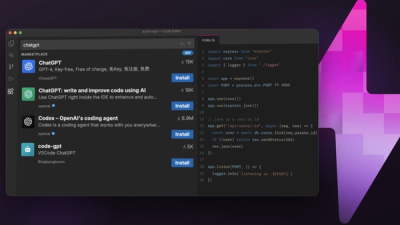
Socket Firewall blocks malicious VS Code and Open VSX extensions before install, protecting developers from compromised editor marketplaces.