
Product
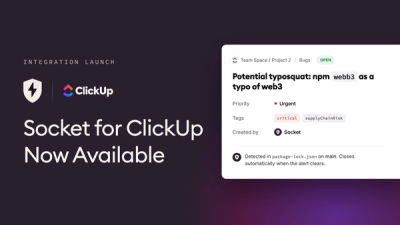
Socket for ClickUp Is Now Available
Create ClickUp tasks from Socket alerts, automate ticketing with custom rules, and keep alert and task status synchronized.
By Jeppe Hasseriis - Aug 26, 2026
@appium/base-driver
Advanced tools
Base class for creating other Appium drivers


This is the parent class that all Appium drivers inherit from. This driver should not be installed directly as it does nothing on its own. Instead, you should extend this driver when creating your own Appium drivers. Check out the Building Drivers documentation for more details.
Apache-2.0
WebdriverIO is a popular automation framework that provides a high-level API for interacting with WebDriver servers. Unlike @appium/base-driver, which is focused on creating custom drivers, WebdriverIO is designed for writing and running tests.
Selenium WebDriver is a widely-used library for browser automation. It provides a set of bindings for various programming languages to interact with WebDriver servers. While @appium/base-driver is focused on creating custom drivers, Selenium WebDriver is aimed at end-users writing automation scripts.
The 'wd' package is a Node.js client for WebDriver/Selenium. It provides a promise-based API for interacting with WebDriver servers. Unlike @appium/base-driver, which is for creating drivers, 'wd' is for writing automation scripts.
FAQs
Base driver class for Appium drivers
The npm package @appium/base-driver receives a total of 1,011,823 weekly downloads. As such, @appium/base-driver popularity was classified as popular.
We found that @appium/base-driver demonstrated a healthy version release cadence and project activity because the last version was released less than a year ago. It has 3 open source maintainers collaborating on the project.
Product
Create ClickUp tasks from Socket alerts, automate ticketing with custom rules, and keep alert and task status synchronized.

Product
Create and manage Asana tasks directly from Socket alerts, with manual task creation, automated ticketing rules, and two-way sync.

Security News
Open VSX has removed three extension IDs from its malicious-extension list as the legitimate publishers they impersonated move to claim the names for themselves.