
Product
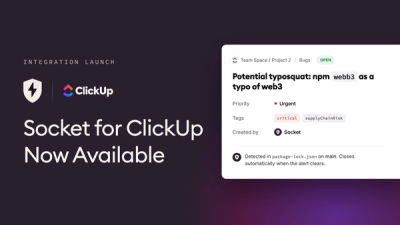
Socket for ClickUp Is Now Available
Create ClickUp tasks from Socket alerts, automate ticketing with custom rules, and keep alert and task status synchronized.
By Jeppe Hasseriis - Aug 26, 2026
@bolthub/agent
Advanced tools
L402 client for AI agents — pay Lightning invoices automatically to access paywalled APIs
L402 client for AI agents. Automatically handles 402 Payment Required challenges, pays Lightning invoices, and retries requests with proof of payment.
npm install @bolthub/agent
import { L402Client, LndWallet } from "@bolthub/agent";

const wallet = new LndWallet({
  host: "https://your-lnd-node:8080",
  macaroon: "0201036c6e...",
});

const client = new L402Client({
  wallet,
  maxPerRequestSats: 100,
  budgetSats: 10_000,
});

const resp = await client.get(
  "https://acme.gw.bolthub.ai/v1/weather",
  { params: { city: "berlin" } }
);
const data = await resp.json();
import { LndWallet } from "@bolthub/agent";

const wallet = new LndWallet({
  host: "https://your-lnd-node:8080",
  macaroon: "admin-macaroon-hex",
  timeoutSeconds: 30,
});
import { LnbitsWallet } from "@bolthub/agent";

const wallet = new LnbitsWallet({
  url: "https://lnbits.example.com",
  adminKey: "your-admin-key",
});
import { NwcWallet } from "@bolthub/agent";

const wallet = new NwcWallet(nwcConnection);
Implement the WalletAdapter interface:
import type { WalletAdapter } from "@bolthub/agent";

const myWallet: WalletAdapter = {
  async payInvoice(bolt11: string) {
    const preimage = await myPaymentLogic(bolt11);
    return { preimage };
  },
};
const client = new L402Client({
  wallet,
  maxPerRequestSats: 100,   // reject invoices over 100 sats
  budgetSats: 10_000,        // total spending cap
});

console.log(client.totalSpent);      // sats spent so far
console.log(client.remainingBudget); // sats remaining
The price of each invoice is determined from the response body (amountSats),
the BOLT11 invoice itself, or an optional priceHeader. If it still cannot be
determined, onUnknownAmount controls what happens — by default ("cap") the
client pays only up to maxPerRequestSats and refuses outright if no ceiling is
set, so a price-less challenge is never paid blind. Use "refuse" to always
refuse, or "allow" for the legacy pay-blind behaviour. Budget accounting is
also concurrency-safe: requests issued together (e.g. via Promise.all) can
never overspend.
By default sessions are kept in memory. Use FileSessionStore to persist
tokens across process restarts (stored in ~/.bolthub/sessions.json):
import { L402Client, LndWallet, FileSessionStore } from "@bolthub/agent";

const client = new L402Client({
  wallet: new LndWallet({ host, macaroon }),
  sessionStore: new FileSessionStore(),
});
| Export | Description |
|---|---|
L402Client | HTTP client with automatic L402 challenge handling |
LndWallet | Wallet adapter for LND REST API |
LnbitsWallet | Wallet adapter for LNbits |
PhoenixdWallet | Wallet adapter for Phoenixd |
NwcWallet | Wallet adapter for Nostr Wallet Connect |
WebLnWallet | Browser-only wallet via the WebLN provider |
isWebLnAvailable() | Check if a WebLN provider exists |
FileSessionStore | Disk-backed session token persistence |
createL402Client() | Shorthand factory for L402Client |
WalletAdapter | Interface to implement for custom wallets |
L402Error | Base error class for L402 failures |
L402BudgetError | Thrown when budget limits are exceeded |
L402PaymentError | Thrown when the wallet fails to pay |
L402TimeoutError | Thrown when a request times out |
MIT
FAQs
L402 client for AI agents — pay Lightning invoices automatically to access paywalled APIs
The npm package @bolthub/agent receives a total of 9 weekly downloads. As such, @bolthub/agent popularity was classified as not popular.
We found that @bolthub/agent demonstrated a healthy version release cadence and project activity because the last version was released less than a year ago. It has 1 open source maintainer collaborating on the project.
Product
Create ClickUp tasks from Socket alerts, automate ticketing with custom rules, and keep alert and task status synchronized.
Product
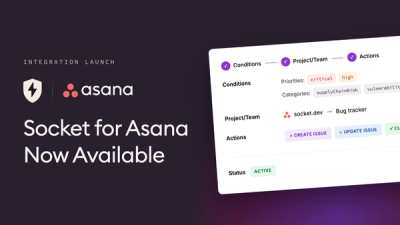
Create and manage Asana tasks directly from Socket alerts, with manual task creation, automated ticketing rules, and two-way sync.

Security News
Open VSX has removed three extension IDs from its malicious-extension list as the legitimate publishers they impersonated move to claim the names for themselves.