
Product
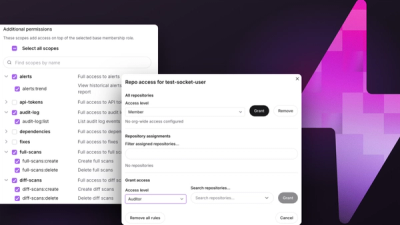
Introducing Repository Access Permissions and Custom Roles
Socket now supports Custom Roles and Repository Access Permissions so organizations can control who can access specific repositories and actions.
By Joe Werle - Jun 19, 2026
@cantoo/capacitor-http-server
Advanced tools
Capacitor plugin exposing a local HTTP server on iOS and Android with routing delegated to JavaScript.
A generic Capacitor plugin that exposes a local HTTP server on iOS and Android with routing delegated to JavaScript.
The plugin has no business logic. It only handles the transport layer:
it starts a listener, hands every incoming request to JavaScript via a
request event, and writes back whatever JavaScript returns through
respond(). This keeps your app code — authentication, routing, payloads,
CORS policy — entirely in TypeScript, where it can be tested, updated from
a hot-reload bundle, and shared across platforms.
npm install @cantoo-scribe/capacitor-http-server
npx cap sync
The plugin ships all required permissions in its manifest:
INTERNET, ACCESS_NETWORK_STATE, ACCESS_WIFI_STATEFOREGROUND_SERVICE and FOREGROUND_SERVICE_DATA_SYNC (API 34+)POST_NOTIFICATIONS (API 33+)The server runs inside a foreground service with type dataSync, so it
survives the screen being locked. On Android 13+ the system requires a
visible notification, hence POST_NOTIFICATIONS. If the user declines the
permission, the server still starts but the system is free to kill the
process at any moment. The plugin requests the permission automatically
on the first start() call.
You must supply android.notificationTitle and android.notificationText
when starting the server:
await HttpServer.start({
  android: {
    notificationTitle: 'My App',
    notificationText: 'Local server is running.',
    smallIconResourceName: 'ic_notification', // res/drawable/ic_notification.png
    channelId: 'my_app_http',
    channelName: 'Local HTTP server',
  },
});
Add the following keys to your app's Info.plist:
<key>NSLocalNetworkUsageDescription</key>
<string>Used to expose a local server for sharing files across devices on this network.</string>

<!-- Optional. Only needed if you broadcast your server over Bonjour. -->
<key>NSBonjourServices</key>
<array>
  <string>_myservice._tcp</string>
</array>
Without NSLocalNetworkUsageDescription, iOS 14+ silently drops every
incoming connection from other devices.
Note: iOS does not allow long-running HTTP servers in background. The plugin requests a short background task on app backgrounding, then emits a
server-errorevent withfatal: truewhen the window expires. Restart the server onUIApplication.didBecomeActive.
A complete, 20-line echo server that returns exactly what it received:
import { HttpServer } from '@cantoo-scribe/capacitor-http-server';

await HttpServer.addListener('request', async (req) => {
  await HttpServer.respond({
    requestId: req.requestId,
    status: 200,
    headers: { 'content-type': req.headers['content-type'] ?? 'text/plain' },
    ...(req.bodyText !== undefined && { bodyText: req.bodyText }),
    ...(req.bodyBase64 !== undefined && { bodyBase64: req.bodyBase64 }),
    ...(req.bodyFilePath !== undefined && { bodyFilePath: req.bodyFilePath }),
  });
});

const { url } = await HttpServer.start({
  android: {
    notificationTitle: 'Echo server',
    notificationText: 'Listening for requests',
  },
});
console.log('Listening at', url);
Test it from a laptop on the same network:
curl http://<device-ip>:<port>/ -d 'hello'
# hello
HttpServer.addListener('server-error', ({ message, fatal }) => {
  console.warn('Server error:', message, 'fatal:', fatal);
  if (fatal) {
    // On iOS the server dies in background; restart on foreground.
  }
});
HttpServer.addListener('request', async (req) => {
  if (req.path === '/big.bin') {
    await HttpServer.respond({
      requestId: req.requestId,
      status: 200,
      headers: { 'content-type': 'application/octet-stream' },
      bodyFilePath: '/absolute/path/to/file.bin', // streamed, no RAM spike
    });
  } else {
    await HttpServer.respond({ requestId: req.requestId, status: 404 });
  }
});
Bodies above fileBodyThresholdBytes (default 1 MB) are streamed to a
temp file managed by the plugin. JavaScript receives the absolute path
via bodyFilePath and is free to move, hash, or re-stream it. The plugin
deletes the temp file automatically once respond() returns.
start(...)stop()respond(...)addListener('request', ...)addListener('server-error', ...)removeAllListeners()start(options?: StartOptions | undefined) => any
Start the local HTTP server. Picks a free port if port is omitted.
On Android, starts a foreground service so the server survives screen lock.
Throws if the server is already running with a different configuration,
or if required permissions are missing.
| Param | Type |
|---|---|
options | StartOptions |
Returns: any
stop() => any
Stop the server and release all resources (port, threads, temp files, service). Safe to call when already stopped.
Returns: any
respond(response: HttpResponse) => any
Reply to a request previously received via the request event.
The plugin looks up requestId, writes the response, and cleans up any
temporary body file. Calling respond twice for the same requestId is a
no-op on the second call. Unanswered requests time out (504) after 60 s.
| Param | Type |
|---|---|
response | HttpResponse |
Returns: any
addListener(eventName: 'request', listener: (event: HttpRequestEvent) => void) => Promise<PluginListenerHandle> & PluginListenerHandle
Subscribe to incoming HTTP requests. Every accepted request fires exactly
one request event; JS is expected to call respond exactly once per
event.
| Param | Type |
|---|---|
eventName | 'request' |
listener | (event: HttpRequestEvent) => void |
Returns: any
addListener(eventName: 'server-error', listener: (event: ServerErrorEvent) => void) => Promise<PluginListenerHandle> & PluginListenerHandle
Subscribe to server-level errors that are not tied to a specific request
(e.g. the underlying socket died, port was stolen, permission revoked).
The server is considered dead when this fires with fatal: true.
| Param | Type |
|---|---|
eventName | 'server-error' |
listener | (event: ServerErrorEvent) => void |
Returns: any
removeAllListeners() => any
Remove every listener registered on this plugin.
Returns: any
| Prop | Type | Description |
|---|---|---|
port | number | If omitted or 0, the OS picks a free port in the dynamic range. |
maxBodyBytes | number | Max request body size in bytes. Bodies above this return 413. Default: 50 * 1024 * 1024 (50 MB). |
fileBodyThresholdBytes | number | Threshold above which the plugin stores the body in a temp file and exposes it via bodyFilePath instead of bodyBase64. Default: 1 * 1024 * 1024 (1 MB). |
android | StartOptionsAndroid | Android only. Title / text / small icon used by the foreground service notification (mandatory on Android 13+). Ignored on iOS. |
| Prop | Type | Description |
|---|---|---|
notificationTitle | string | Foreground-service notification title. Required on Android 13+. |
notificationText | string | Foreground-service notification body text. |
smallIconResourceName | string | Android drawable resource name, e.g. "ic_notification". |
channelId | string | Notification channel ID. Plugin creates the channel if missing. |
channelName | string | Notification channel display name. |
| Prop | Type | Description |
|---|---|---|
port | number | Chosen port (same as options.port when provided). |
url | string | Full URL, e.g. "http://192.168.1.42:49281". Empty string when no LAN-reachable interface was found (e.g. cellular only). The server is still listening on the port, but cannot be reached by a peer LAN device. A server-error event with fatal: false is emitted in that case so consumers can warn the user. |
localIp | string | Primary LAN IPv4. Empty string when no LAN-reachable interface was found. See url. |
| Prop | Type | Description |
|---|---|---|
data | any | Additional data received with the Http response. |
status | number | The status code received from the Http response. |
headers | HttpHeaders | The headers received from the Http response. |
url | string | The response URL received from the Http response. |
| Prop | Type | Description |
|---|---|---|
requestId | string | Opaque ID. Pass back unchanged in respond. |
method | HttpMethod | |
path | string | Decoded pathname, always starts with "/". No querystring. |
query | Record<string, string> | Parsed querystring. Repeated keys keep the last value. |
headers | Record<string, string> | Lower-cased header names. |
clientIp | string | Remote peer IP if available (useful for logging only). |
bodyText | string | Exactly one of the three body fields is set (undefined when the request has no body). The plugin picks the representation based on content type and size: - UTF-8 body with a text-like content type (text/*, application/json, application/x-www-form-urlencoded) below threshold -> bodyText - Any other body below threshold -> bodyBase64 - Body above threshold -> bodyFilePath Temp files referenced by bodyFilePath are deleted automatically once respond is called for the same requestId (or on timeout). |
bodyBase64 | string | |
bodyFilePath | string |
| Prop | Type |
|---|---|
remove | () => any |
| Prop | Type | Description |
|---|---|---|
message | string | |
fatal | boolean | True when the server is no longer listening and must be restarted. |
HTTP methods that the plugin forwards to JavaScript. Any value outside this
list produced by a client is still forwarded as-is (upper-cased) but typed
as HttpMethod for convenience of the common cases.
'GET' | 'POST' | 'PUT' | 'DELETE' | 'PATCH' | 'OPTIONS' | 'HEAD'
Content-Length; otherwise the server replies with 501.server-error event is emitted with fatal: true.MIT © Cantoo Scribe
FAQs
Capacitor plugin exposing a local HTTP server on iOS and Android with routing delegated to JavaScript.
We found that @cantoo/capacitor-http-server demonstrated a healthy version release cadence and project activity because the last version was released less than a year ago. It has 5 open source maintainers collaborating on the project.
Did you know?

Socket for GitHub automatically highlights issues in each pull request and monitors the health of all your open source dependencies. Discover the contents of your packages and block harmful activity before you install or update your dependencies.
Product
Socket now supports Custom Roles and Repository Access Permissions so organizations can control who can access specific repositories and actions.
Product
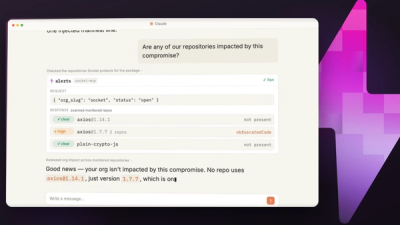
Socket MCP now lets AI assistants review org alerts, investigate threats using the Socket threat feed, and inspect package files in addition to dependency scoring.
Product
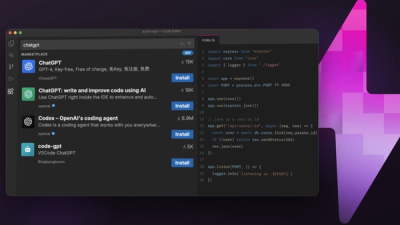
Socket Firewall blocks malicious VS Code and Open VSX extensions before install, protecting developers from compromised editor marketplaces.