
Product
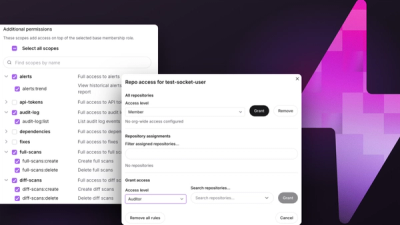
Introducing Repository Access Permissions and Custom Roles
Socket now supports Custom Roles and Repository Access Permissions so organizations can control who can access specific repositories and actions.
By Joe Werle - Jun 19, 2026
@cerios/xml-poto-codegen
Advanced tools
Generate TypeScript classes with xml-poto decorators from XSD schemas. CLI tool with config-based multi-XSD support.
Generate TypeScript classes with @cerios/xml-poto decorators from XSD schemas. Turn your XML Schema definitions into fully decorated, type-safe TypeScript code — ready for bidirectional XML serialization.




per-type) or all-in-one (per-xsd)xs:import resolutioninit command to scaffold your confignpm install -D @cerios/xml-poto-codegen
Peer dependency:
@cerios/xml-potomust be installed in the project where generated code will be used.
npx xml-poto-codegen init
The init flow asks you to choose either a JSON or TypeScript config file and then scaffolds it in your project root.
Example xml-poto-codegen.config.json:
{
	"sources": [
		{
			"xsdPath": "./schemas/my-schema.xsd",
			"outputPath": "./src/generated",
			"outputStyle": "per-type"
		}
	]
}
npx xml-poto-codegen generate
Given this XSD:
<xs:schema xmlns:xs="http://www.w3.org/2001/XMLSchema">
  <xs:element name="Person">
    <xs:complexType>
      <xs:sequence>
        <xs:element name="FirstName" type="xs:string"/>
        <xs:element name="LastName" type="xs:string"/>
        <xs:element name="Age" type="xs:integer"/>
        <xs:element name="Email" type="xs:string" minOccurs="0"/>
      </xs:sequence>
      <xs:attribute name="id" type="xs:string" use="required"/>
    </xs:complexType>
  </xs:element>
</xs:schema>
The codegen produces:
// ──────────────────────────────────────────────
// AUTO-GENERATED — do not edit
// ──────────────────────────────────────────────

import { XmlAttribute, XmlElement, XmlRoot } from "@cerios/xml-poto";

@XmlRoot({ name: "Person" })
export class Person {
	@XmlAttribute({ name: "id", required: true })
	id: string = "";

	@XmlElement({ name: "FirstName" })
	firstName: string = "";

	@XmlElement({ name: "LastName" })
	lastName: string = "";

	@XmlElement({ name: "Age" })
	age: number = 0;

	@XmlElement({ name: "Email" })
	email?: string;
}
You can then serialize and deserialize immediately with @cerios/xml-poto:
import { XmlSerializer } from "@cerios/xml-poto";
import { Person } from "./generated/person";

const serializer = new XmlSerializer();
const person = serializer.fromXml(xmlString, Person);
const xml = serializer.toXml(person);
initnpx xml-poto-codegen init
Interactively create a config file. Prompts for config format (json/ts, default: ts), validates XSD paths, asks for output style, then asks for a folder path (per-type) or file path (per-xsd) accordingly.
generatenpx xml-poto-codegen generate
Create xml-poto-codegen.config.json or xml-poto-codegen.config.ts in your project root.
{
	"sources": [
		{
			"xsdPath": "./schemas/orders.xsd",
			"outputPath": "./src/generated/orders",
			"outputStyle": "per-type"
		},
		{
			"xsdPath": "./schemas/products.xsd",
			"outputPath": "./src/generated/products.ts",
			"outputStyle": "per-xsd"
		}
	],
	"defaultOutputStyle": "per-type"
}
import type { XmlPotoCodegenConfig } from "@cerios/xml-poto-codegen";

const config: XmlPotoCodegenConfig = {
	sources: [
		{
			xsdPath: "./schemas/orders.xsd",
			outputPath: "./src/generated/orders",
			outputStyle: "per-type",
		},
	],
	defaultOutputStyle: "per-type",
};

export default config;
| Option | Type | Description |
|---|---|---|
sources | XsdSource[] | Array of XSD sources to process |
defaultOutputStyle | 'per-type' | 'per-xsd' | Default output style for all sources (default: 'per-type') |
enumStyle | 'union' | 'enum' | 'const-object' | Default enum generation style (default: 'union') |
| Option | Type | Description |
|---|---|---|
xsdPath | string | Path to the XSD file (required) |
outputPath | string | Output path. per-type: directory. per-xsd: .ts file path |
outputStyle | 'per-type' | 'per-xsd' | 'per-type': one file per class. 'per-xsd': all in one file |
enumStyle | 'union' | 'enum' | 'const-object' | Enum generation style for this source (overrides global) |
Choose how XSD enumerations are generated with the enumStyle option.
"union" (default)export type StatusType = "active" | "inactive" | "pending";
"enum"export enum StatusType {
Active = "active",
Inactive = "inactive",
Pending = "pending",
}
"const-object"export const StatusType = {
Active: "active",
Inactive: "inactive",
Pending: "pending",
} as const;
export type StatusType = (typeof StatusType)[keyof typeof StatusType];
| XSD Concept | Generated Code |
|---|---|
| Root element + complexType | @XmlRoot({ name: '...' }) |
| Named complexType | @XmlElement() class |
| Element in sequence | @XmlElement({ name: '...' }) |
Element with maxOccurs > 1 | @XmlArray({ itemName: '...' }) |
| Attribute | @XmlAttribute({ name: '...' }) |
| simpleContent | @XmlText() |
| Enumeration restriction | enumValues option |
| Pattern restriction | pattern option |
nillable="true" | isNullable: true |
xs:any | @XmlDynamic() |
| Extension base | TypeScript extends |
xs:import | Cross-file type resolution |
substitutionGroup | Resolved to concrete types |
| Groups / attributeGroups | Inlined into the containing class |
Codegen focuses on what can be inferred from XSD structure and constraints. The generated code covers core decorators and common options, but not every runtime-only xml-poto capability.
@XmlRoot, @XmlElement, @XmlAttribute, @XmlText, @XmlArray, @XmlDynamic@XmlComment, @XmlIgnore@XmlDynamic parse/cache/lazy settings are not inferred from XSD and must be added manually when needed.per-type (default)One file per class/enum plus a barrel index.ts:
src/generated/
  ├── person.ts
  ├── address-type.ts
  ├── status-type.ts
  └── index.ts
per-xsdAll types in a single file:
src/generated/
  └── my-schema.ts
// Manually write decorated classes for every XSD type
@XmlRoot({ name: "Person" })
class Person {
	@XmlAttribute({ name: "id", required: true })
	id: string = "";

	@XmlElement({ name: "FirstName" })
	firstName: string = "";

	// ... dozens more properties, easy to get wrong
}
# One command, always in sync with your schema
npx xml-poto-codegen generate
Benefits:
Commit your config, not the generated code — Add src/generated/ to .gitignore and run codegen as part of your build pipeline.
Use per-type for large schemas — Keeps files small and enables tree-shaking.
Pin your enum style per-source — Override enumStyle at the source level when different schemas need different patterns.
Regenerate after schema changes — Run npx xml-poto-codegen generate whenever your XSD files are updated.
Contributions are welcome! Please see our Contributing Guide.
MIT © Ronald Veth - Cerios
FAQs
Generate TypeScript classes with xml-poto decorators from XSD schemas. CLI tool with config-based multi-XSD support.
The npm package @cerios/xml-poto-codegen receives a total of 13 weekly downloads. As such, @cerios/xml-poto-codegen popularity was classified as not popular.
We found that @cerios/xml-poto-codegen demonstrated a healthy version release cadence and project activity because the last version was released less than a year ago. It has 2 open source maintainers collaborating on the project.
Did you know?

Socket for GitHub automatically highlights issues in each pull request and monitors the health of all your open source dependencies. Discover the contents of your packages and block harmful activity before you install or update your dependencies.
Product
Socket now supports Custom Roles and Repository Access Permissions so organizations can control who can access specific repositories and actions.
Product
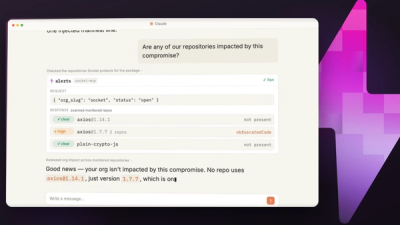
Socket MCP now lets AI assistants review org alerts, investigate threats using the Socket threat feed, and inspect package files in addition to dependency scoring.
Product
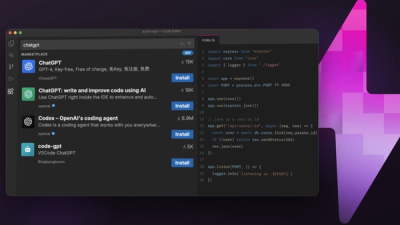
Socket Firewall blocks malicious VS Code and Open VSX extensions before install, protecting developers from compromised editor marketplaces.