
Product
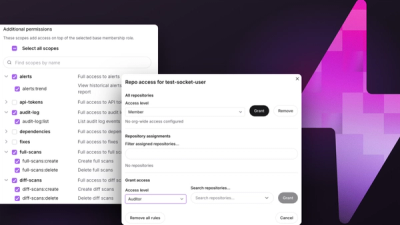
Introducing Repository Access Permissions and Custom Roles
Socket now supports Custom Roles and Repository Access Permissions so organizations can control who can access specific repositories and actions.
By Joe Werle - Jun 19, 2026
@claudemini/ses-cli
Advanced tools
A memory system for human-AI coding sessions. Tracks what happened, classifies intent and risk, and provides structured data for code review automation.
Supports Claude Code, Gemini CLI, Cursor, and OpenCode.
claude, codex, qwen, dim, and opencodenpm install -g @claudemini/ses-cli
cd /path/to/your/project
ses enable # Setup hooks + .ses-logs
# ... use Claude Code normally ...
ses list # See sessions
ses status # Check current session
npm install -g @claudemini/ses-cli
Or use directly without installing:
npx @claudemini/ses-cli <command>
ses enable                    # Enable for Claude Code (default)
ses enable gemini-cli         # Enable for Gemini CLI
ses enable --all              # Enable for all supported agents
ses enable --checkpoint       # Also create checkpoints on git commit
ses disable                   # Remove hooks (keep data)
ses disable --clean           # Remove hooks and all data
ses init                      # Low-level: register hooks in .claude/settings.json
ses status                    # Show current session + git info
ses list                      # List all sessions with type, risk, intent
ses view <session-id>         # View semantic session report
ses view <session-id> --json  # Include raw JSON data
ses review [session-id]       # Run structured code review from session data
ses review --json             # Machine-readable findings (structured schema)
ses review --engine=multi-agent --providers=codex,dim,opencode
ses review --recent=3 --md    # Aggregated Markdown report for PR comments
ses review --strict --fail-on=medium  # CI gate by severity threshold
ses explain <session-id>      # Human-friendly explanation of a session
ses explain <commit-sha>      # Explain a commit via its checkpoint
ses review options:
--engine=<agent|multi-agent> choose single-agent or multi-provider review--providers=<claude|codex|qwen|dim|opencode>[,...] select multi-agent providers--recent=<n> review latest n sessions (default 1)--all review all sessions in .ses-logs--min-severity=<info|low|medium|high|critical> filter findings--fail-on=<info|low|medium|high|critical> strict-mode failure threshold (default high)--provider-timeout-ms=<ms> per-provider timeout in multi-agent mode--max-provider-parallelism=<n> multi-agent concurrency (0 = full parallel)--agent-timeout-ms=<ms> total timeout for the review agent (default: 60s base + 30s per session)--allow-worktree-diff allow worktree fallback diff when checkpoint commits are unavailable--agent-auto-approve=<bool> auto approve agent tool calls (default true)--no-agent-auto-approve disable auto approval for agent tool calls--agent deprecated alias (accepted but ignored)--strict exit code 1 when findings reach --fail-on--strict-contract escalate provider parse / execution failures--json output structured JSON--markdown / --md output Markdownses query --recent=5 # Recent 5 sessions
ses query --file=src/auth/auth.service.ts # Sessions that modified this file
ses query --type=bugfix # All bugfix sessions
ses query --risk=high # High-risk sessions
ses query --type=feature --json # JSON output for bot consumption
ses checkpoints               # List all checkpoints
ses commit                    # Manually create checkpoint for current HEAD
ses rewind <checkpoint>       # Rollback to a checkpoint (git reset --hard)
ses rewind --interactive      # Choose from available checkpoints
ses resume <checkpoint>       # Restore session data from a checkpoint
ses reset --force             # Delete checkpoint for current HEAD
ses doctor                    # Diagnose issues (corrupted state, stuck sessions)
ses doctor --fix              # Auto-fix detected issues
ses shadow                    # List shadow branches
ses shadow info <branch>      # Show branch details
ses clean --days=7 --dry-run  # Preview cleanup
ses clean --days=7            # Delete sessions older than 7 days
ses summarize <session-id>    # Generate AI summary (requires API key)
| Command | Description |
|---|---|
enable | Enable ses-cli in repository (multi-agent support) |
disable | Remove hooks, optionally clean data |
status | Show current session and git info |
init | Register hooks in .claude/settings.json |
log <type> | Log a hook event from stdin (called by hooks) |
list | List all sessions with type, intent, risk |
view <id> | View semantic session report |
review [id] | Run structured code review (single-agent or multi-agent) |
query | Query session memory across sessions |
explain <id> | Human-friendly explanation of a session or commit |
commit | Create checkpoint on git commit |
checkpoints | List all checkpoints |
rewind <cp> | Rollback to a checkpoint |
resume <cp> | Resume session from a checkpoint |
reset | Delete checkpoint for current HEAD |
summarize <id> | Generate AI summary for a session |
doctor | Diagnose and fix issues |
shadow | List/inspect shadow branches |
clean | Clean old sessions |
webhook | Show/test webhook configuration |
Human <-> AI Agent (Claude Code, Gemini CLI, ...)
              | (hooks)
         Event Ingestion (log.js)
              |
         Semantic Extraction (extract.js)
              |
         Canonical Events -> Session State -> Reports
              |
         Session Artifacts (.ses-logs/ + index.json)
              |
         Review Engines / Human Queries / Webhooks
events.jsonl.summary.json, metadata.json, context.md, summary.txt, prompts.txt, and review-run.json are stable projections of the session artifact.ses/checkpoints/v1/* without changing the working tree.All configuration lives in .ses-logs/config.json. Environment variables override file config.
{
  "provider": "openai",
  "api_key": "sk-...",
  "model": "gpt-4o-mini",
  "openai_base_url": "https://api.openai.com/v1",
  "openai_endpoint": "",
  "max_tokens": 1000,
  "temperature": 0.7,

  "webhooks": {
    "url": "https://example.com/hook",
    "events": ["session.ended", "review.completed"],
    "secret": "",
    "auth_token": "",
    "headers": {},
    "timeout_ms": 5000,
    "retry": 1
  },

  "env": {
    "SES_WEBHOOK_URL": "",
    "SES_WEBHOOK_SECRET": "",
    "SES_WEBHOOK_EVENTS": ""
  }
}
| Field | Description | Default |
|---|---|---|
provider | "openai" or "anthropic" | "openai" |
api_key | API key for the provider | — |
model | Model ID for summarize / review | "gpt-4o-mini" |
openai_base_url | OpenAI-compatible base URL | "https://api.openai.com/v1" |
openai_endpoint | Full endpoint URL (overrides openai_base_url) | — |
max_tokens | Max tokens for AI summary | 1000 |
temperature | Temperature for AI summary | 0.7 |
webhooks | Webhook configuration object (see Webhook) | — |
env | Environment variable overrides (lower priority than real env vars) | — |
OpenAI-compatible provider (e.g. MiniMax, DeepSeek, Together):
{
  "provider": "openai",
  "api_key": "sk-...",
  "model": "your-model-id",
  "openai_base_url": "https://api.your-provider.com/v1"
}
Anthropic:
{
  "provider": "anthropic",
  "api_key": "sk-ant-...",
  "model": "claude-3-haiku-20240307"
}
With webhook:
{
  "provider": "openai",
  "api_key": "sk-...",
  "model": "gpt-4o-mini",
  "webhooks": {
    "url": "https://hooks.slack.com/services/xxx",
    "events": ["session.ended", "review.completed"]
  }
}
.ses-logs/
├── index.json                              # Cross-session index
└── <session-id>/
    ├── events.jsonl                        # Raw hook events
    ├── state.json                          # Incremental processing state
    ├── summary.json                        # Bot data interface (v2)
    ├── summary.txt                         # Human-readable report
    ├── context.md                          # Session context (Entire-style)
    ├── prompts.txt                         # User prompts with timestamps
    ├── metadata.json                       # Lightweight session metadata
    ├── review-run.json                     # Latest stable review record
    ├── review.json                         # Full review report
    ├── review.md                           # Markdown review projection
    └── ai-summary.md                       # AI-generated summary (optional)
{
  "version": "2.0",
  "session": {
    "id": "f608c31e...",
    "start": "2026-02-27T10:00:00Z",
    "end": "2026-02-27T10:45:00Z",
    "duration_minutes": 45,
    "type": "bugfix",
    "intent": "Fix authentication timeout issue",
    "risk": "medium",
    "summary": "Fixed: Fix authentication timeout issue"
  },
  "changes": {
    "files": [{ "path": "src/auth.ts", "category": "source", "operations": ["edit"] }],
    "summary": { "source": 3, "test": 1 }
  },
  "activity": {
    "tools": { "Read": 15, "Edit": 3, "Bash": 5 },
    "commands": { "test": ["npm run test"], "git": ["git status"] },
    "errors": []
  },
  "review_hints": {
    "tests_run": true,
    "build_verified": false,
    "files_without_tests": ["src/auth.ts"],
    "large_change": false,
    "config_changed": false,
    "migration_added": false
  },
  "prompts": [{ "time": "...", "text": "Fix the auth timeout bug" }],
  "scope": ["auth"]
}
| Type | Description |
|---|---|
bugfix | Bug fixes |
feature | New features |
refactor | Code restructuring |
debug | Investigation/debugging |
test | Test writing/updates |
docs | Documentation |
devops | CI/CD, deployment |
upgrade | Dependency updates |
config | Configuration changes |
style | Formatting, UI |
security | Security-related |
perf | Performance optimization |
import { readFileSync } from 'fs';

// Read session data
const summary = JSON.parse(readFileSync('.ses-logs/<id>/summary.json', 'utf-8'));

// Check review hints
if (!summary.review_hints.tests_run && summary.changes.files.length > 0) {
  review.warn('Files modified but no tests run');
}
if (summary.review_hints.migration_added) {
  review.flag('Database migration requires careful review');
}

// Query file history via index
const index = JSON.parse(readFileSync('.ses-logs/index.json', 'utf-8'));
const history = index.file_history['src/auth/auth.service.ts'];
if (history && history.length > 3) {
  review.note('This file has been modified frequently');
}
ses-cli can send webhook notifications to external systems (Slack, Lark, CI, custom platforms) when key events occur.
| Event | Trigger | Payload |
|---|---|---|
session.ended | Session ends (hook session-end / stop) | summary.json content |
review.completed | ses review finishes | Review report |
Webhook supports three configuration sources (highest priority first):
1. Environment variables (highest priority):
export SES_WEBHOOK_URL=https://example.com/hook
export SES_WEBHOOK_SECRET=my-secret        # HMAC-SHA256 signing
export SES_WEBHOOK_AUTH_TOKEN=bearer-token  # Bearer auth (alternative to secret)
export SES_WEBHOOK_EVENTS=session.ended,review.completed
2. .ses-logs/config.json env field:
{
  "env": {
    "SES_WEBHOOK_URL": "https://example.com/hook",
    "SES_WEBHOOK_SECRET": "my-secret",
    "SES_WEBHOOK_EVENTS": "session.ended,review.completed"
  }
}
3. .ses-logs/config.json webhooks field (lowest priority):
{
  "webhooks": {
    "url": "https://example.com/hook",
    "events": ["session.ended", "review.completed"],
    "secret": "hmac-secret-key",
    "headers": { "X-Custom": "value" },
    "timeout_ms": 5000,
    "retry": 1
  }
}
secret or SES_WEBHOOK_SECRET. Adds X-Signature-256: sha256=<hex> header (GitHub-compatible format).auth_token or SES_WEBHOOK_AUTH_TOKEN. Adds Authorization: Bearer <token> header.{
"event": "session.ended",
"timestamp": "2026-03-03T12:00:00.000Z",
"payload": { ... }
}
ses webhook              # Show current webhook configuration
ses webhook --test       # Send a test ping to the configured URL
Set one of these environment variables to enable AI-powered session summaries:
export OPENAI_API_KEY=sk-...      # Uses gpt-4o-mini by default
export OPENAI_BASE_URL=https://api.openai.com/v1  # Optional: OpenAI-compatible base URL
export AI_MODEL=gpt-5-mini         # Optional: universal model override (all providers)
export ANTHROPIC_API_KEY=sk-...   # Uses claude-3-haiku by default
Then run:
ses summarize <session-id>
| Variable | Description |
|---|---|
SES_LOG_DIR | Custom log directory (default: .ses-logs in project root) |
OPENAI_API_KEY | Enable AI summaries via OpenAI |
OPENAI_BASE_URL | OpenAI-compatible base URL for summaries (default: https://api.openai.com/v1) |
OPENAI_ENDPOINT | Full OpenAI-compatible endpoint (overrides OPENAI_BASE_URL) |
AI_MODEL | Universal model override for summaries (applies to all providers) |
OPENAI_MODEL | OpenAI-only model override (takes precedence over AI_MODEL for OpenAI) |
ANTHROPIC_API_KEY | Enable AI summaries via Anthropic |
ANTHROPIC_MODEL | Anthropic-only model override (takes precedence over AI_MODEL for Anthropic) |
SES_REVIEW_AGENT_TIMEOUT_MS | Agent review timeout in milliseconds (default: 60s base + 30s per session) |
SES_REVIEW_AUTO_APPROVE | Auto approve agent tool calls (true/false, default: true) |
SES_WEBHOOK_URL | Webhook endpoint URL |
SES_WEBHOOK_SECRET | HMAC-SHA256 signing secret for webhooks |
SES_WEBHOOK_AUTH_TOKEN | Bearer token for webhook authentication |
SES_WEBHOOK_EVENTS | Comma-separated list of webhook events to subscribe to |
ses summarize also accepts OpenAI-compatible responses where completion text is returned via reasoning_content instead of content.
.ses-logs/ (added to .gitignore automatically)Single-agent review still uses goatchain. Multi-agent review orchestrates external provider CLIs directly.
FAQs
Session-based Hook Intelligence Tracker for human-AI coding sessions
The npm package @claudemini/ses-cli receives a total of 68 weekly downloads. As such, @claudemini/ses-cli popularity was classified as not popular.
We found that @claudemini/ses-cli demonstrated a healthy version release cadence and project activity because the last version was released less than a year ago. It has 1 open source maintainer collaborating on the project.
Did you know?

Socket for GitHub automatically highlights issues in each pull request and monitors the health of all your open source dependencies. Discover the contents of your packages and block harmful activity before you install or update your dependencies.
Product
Socket now supports Custom Roles and Repository Access Permissions so organizations can control who can access specific repositories and actions.
Product
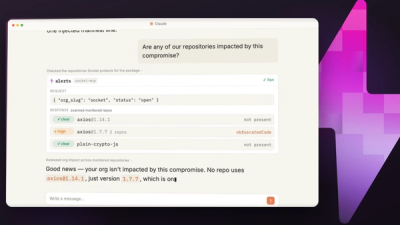
Socket MCP now lets AI assistants review org alerts, investigate threats using the Socket threat feed, and inspect package files in addition to dependency scoring.
Product
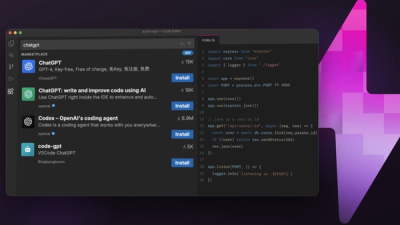
Socket Firewall blocks malicious VS Code and Open VSX extensions before install, protecting developers from compromised editor marketplaces.