

Product
Socket for Jira Is Now Available
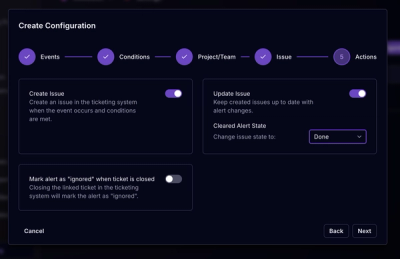
Socket for Jira lets teams turn alerts into Jira tickets with manual creation, automated ticketing rules, and two-way sync.
By Jeppe Hasseriis - Apr 20, 2026
@cloudbeds/slate-serializers
Advanced tools
Serialize Slate JSON objects to HTML and vice versa. Define rules to modify the end result.
A collection of serializers to convert Slate JSON objects to various formats and vice versa. Designed to work in both Node.js and browser environments.
Serializers included so far:
View the demo at https://thompsonsj.github.io/slate-serializers-demo.
Serializers are only compatible with Slate >=0.50.0. Earlier versions used a different data model.
Note that compatibility has only been tested with Slate v0.72.8. These serializers are still in active development/testing.
yarn add slate-serializers
# or
npm install slate-serializers
Each serializer uses a default configuration, which may not transform your data effectively.
One of the principles of Slate is its schema-less core.
Check configuration objects in src/config/. Extend the default configuration or write your own in order to apply your schema/transformation rules.
import { slateToHtml } from 'slate-serializers'

const slate = [
  {
    children: [
      {
        text: 'Heading 1',
      },
    ],
    type: 'h1',
  },
  {
    children: [
      {
        text: 'Paragraph 1',
      },
    ],
    type: 'p',
  },
]

const serializedToHtml = slateToHtml(slate)
// output
// <h1>Heading 1</h1><p>Paragraph 1</p>
By default, slateToHtml incorporates transformation rules based on the example in Deserializing | Serializing | Slate.
If you are using Payload CMS, import the Payload configuration file and pass it as a parameter to the serializer.
import { slateToHtml, payloadSlateToDomConfig } from 'slate-serializers'

const slate = [
  {
    children: [
      {
        text: 'Heading 1',
      },
    ],
    type: 'h1',
  },
]

const serializedToHtml = slateToHtml(slate, payloadSlateToDomConfig)
You can create your own configuration file that implements your schema. See src/config/slateToDom/payload.ts for an example of how to extend the default configuration or copy src/config/slateToDom/default.ts and rewrite it as appropriate.
import { htmlToSlate } from 'slate-serializers'

const html = `<h1>Heading 1</h1><p>Paragraph 1</p>`

const serializedToSlate = htmlToSlate(html)
// output
/*
[
  {
    children: [
      {
        text: 'Heading 1',
      },
    ],
    type: 'h1',
  },
  {
    children: [
      {
        text: 'Paragraph 1',
      },
    ],
    type: 'p',
  },
]
/*
By default, htmlToSlate incorporates transformation rules based on the example in HTML | Serializing | Slate.
If you are using Payload CMS, import the Payload configuration file and pass it as a parameter to the serializer.
import { htmlToSlate, payloadHtmlToSlateConfig } from 'slate-serializers'

const html = `<h1>Heading 1</h1><p>Paragraph 1</p>`

const serializedToSlate = htmlToSlate(html, payloadHtmlToSlateConfig)
You can create your own configuration file that implements your schema. See src/config/htmlToSlate/payload.ts for an example of how to extend the default configuration or copy src/config/htmlToSlate/default.ts and rewrite it as appropriate.
For a breakdown of configuration options, see docs/config/htmlToSlate.md.
htmlToSlate processes whitespace in a similar way to browsers. It minifies whitespace while trying to preserve meaning. For details, see docs/engineering.md#whitespace.
slateToHtml is a simple wrapper that runs dom-serializer on the output from slateToDom.
slateToDom is made available in case you wish to work with the DOM output yourself or run dom-serializer using any of the available options.
It accepts the same configuration object as slateToHtml.
TLDR: contributors can format commit messages in any way, maintainers should use conventional commits.
This repository uses conventional commits.
Conventional commits are not enforced. General guidance:
Run npx cz instead of git commit to lint commit messages using @commitlint/cli.
FAQs
Serialize Slate JSON objects to HTML and vice versa. Define rules to modify the end result.
We found that @cloudbeds/slate-serializers demonstrated a not healthy version release cadence and project activity because the last version was released a year ago. It has 59 open source maintainers collaborating on the project.
Did you know?

Socket for GitHub automatically highlights issues in each pull request and monitors the health of all your open source dependencies. Discover the contents of your packages and block harmful activity before you install or update your dependencies.
Product
Socket for Jira lets teams turn alerts into Jira tickets with manual creation, automated ticketing rules, and two-way sync.

Company News
Socket won two 2026 Reppy Awards from RepVue, ranking in the top 5% of all sales orgs. AE Alexandra Lister shares what it's like to grow a sales career here.

Security News
NIST will stop enriching most CVEs under a new risk-based model, narrowing the NVD's scope as vulnerability submissions continue to surge.