
Research
/Security News
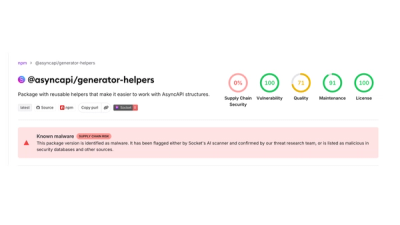
Compromised npm Packages in the AsyncAPI Namespace Deliver Miasma Botnet Loader
4 compromised asyncapi packages deliver miasma botnet loader on macOS, Linux and Windows.
By Socket Research Team - Jul 14, 2026
@czap/astro
Advanced tools
The Astro integration for LiteShip: render adaptive UI as islands with the `client:satellite` directive and resolve device tiers on the server for first paint.
Astro 7 integration that compiles your boundary definitions at build time and activates their state evaluators on the client.
Install this directly when your site is built on Astro 7 — this is the integration most LiteShip projects install first. The other
@czap/*runtime packages arrive with it.
pnpm add @czap/astro @czap/core effect@beta
effect must be the Effect 4 beta (effect@beta) — a bare pnpm add effect installs 3.x and fails the peer check.
// astro.config.mjs
import { defineConfig } from 'astro/config';
import { integration as czap } from '@czap/astro';

export default defineConfig({ integrations: [czap()] });

// src/boundaries.ts — a boundary names where one state becomes the next
import { Boundary } from '@czap/core';

export const viewport = Boundary.make({
  input: 'viewport.width',
  at: [[0, 'stacked'], [768, 'split']],
  hysteresis: 20, // 20px of grace so the state doesn't flicker
});
---
// src/pages/index.astro
import Satellite from '@czap/astro/Satellite';
import { viewport } from '../boundaries.js';
---
<Satellite boundary={viewport}>
  <section>Resize the window.</section>
</Satellite>
Drag the window edge across 768px: the wrapper's data-czap-state attribute flips between stacked and split for your CSS to key on. No client:* attribute needed — the integration's injected boot script activates the evaluator.
czap({ middleware: true }) auto-wires capability detection, so the common case needs no src/middleware.ts; it populates a typed Astro.locals.czap.tiers.{tier,motion,design} (no cast). Astro 7 hosts that need CZAP before Astro's page pipeline can use czapFetchLayer() from @czap/astro/fetch-layer. Boundaries can also bind live audio.amplitude / audio.beat signals (driveAudioFromAnalyser from @czap/astro/runtime), and the dev boundary inspector ships as an Astro dev-toolbar app (toggle from the toolbar icon).
Continuous authored motion has a production runtime: czap({ motion: { enabled: true } }) registers client:motion, the JS FLOOR for the scroll-scrubbed reveal. Native animation-timeline CSS (from MotionCompiler) owns the scrub where supported; everywhere it is not, client:motion reads the SSR-inlined lowered program off data-czap-motion-program and drives writeContinuousMap every frame — sampling the SAME Easing.spring the native linear() compiled from, so the two paths render one identical curve. The continuous tween is a leaf write (never a graph patch); prefers-reduced-motion with a settle policy pins the final pose with no tween. Runnable in examples/showcase at /motion.
Responsive media adapts at the host: Astro.locals.czap.responsiveMedia(intent) derives Save-Data / DPR caps from the request's Client Hints and projects a ResponsiveMedia.intent through the ONE effective-candidate law (selectCandidates in @czap/core). Every artifact — src, srcset, each <source>, the preload imagesrcset — derives from that set, so under Save-Data the whole picture is capped to the light asset and a high-DPR client can never re-fetch the heavy hero. The middleware also merges the responsive Vary axis (Sec-CH-DPR, Save-Data) into the response so a CDN keys the two representations apart. projectResponsiveMediaForRequest / applyResponsiveMediaVary are the standalone route-handler helpers. Runnable in examples/showcase at /responsive-media (and examples/cloudflare-astro on the Workers edge).
The host integration most apps touch: it registers @czap/vite (build-time boundary scanning and CSS), injects @czap/detect's device-tier probe, and rigs the client directives backed by @czap/web (DOM morphing, SSE, LLM streams) and @czap/worker (off-thread evaluation), with @czap/edge supplying SSR tier detection for the optional middleware. Boundary authoring itself lives in @czap/core; Cloudflare deploys add @czap/cloudflare on top. See the
package surfaces map
for the full layout.
If data-czap-state never changes on resize, the boot script was never injected — confirm czap() is in integrations in astro.config.mjs. Astro's own client:visible / client:idle directives do not wire the evaluator; Satellite (or satelliteAttrs(...) spread onto any element) emits the data-czap-directive="satellite" marker the boot scanner looks for.
Part of LiteShip — powered by the CZAP engine (Content-Zoned Adaptive Projection), distributed as @czap/* packages.
FAQs
The Astro integration for LiteShip: render adaptive UI as islands with the `client:satellite` directive and resolve device tiers on the server for first paint.
The npm package @czap/astro receives a total of 285 weekly downloads. As such, @czap/astro popularity was classified as not popular.
We found that @czap/astro demonstrated a healthy version release cadence and project activity because the last version was released less than a year ago. It has 1 open source maintainer collaborating on the project.
Did you know?

Socket for GitHub automatically highlights issues in each pull request and monitors the health of all your open source dependencies. Discover the contents of your packages and block harmful activity before you install or update your dependencies.
Research
/Security News
4 compromised asyncapi packages deliver miasma botnet loader on macOS, Linux and Windows.
Research
/Security News
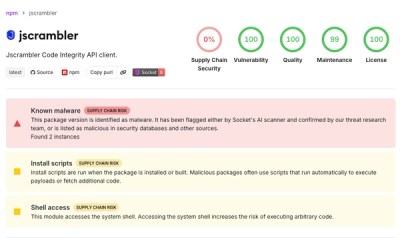
A compromised jscrambler npm release added a malicious preinstall hook that runs hidden native binaries on Linux, macOS, and Windows.

Research
/Security News
A malicious .NET package is typosquatting the Braintree SDK to steal live payment card data, merchant API keys, and host secrets from production apps.