
Product
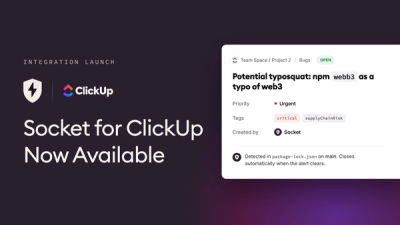
Socket for ClickUp Is Now Available
Create ClickUp tasks from Socket alerts, automate ticketing with custom rules, and keep alert and task status synchronized.
By Jeppe Hasseriis - Aug 26, 2026
@dashclaw/mcp-server
Advanced tools
MCP server for DashClaw governance — guard, record, invoke, discover capabilities, and read the decision ledger through the governance loop.
MCP server for DashClaw governance. Exposes 17 governance tools, 2 stdio-only support tools, and 3 read-only resources over Model Context Protocol — guard, record, invoke governed capabilities, wait for approvals, and read the decision ledger, all through the DashClaw governance loop. Works with Claude Code, Claude Desktop, Claude Managed Agents, and any MCP-compatible client.
The governance tools register only when DASHCLAW_URL and DASHCLAW_API_KEY are both set; without them the server registers nothing and warns on stderr if exactly one is present.
npx -y @dashclaw/mcp-server --url https://your-dashclaw.vercel.app --key oc_live_xxx --agent-id claude-code
Or add to your MCP config (.mcp.json for Claude Code, or claude mcp add):
{
  "mcpServers": {
    "dashclaw": {
      "command": "npx",
      "args": ["-y", "@dashclaw/mcp-server"],
      "env": {
        "DASHCLAW_URL": "https://your-dashclaw.vercel.app",
        "DASHCLAW_API_KEY": "oc_live_xxx",
        "DASHCLAW_AGENT_ID": "claude-code"
      }
    }
  }
}
Claude Desktop main chat: do not use stdio. Desktop runs local MCP servers on its bundled Node, which crashes this server. Use the OAuth custom connector instead — no local process, works in chat and Cowork.
About DASHCLAW_AGENT_ID: this is the name that shows up on /fleet, /decisions, and every other governance surface. If you omit it, the server auto-derives an agent_id from the MCP protocol's clientInfo.name (e.g. claude-ai for Claude Desktop, cursor-vscode for Cursor) so calls don't silently commingle with other agents — but a human-friendly name like claude-desktop is what you actually want for dashboard readability. Explicit configuration always wins over auto-derivation.
If you're running DashClaw, the MCP endpoint is built in at /api/mcp:
agent = client.beta.agents.create(
    name="Governed Agent",
    model="claude-sonnet-4-6",
    tools=[{"type": "agent_toolset_20260401"}],
    mcp_servers=[{
        "type": "url",
        "url": "https://your-dashclaw.vercel.app/api/mcp",
        "headers": {"x-api-key": "oc_live_xxx"},
        "name": "dashclaw"
    }],
)
Use the OAuth custom connector (next section) — it is the verified path for
Desktop chat, web, and Cowork, and needs no install. The old one-click .mcpb
bundle is retired: it ran the stdio server on Desktop's bundled Node, which
crash-loops. If you still have a dashclaw extension installed from it,
uninstall it (Settings → Extensions) before adding the connector.
Self-hosted DashClaw is addable as a Claude custom connector with no API key in the UI — Claude's connector flow requires OAuth, not headers:
https://<your-instance>/api/mcp./.well-known/oauth-protected-resource, registers via DCR,
and opens your DashClaw login + a consent screen.Works on Free/Pro/Max/Team/Enterprise (Free is capped at one custom connector).
The legacy x-api-key path (Managed Agents) is unchanged.
To also load the DashClaw skills (governance protocol + platform intelligence)
in the Claude app: Customize → Plugins → "+" → Add marketplace →
github: ucsandman/DashClaw, then install the dashclaw plugin.
Grouped by domain. See src/tools.ts for the canonical definitions.
Core governance (9) — the guard / record / invoke loop plus discovery and session lifecycle.
| Tool | Description |
|---|---|
dashclaw_guard | Evaluate policies before risky actions |
dashclaw_record | Log actions to audit trail |
dashclaw_invoke | Execute governed capabilities (guard + run + record) |
dashclaw_capabilities_list | Discover available APIs |
dashclaw_policies_list | See active governance policies |
dashclaw_wait_for_approval | Block until a human resolves an approval |
dashclaw_session_start | Register agent session |
dashclaw_session_end | Close agent session |
dashclaw_session_retro | Read the session's own defensibility retro (clean/review/flagged posture) |
Session linkage: after
dashclaw_session_start, the server auto-stamps that session's id onto everydashclaw_recordin the same connection (stdio). Passsession_idondashclaw_recordto override, or to attribute explicitly on the HTTP transport (POST /api/mcp), where each request is stateless.
Retrospection (2) — record assumptions; recent governed-action ledger.
| Tool | Description |
|---|---|
dashclaw_assumption_record | Record an unverified assumption underpinning an action |
dashclaw_decisions_recent | Recent governed-action ledger |
Agent identity (1) — operator-approved pairing of an unidentified agent to a registered identity.
| Tool | Description |
|---|---|
dashclaw_pair | Enroll agent identity: keypair locally, public key to /api/pairings |
Team Tasks (3) — create a Team Task, append an inter-agent timeline event, update task status.
| Tool | Description |
|---|---|
dashclaw_task_create | Create a Team Task — one record per multi-agent /team run |
dashclaw_task_event | Append one event to a Team Task timeline (delegation, reply, status, approval_needed, result, error, done) |
dashclaw_task_update | Update a Team Task: status transitions and stored transport session ids |
Plans (2) — submit a preflight plan for one-card operator review; poll its verdict before executing.
| Tool | Description |
|---|---|
dashclaw_plan_submit | Submit an ordered step list for preflight review; approved steps become single-use grants |
dashclaw_plan_status | Check a submitted plan's overall and per-step verdict |
Registered by src/tools/index.ts on the local stdio
server only, gated on the same DASHCLAW_URL + DASHCLAW_API_KEY credentials
as the governance set:
| Tool | Description |
|---|---|
dashclaw_status | Check DashClaw gate configuration and reachability |
export_dashclaw_evidence | Export local audit entries carrying DashClaw guard/evidence metadata |
| URI | Description |
|---|---|
dashclaw://policies | Active policy set |
dashclaw://agent/{agent_id}/history | Recent action history (last 50) |
dashclaw://status | Instance health + operational metrics |
Set these in your MCP client's env block (preferred — scoped to the server
process, invisible to your terminals) or your shell. The annotated template
lives in .env.example.
| CLI Arg | Env Var | Default | Description |
|---|---|---|---|
--url | DASHCLAW_URL | http://localhost:3000 | DashClaw instance URL — with DASHCLAW_API_KEY, enables the governance tool set |
--key | DASHCLAW_API_KEY | (empty) | API key (oc_live_ prefix) |
--agent-id | DASHCLAW_AGENT_ID | (empty) | Default agent ID (auto-derived from MCP clientInfo.name when empty) |
DASHCLAW_MODE | authoritative | DashClaw gate mode (only authoritative is supported) | |
DASHCLAW_LOCAL_HOME | <cwd>/.dashclaw-local | Where local state lives (see Storage below) | |
DASHCLAW_TIMEOUT_MS | 30000 | DashClaw API request timeout | |
DASHCLAW_LOCK_STALE_MS | 30000 | Stale file-lock threshold for local state files | |
DASHCLAW_AUDIT_MAX_ENTRIES | (unlimited) | Cap retained audit entries |
CLI args take precedence over environment variables.
Note: This server reads
DASHCLAW_URL(notDASHCLAW_BASE_URL); the hooks and CLI in the DashClaw repo readDASHCLAW_BASE_URL.
Local-first state under .dashclaw-local/ in the working directory
(override with DASHCLAW_LOCAL_HOME). Plain JSON — human-readable,
diffable, zero native dependencies:
| File | Holds |
|---|---|
state.json | The local default workspace |
audit.log | Append-only JSONL audit trail read by the DashClaw evidence tools |
Secrets are never written here — tokens stay in the environment, read at call time.
Apache-2.0. This package incorporates code from an upstream
Apache-2.0 project — see NOTICE for the attribution.
After bumping version in mcp-server/package.json, run from the repo root:
npm run release:mcp
One command does everything, and re-running is always safe (already-published steps are skipped):
server.json versions to package.json (commit the change if it edits the file).mcp-publisher — if the saved GitHub token expired, it re-runs the device-flow login (enter the printed code at github.com/login/device) and retries.Prereqs (one-time): npm login, and the official mcp-publisher binary from modelcontextprotocol/registry releases — never npm i -g mcp-publisher, that name is squatted by an unrelated package.
FAQs
MCP server for DashClaw governance — guard, record, invoke, discover capabilities, and read the decision ledger through the governance loop.
We found that @dashclaw/mcp-server demonstrated a healthy version release cadence and project activity because the last version was released less than a year ago. It has 1 open source maintainer collaborating on the project.
Product
Create ClickUp tasks from Socket alerts, automate ticketing with custom rules, and keep alert and task status synchronized.
Product
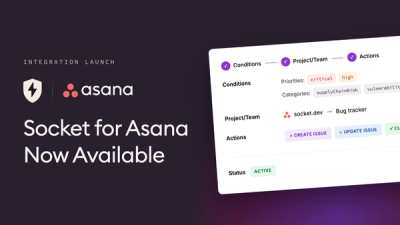
Create and manage Asana tasks directly from Socket alerts, with manual task creation, automated ticketing rules, and two-way sync.

Security News
Open VSX has removed three extension IDs from its malicious-extension list as the legitimate publishers they impersonated move to claim the names for themselves.