
Product
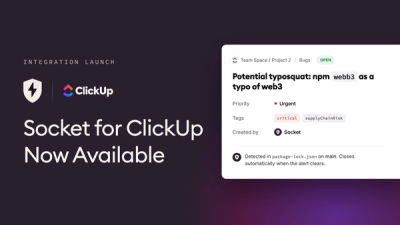
Socket for ClickUp Is Now Available
Create ClickUp tasks from Socket alerts, automate ticketing with custom rules, and keep alert and task status synchronized.
By Jeppe Hasseriis - Aug 26, 2026
@decionis/mcp
Advanced tools
Local MCP policy checks and native Codex, Copilot, and Claude execution hooks.
A stdio Model Context Protocol server that lets AI coding
agents (Claude Code, Cursor, Codex, OpenHands, …) read a repository's DECIONIS_POLICY.md
and evaluate candidate actions before they commit, deploy, or migrate anything.
It is not a re-implementation: decionis_evaluate boots the real @decionis/protocol
service in-process with an in-memory store, publishes the repo policy through the
protocol's own schema-validated bundle ingestion, and evaluates through
POST /v1/protocol/evaluate-decision via fastify inject(). The verdict an agent sees
locally is the verdict the platform would produce — with zero network, zero database,
zero credentials, and nothing recorded.
(The protocol service separately exposes a remote, authenticated MCP surface for org-connected agents; this package is the local, offline complement for repo checkouts.)
The package now exposes two complementary surfaces:
PreToolUse hooks intercept every supported tool call outside the model's
discretion. Codex, GitHub Copilot, and Claude Code all normalize into one
AgentToolCall contract and one AgentGateEvaluator interface.MCP is the discovery and explanation surface. The native hook is the binding enforcement surface.
| Tool | Purpose |
|---|---|
decionis_read_policy | Path, sha256, and compiled rules (or compile errors) of the repo's DECIONIS_POLICY.md. |
decionis_evaluate | Evaluate a candidate action payload against the policy through the real evaluator; returns the verdict + matched rule. |
decionis_demo | The one-minute demo: four canned intents through the real evaluator with a built-in sample policy — one per wire outcome. No account, no key, no policy file, no network, nothing recorded. |
decionis_verdict_help | The verdict vocabulary, rules-block grammar, and how an agent should behave on each verdict. |
All four are read-only, credential-free, and networkless (readOnlyHint: true,
openWorldHint: false) — an agent host that gates side-effectful tools behind
approval has nothing to gate here. The shield.* tools register only when
DECIONIS_SHIELD_API_KEY and DECIONIS_SHIELD_APP_ID are configured.
The optional Kubernetes tools add a client-side gate while the validating admission webhook remains the independent cluster-side gate:
| Tool | Purpose |
|---|---|
k8s_plan | Resolve exact objects and show only digests, action hashes, diffs, and bounded facts. |
k8s_request_authority | Request ALLOW/HOLD/BLOCK and signed dossier references without applying. |
k8s_apply | Consume an exact Decionis grant, then stream the bound object snapshot to Kubernetes. |
k8s_scale | Consume an exact scale grant, then submit that bound scale object, including scale-to-zero. |
k8s_rollback | Apply an exact, existing-target rollback manifest after authority; vague undo is rejected. |
k8s_verify_dossier | Independently verify the dossier proof bundle and Ed25519 evidence. |
Enable them explicitly. The process uses the selected local kube context without reading or exporting kubeconfig credentials:
DECIONIS_KUBERNETES_TOOLS_ENABLED=true
DECIONIS_AUTHORITY_BASE_URL=https://api.decionis.example
DECIONIS_API_KEY=<org-scoped-key>
DECIONIS_ORG_ID=<org-uuid>
DECIONIS_KUBERNETES_CLUSTER_ID=production-eu-1
DECIONIS_KUBERNETES_ACTOR=operator@example.com
DECIONIS_KUBERNETES_POLICY_VERSION=kubernetes-production-v1
DECIONIS_KUBERNETES_CONTEXT=production-eu-1
DECIONIS_KUBERNETES_VERIFICATION_ORIGINS may add comma-separated HTTPS origins for
dossier/JWKS verification. Arbitrary origins are rejected. Mutating tools fail closed on
authority, dossier, action-hash, grant, or Kubernetes errors; a Kubernetes command failure
requires fresh authority because the single-use client grant has already been consumed.
The policy file resolves from the tool's path argument, then $DECIONIS_POLICY_PATH,
then ./DECIONIS_POLICY.md in the working directory.
Claude Code — as a plugin (one command, gate included):
/plugin marketplace add decionis/mcp
/plugin install decionis
That installs the MCP tools and the binding PreToolUse gate together. Then,
in a repository you want governed:
/decionis:init
…which writes a starter DECIONIS_POLICY.md. Ask your agent to run
rm -rf /var/lib/postgresql and it comes back refused, by rule name.
A repository with no DECIONIS_POLICY.md is simply not governed — the plugin
runs everywhere, so it does not gate projects that never opted in. A policy that
exists but cannot be compiled still fails closed.
Everything else:
npm install -g @decionis/mcp
Or skip the install entirely — every client config below can launch the server
through npx -y @decionis/mcp.
Claude Code — .mcp.json at the repo root:
{
  "mcpServers": {
    "decionis": {
      "command": "npx",
      "args": ["-y", "@decionis/mcp"]
    }
  }
}
Codex — add the stdio server to ~/.codex/config.toml or a trusted project's
.codex/config.toml:
[mcp_servers.decionis]
command = "npx"
args = ["-y", "@decionis/mcp"]
required = true
Cursor — use the Claude server block in .cursor/mcp.json. During development,
"command": "pnpm", "args": ["--filter", "@decionis/mcp", "dev"] also works.
Source checkout — build once (pnpm --filter @decionis/mcp build) and point the
client at the bin directly: "command": "node", "args": ["<repo>/apps/mcp/dist/index.js"].
Install the package globally so decionis-agent-hook (and the other bins) land on the
host's PATH:
npm install -g @decionis/mcp
Copy the provider template to its native repository location:
| Host | Template | Native location |
|---|---|---|
| Codex | templates/CodexHooks.json | .codex/hooks.json |
| Claude Code | templates/ClaudeSettings.json | .claude/settings.json |
| GitHub Copilot CLI/cloud agent/VS Code | templates/CopilotHooks.json | .github/hooks/Decionis.json |
For a source checkout, replace the template's decionis-agent-hook … command with:
node "$(git rev-parse --show-toplevel)/apps/mcp/dist/AgentHookCli.js" <provider>
where <provider> is codex, copilot, or claude.
The hook defaults to local mode. It loads DECIONIS_POLICY.md, publishes it into the
real in-process protocol evaluator, and enforces the result without network access or
credentials.
Set these variables to use the enterprise policy graph and signed decision pipeline:
DECIONIS_AGENT_GATE_MODE=remote
DECIONIS_AGENT_GATE_URL=https://protocol.decionis.com/v1/protocol/evaluate-decision
DECIONIS_API_KEY=<org-scoped-key>
DECIONIS_ORG_ID=<org-uuid>
DECIONIS_AGENT_GATE_TIMEOUT_MS optionally changes the remote request timeout (default:
4 seconds). Partial remote configuration is rejected; network errors, invalid hook input,
missing policy, and evaluator failures all produce a native deny response.
An APPROVE result returns no permission override, so the host's normal sandbox and user
approval flow still applies. REJECT, REVIEW, and ESCALATE all stop the tool call;
the latter two remain blocked until a human resolves them through the policy workflow.
Other runtimes can import the same contracts and orchestration layer:
import {
  AgentHookRunner,
  type AgentGateEvaluator,
  type AgentHostAdapter,
  type AgentToolCall,
} from "@decionis/mcp/agent";
A new provider implements only AgentHostAdapter; a new decision backend implements only
AgentGateEvaluator. Neither needs to understand the other provider formats.
For pre-prompt enforcement, @decionis/sdk exposes the complementary
DecionisAgentTaskGateway interface. It reserves the model budget before an OpenAI or
Anthropic proxy call, verifies sandbox egress, consumes the same bound grant at the proxy,
and reconciles provider usage. Copilot embeddings use the same reserve/egress/reconcile
contract when model transport itself is not replaceable.
See
docs/integrations/agents/AgentBoundaryGateway.md
for the provider SDK configuration and four-boundary deployment model.
Device-management templates are under templates/managed:
CodexRequirements.toml pins the managed PreToolUse hook in
requirements.toml.CopilotPolicyHooks.json is the root-owned Copilot CLI policy hook; cloud agent
continues to use the repository template.ClaudeManagedSettings.json is the organization-controlled Claude Code settings
fragment.AgentPolicyBundle.json is a fail-closed, source-dated policy-graph skeleton. It
contains explicit official list-price cards retrieved on 2026-07-27. Negotiated rates
are stored separately under the organization policy's
agentExecution.providerContracts; a contract overrides the public baseline only while
it is effective and independently maker-checker approved.AgentGateConfig.example.json documents the protected, org-scoped runtime
configuration. The package never embeds its API key.Build the deterministic deployment ZIP with:
pnpm --filter @decionis/mcp package:managed
The ZIP contains Linux, macOS, and Windows payload trees, the bundled managed runner,
native policy files, the organization policy template, an install manifest, and
SHA256SUMS. Codex executes the runner from its declared managed hook directory. Render
the example runtime configuration at the manifest destination, protect it with
administrator-only permissions, and distribute the matching payload through the
organization's package or device-management system.
PreToolUse happens after the host has already spent tokens choosing a tool. It prevents
the side effect, but it cannot prevent the model cost incurred before that point. Put the
Decionis API/network gateway in front of model traffic when pre-prompt token and cost
reservation is required.apply_patch, MCP calls, and supported local
function tools. Hosted tools that do not traverse the local hook path need a separate
gateway boundary..github/hooks/*.json template, emits the PascalCase-compatible snake-case payload,
and receives the nested native denial shape from the adapter.userPromptSubmitted event is observational and cannot block prompt
processing. Copilot pre-prompt spend enforcement therefore belongs at the enterprise
proxy/API boundary, not in a repository hook.Where machines find these surfaces without reading this README:
/.well-known/mcp.json — both MCP
surfaces (this stdio package and the hosted https://protocol.decionis.com/mcp
streamable-HTTP server), their tools, and how each authenticates./.well-known/openapi.json — the
published REST contract the hosted surfaces sit on.server.json (official MCP registry, namespace
com.decionis/mcp; package.json carries the matching mcpName),
smithery.yaml, and glama.json live next to this file. Submission steps:
docs/marketplace/mcp-registries.md in the monorepo.Publish MCP Registry Entry workflow authenticates the
com.decionis namespace, publishes this metadata, and verifies the exact
version through the public registry API.pnpm --filter @decionis/mcp test # vitest (includes the real evaluator)
pnpm --filter @decionis/mcp typecheck
pnpm --filter @decionis/mcp build # self-contained dist/index.js (shebang bin)
pnpm --filter @decionis/mcp package:managed
Smoke test over stdio:
printf '%s\n' \
  '{"jsonrpc":"2.0","id":1,"method":"initialize","params":{"protocolVersion":"2025-06-18"}}' \
  '{"jsonrpc":"2.0","id":2,"method":"tools/call","params":{"name":"decionis_evaluate","arguments":{"payload":{"action":"production-deploy","change_freeze":true}}}}' \
  | node dist/index.js
apps/api/src/services/policyEncoding/decionisRulesBlock.ts and must stay in lockstep
(local difference: JSON-only block bodies; the platform also accepts YAML)."domain": "*" are filtered by the platform's decision-domain match —
the evaluate tool detects this and tells the agent how to fix the policy.decionis/govern produce the verifiable record.FAQs
Local MCP policy checks and native Codex, Copilot, and Claude execution hooks.
The npm package @decionis/mcp receives a total of 125 weekly downloads. As such, @decionis/mcp popularity was classified as not popular.
We found that @decionis/mcp demonstrated a healthy version release cadence and project activity because the last version was released less than a year ago. It has 1 open source maintainer collaborating on the project.
Product
Create ClickUp tasks from Socket alerts, automate ticketing with custom rules, and keep alert and task status synchronized.
Product
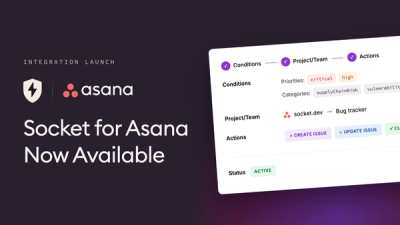
Create and manage Asana tasks directly from Socket alerts, with manual task creation, automated ticketing rules, and two-way sync.

Security News
Open VSX has removed three extension IDs from its malicious-extension list as the legitimate publishers they impersonated move to claim the names for themselves.