Draft
Stop shipping AI-generated bugs.
One command runs a three-stage review on your branch — validation, spec compliance, code quality — and writes the missing tests. Free. Open-source. MIT.




Powered by codebase-memory-mcp by DeusData — a 159-language, 100% local knowledge-graph engine.
Website ·
Docs ·
Methodology ·
Watch (8 min) ·
All Videos
The 60-second pitch
Your AI assistant just wrote 200 lines. Some of them are bugs. Some don't match your patterns. Some skip tests.
/draft:review
Three stages, one command:
- Validation — runs your tests, lints, type-checks, and surfaces real failures
- Spec compliance — checks the diff against the agreed spec, not vibes
- Code quality — flags hotspots, blast radius, and missing test coverage using a tree-sitter knowledge graph of your repo
No setup required for the first run: on an un-indexed repo it reviews the diff and names the structural checks it skipped, so you see findings before you spend anything.
Free. No API keys. No paid tier. No vendor lock-in. Catches the 3 bugs you missed before they hit your reviewer.
Demo coming soon — for now, watch the 8-minute walkthrough.
Install (30 seconds)
One command installs Draft into your agent. No clone, no config.
npx @drafthq/draft install <host>
…or install the CLI once and reuse it:
npm install -g @drafthq/draft
draft install <host>
draft list
Each host installs the way that host actually loads extensions — no manual steps after the command:
| Claude Code | claude-code | Registers the plugin via claude plugin marketplace add + claude plugin install (user scope). Restart Claude Code. |
| Cursor | cursor | Copies the plugin into ~/.cursor/plugins/local/draft/, writes .cursor-plugin/plugin.json, registers draft@draft-plugins in Cursor's plugin registry, and enables it. Restart Cursor (or Developer: Reload Window). Existing installs upgrade with draft install cursor --force. |
| Codex | codex | Writes ./AGENTS.md, which Codex reads automatically. |
| opencode | opencode | Writes ./AGENTS.md + ~/.agents/skills/draft/, both auto-discovered. |
Flags: --global / --project to pick scope, --dry-run to preview, --force to overwrite, --no-graph to skip the graph-engine fetch.
Then, in Claude Code (after restarting):
/draft:review
/draft:init
/draft:review
/draft:review runs on an un-indexed repo and tells you exactly which structural checks it had to skip. Indexing is the upgrade, not the entry fee.
Run /draft for the full command map.
Other ways to install →
Claude Code — native marketplace
/plugin marketplace add drafthq/draft
/plugin install draft
Cursor — from GitHub
Cursor requires .cursor-plugin/plugin.json; the draft install cursor command also registers the plugin via the shared Claude plugin registry that Cursor reads on many builds. To add from source instead, use Settings > Rules, Skills, Subagents > Rules > New > Add from Github:
https://github.com/drafthq/draft.git
GitHub Copilot
Copilot reads a committed instructions file — copy it directly (not a draft install host):
mkdir -p .github && curl -o .github/copilot-instructions.md \
  https://raw.githubusercontent.com/drafthq/draft/main/integrations/copilot/.github/copilot-instructions.md
Gemini
curl -o .gemini.md https://raw.githubusercontent.com/drafthq/draft/main/integrations/gemini/.gemini.md
The five commands
/draft:review | 3-stage review of your diff. Works with zero setup — run it first. |
/draft:init | Index the repo once. Adds blast radius, caller lookup, hotspot ranking, and cycle detection to every later review. |
/draft:new-track | Turn an idea into a spec + plan before any code is written. |
/draft:implement | Execute the plan task-by-task under TDD with verification gates. |
/draft:graph | Build or refresh the knowledge-graph snapshot on its own. |
That is the whole loop. 28 more specialist commands — bug hunting, ACID audits, ADRs, tech debt, incident response, Jira, coverage, standups — sit behind five intent routers (/draft:plan, /draft:discover, /draft:ops, /draft:docs, /draft:jira).
Full command reference → · run /draft for the interactive intent map
Built-in Code Intelligence
Draft is powered by a local knowledge graph engine (codebase-memory-mcp) that gives every command precise structural context — module boundaries, call graphs, dependencies, hotspots. It's 100% local (no API key, no SaaS), fetched during draft install (best-effort; --no-graph to skip), with first-use fetch as a fallback.
/draft:graph
scripts/tools/graph-impact.sh --file src/auth/login.go
| Multi-language extraction | Tree-sitter + LSP-grade resolution across 159 languages, 100% local |
| Call graph | Callers/callees with confidence signals so review/bughunt can weight findings |
| Impact analysis | Blast-radius with file-class dimension (code/test/doc/config) — answers "what breaks if I change this?" |
| Cycle detection | Flags circular call dependencies before they bite |
| Hotspot ranking | Fan-in score so high-risk symbols get extra scrutiny |
| Incremental indexing | git-aware, content-based; only changed code re-indexes |
| Track impact memory | metadata.json.impact snapshots each completed track's blast radius — /draft:new-track flags overlap with recent work |
The graph powers /draft:graph and /draft:impact, enriches /draft:bughunt and /draft:review, and is consumed by skills via core/shared/graph-query.md. The engine is installed via scripts/fetch-memory-engine.sh; the deterministic shell helpers live under scripts/tools/.
Deterministic helper tools
Skills also call into shell helpers under scripts/tools/ for mechanical work — git metadata, file classification, test-framework detection, hotspot ranking, freshness checks, ADR indexing, and live graph queries (graph-callers.sh, graph-impact.sh, hotspot-rank.sh, cycle-detect.sh, mermaid-from-graph.sh). All emit JSON or markdown, follow a uniform exit-code contract, and degrade gracefully when their input source is unavailable.
How It Works
┌─────────────────────────────────────────────────────────────┐
│                        /draft:init                          │
│    5-phase codebase analysis + signal detection + state     │
│  architecture.md + .ai-context.md + .state/ (freshness,    │
│                   signals, run memory)                      │
└────────────────────────────┬────────────────────────────────┘
                             │
                             ▼
┌─────────────────────────────────────────────────────────────┐
│                      /draft:new-track                       │
│            AI-guided spec.md + phased plan.md               │
└────────────────────────────┬────────────────────────────────┘
                             │
                             ▼
┌─────────────────────────────────────────────────────────────┐
│                     /draft:implement                        │
│              RED → GREEN → REFACTOR (repeat)                │
└────────────────────────────┬────────────────────────────────┘
                             │
                             ▼
┌─────────────────────────────────────────────────────────────┐
│                      /draft:review                          │
│        Three-stage review (validation + spec + quality)     │
└─────────────────────────────────────────────────────────────┘

         /draft:init refresh  ←── incremental: only re-analyze
                                   files with changed hashes
Context output modes (/draft:init)
/draft:init packages your architecture context in one of two modes, selected
automatically by repo size (override with DRAFT_INIT_MODE):
monolith (default for small repos, tiers 1–2) — a single
graph-primary architecture.md is the source of truth; .ai-context.md is
the token-optimized AI view derived from it.okf (default for larger repos, tiers 3+) — an OKF concept taxonomy
under draft/wiki/ is the source of truth (one concept per file, cross-links
form the graph), .ai-context.md becomes the navigable index root
(Synopsis + Concept Map), and architecture.md is demoted to a generated
rendered view. An optional self-contained offline HTML viewer ships under
draft/wiki/web/.
Both modes produce the same product.md, tech-stack.md, workflow.md,
guardrails.md, tracks, and .state/ — only the architecture packaging differs.
Full workflow →
Why Draft?
AI tools are fast but unstructured. Draft applies Context-Driven Development to impose clear boundaries: explicit context, phased execution, and built-in verification, ensuring outputs remain aligned, predictable, and production-ready.
product.md       →  "Build a task manager"
tech-stack.md    →  "React, TypeScript, Tailwind"
architecture.md  →  Comprehensive: 10-section graph-primary engineering reference, Mermaid diagrams (source of truth). Mature brownfield projects with strong existing agent docs (CLAUDE.md, INVARIANTS.md, etc.) receive early Context Quality Audit, graph fidelity dashboard, and explicit Relationship + Gaps sections (no blind duplication).
.ai-context.md   →  200-400 lines: condensed from architecture.md (token-optimized AI context)
.state/          →  freshness hashes, signal classification, run memory (incremental refresh)
spec.md          →  "Add drag-and-drop reordering"
plan.md          →  "Phase 1: sortable, Phase 2: persist"
Each layer narrows the solution space. By the time AI writes code, decisions are made.
Incremental refresh: After initial setup, /draft:init refresh uses stored file hashes and signal classification to only re-analyze what changed — no full re-scan needed.
Read methodology →
Contributing
Source of Truth
core/methodology.md — Master methodologyskills/<name>/SKILL.md — Command implementationsintegrations/ — Auto-generated (don't edit)
Update Workflow
./scripts/build-integrations.sh
Full architecture →
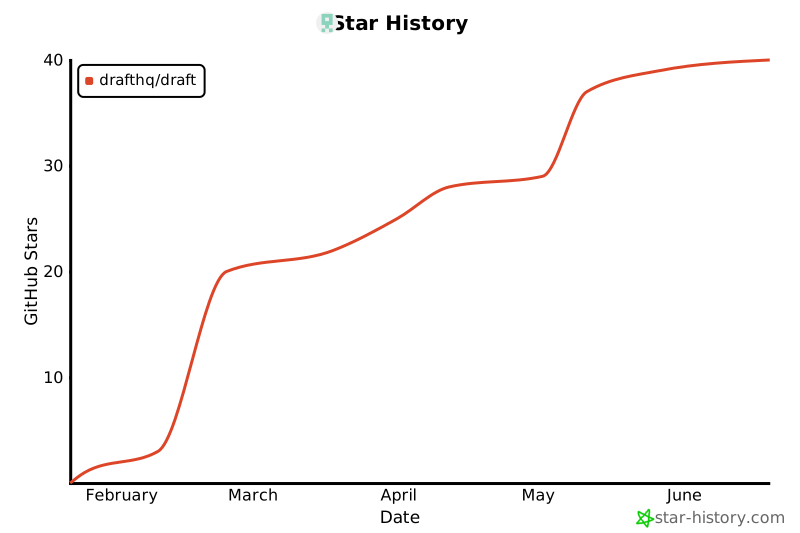
Star History
MIT License · Graph engine: codebase-memory-mcp by DeusData
Credits: Inspired by gemini-cli-extensions/conductor