
Product
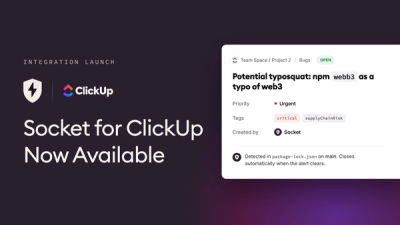
Socket for ClickUp Is Now Available
Create ClickUp tasks from Socket alerts, automate ticketing with custom rules, and keep alert and task status synchronized.
By Jeppe Hasseriis - Aug 26, 2026
@electric-sql/pglite
Advanced tools
PGlite is a WASM Postgres build packaged into a TypeScript client library that enables you to run Postgres in the browser, Node.js and Bun, with no need to install any other dependencies. It is only 3.7mb gzipped.

PGlite - the WASM build of Postgres from Electric.
Build reactive, realtime, local-first apps directly on Postgres.






PGlite is a WASM Postgres build packaged into a TypeScript client library that enables you to run Postgres in the browser, Node.js, Bun and Deno, with no need to install any other dependencies. It is only 3mb gzipped and has support for many Postgres extensions, including pgvector and PostGIS.
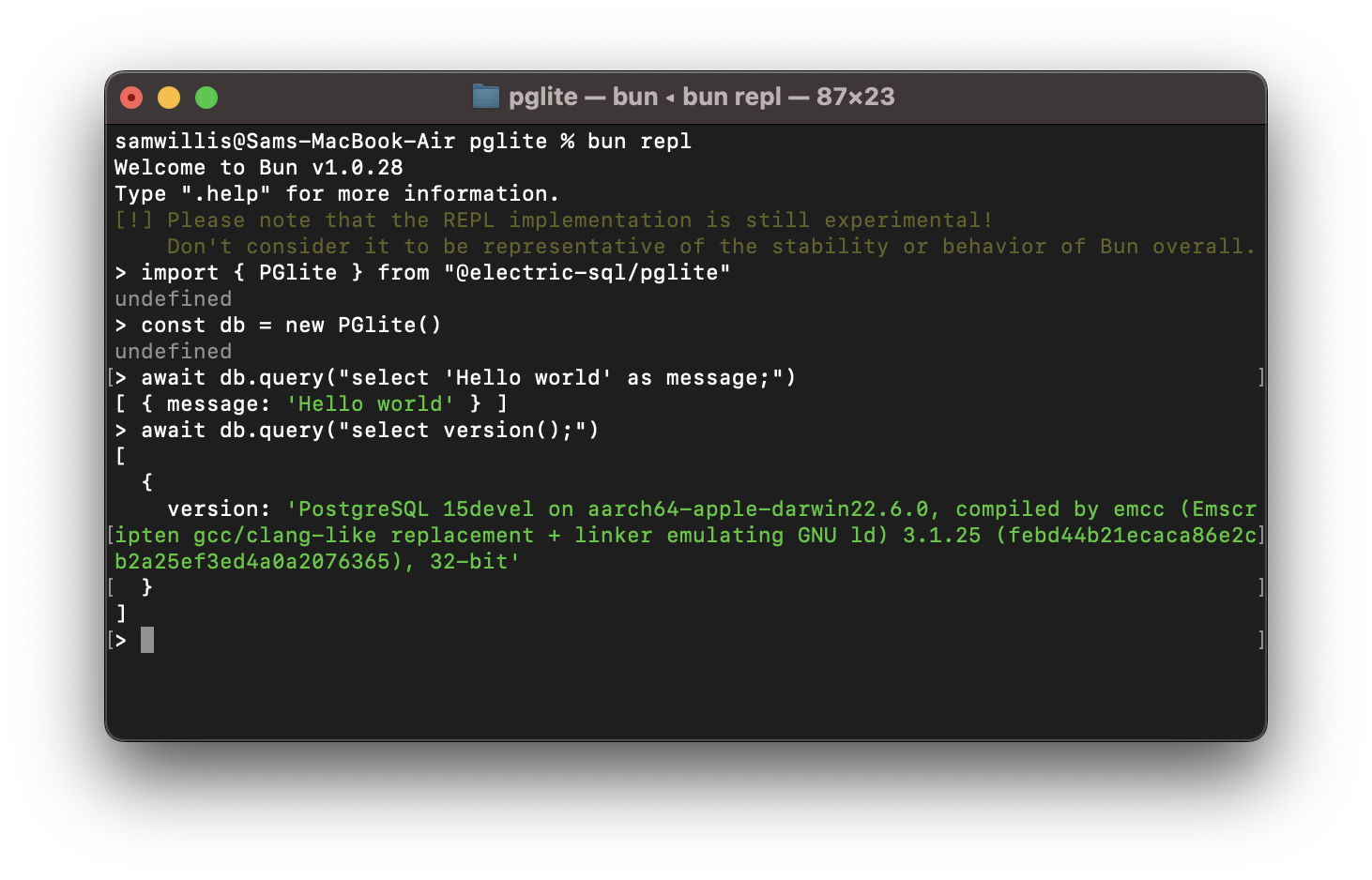
import { PGlite } from '@electric-sql/pglite'
const db = new PGlite()
await db.query("select 'Hello world' as message;")
// -> { rows: [ { message: "Hello world" } ] }
It can be used as an ephemeral in-memory database, or with persistence either to the file system (Node/Bun/Deno) or indexedDB (Browser).
Unlike previous "Postgres in the browser" projects, PGlite does not use a Linux virtual machine - it is simply Postgres in WASM.
For full documentation and user guides see pglite.dev.
It can be installed and imported using your usual package manager:
import { PGlite } from '@electric-sql/pglite'
or using a CDN such as JSDeliver:
import { PGlite } from 'https://cdn.jsdelivr.net/npm/@electric-sql/pglite/dist/index.js'
Then for an in-memory Postgres:
const db = new PGlite()
await db.query("select 'Hello world' as message;")
// -> { rows: [ { message: "Hello world" } ] }
or to persist the database to indexedDB:
const db = new PGlite('idb://my-pgdata')
Install into your project:
NodeJS
npm install @electric-sql/pglite
Bun
bun install @electric-sql/pglite
Deno
deno add npm:@electric-sql/pglite
To use the in-memory Postgres:
import { PGlite } from '@electric-sql/pglite'

const db = new PGlite()
await db.query("select 'Hello world' as message;")
// -> { rows: [ { message: "Hello world" } ] }
or to persist to the filesystem:
const db = new PGlite('./path/to/pgdata')
PostgreSQL typically operates using a process forking model; whenever a client initiates a connection, a new process is forked to manage that connection. However, programs compiled with Emscripten - a C to WebAssembly (WASM) compiler - cannot fork new processes, and operates strictly in a single-process mode. As a result, PostgreSQL cannot be directly compiled to WASM for conventional operation.
Fortunately, PostgreSQL includes a "single user mode" primarily intended for command-line usage during bootstrapping and recovery procedures. Building upon this capability, PGlite introduces a input/output pathway that facilitates interaction with PostgreSQL when it is compiled to WASM within a JavaScript environment.
The build process of PGlite is split into two parts:
Docker is required to build the WASM module, along with Node (v20 or above) and pnpm for package management and building the TypeScript packages.
To start checkout the repository and install dependencies:
git clone https://github.com/electric-sql/pglite
cd pglite
pnpm install
To build everything, we have the convenient pnpm build:all command in the root of the repository. This command will:
/packages/pglite/release.To only build the Postgres WASM module (i.e. point 1 above), run
pnpm wasm:build
If you don't want to build the WASM module and assorted WASM binaries from scratch, you can download them from a comment under the most recently merged PR, labeled as interim build files, and place them under packages/pglite/release.
To build all TypeScript packages (i.e. point 2 of the above), run:
pnpm ts:build
This will build all packages in the correct order based on their dependency relationships. You can now develop any individual package using the build and test scripts, as well as the stylecheck and typecheck scripts to ensure style and type validity.
Or alternatively to build a single package, move into the package directory and run:
cd packages/pglite
pnpm build
When ready to open a PR, run the following command at the root of the repository:
pnpm changeset
And follow the instructions to create an appropriate changeset. Please ensure any contributions that touch code are accompanied by a changeset.
PGlite builds on the work of Stas Kelvich of Neon in this Postgres fork.
PGlite is dual-licensed under the terms of the Apache License 2.0 and the PostgreSQL License, you can choose which you prefer.
Changes to the Postgres source are licensed under the PostgreSQL License.
FAQs
PGlite is a WASM Postgres build packaged into a TypeScript client library that enables you to run Postgres in the browser, Node.js and Bun, with no need to install any other dependencies. It is only 3.7mb gzipped.
The npm package @electric-sql/pglite receives a total of 12,685,125 weekly downloads. As such, @electric-sql/pglite popularity was classified as popular.
We found that @electric-sql/pglite demonstrated a healthy version release cadence and project activity because the last version was released less than a year ago. It has 4 open source maintainers collaborating on the project.
Product
Create ClickUp tasks from Socket alerts, automate ticketing with custom rules, and keep alert and task status synchronized.
Product
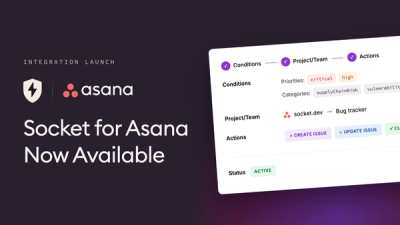
Create and manage Asana tasks directly from Socket alerts, with manual task creation, automated ticketing rules, and two-way sync.

Security News
Open VSX has removed three extension IDs from its malicious-extension list as the legitimate publishers they impersonated move to claim the names for themselves.