
Product
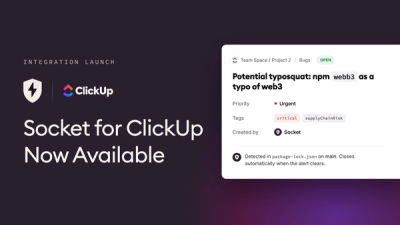
Socket for ClickUp Is Now Available
Create ClickUp tasks from Socket alerts, automate ticketing with custom rules, and keep alert and task status synchronized.
By Jeppe Hasseriis - Aug 26, 2026
@elementor/utils
Advanced tools
This package contains utility functions that are being used across the Elementor packages
This package contains utility functions that are being used across the Elementor packages.
This module contains a standard API for creating custom error classes in Elementor packages.
createErrorTo ensure consistency across the Elementor packages, we recommend creating a new error class that extends the
ElementorError class using the createError function that does it for you.
For convenience, we've exposed a createError utility function that will create a custom error type for you.
This function will force your error code and message to be static (per our guidelines), and will shorten your code a little bit:
// errors.ts
import { createError } from '@elementor/utils';

export const CannotRender = createError<{ id: string; }>( 'cannot-render', 'Cannot render element' );
export const CannotSave = createError<{ id: number; status: string; }>( 'cannot-save', 'Cannot save document' );
export const ElementNotFound = createError<{ id: string; }>( 'element-not-found', 'Element not found' );
If you prefer to create a new error type manually, you can extend the ElementorError class.
Inside your class, you'll need to define a unique error code and message that should be passed to the parent constructor.
We recommend having static string values for both the code and the message, so it'll then be easier to filter them in the
error-tracking tools (e.g. message = 'cannot render element'; rather than message = 'Cannot render element' + id;).
If you need to pass more information about the error, attach it to the context.
import { ElementorError, type ElementorErrorOptions } from '@elementor/utils';

type CannotRenderContext = {
	id: string;
};

type CannotRenderOptions = {
	context: CannotRenderContext;
	cause?: ElementorErrorOptions['cause'];
};

class CannotRender extends ElementorError {
	constructor( { context, cause }: CannotRenderOptions ) {
		const code = 'cannot-render';
		const message = 'Cannot render element';

		super( message, { cause, context, code } );
	}
}
After creating your custom error type (as described above), you can throw it in your code:
Basic example:
export const ElementNotFound = createError<{ id: string; }>( 'element-not-found', 'Element not found' );

function renderElement( id: string ): string {
	const element = findElementById( id );

	if ( ! element ) {
		throw new ElementNotFound({ context: { id } });
	}

	return element.render();
}
Example with a cause:
export const CannotSave = createError<{ id: number; status: string; }>( 'cannot-save', 'Cannot save document' );

try {
	 thirdPartyService.save( id );
} catch ( error ) {
	throw new CannotSave({ context: { id, status: error.status }, cause: error });
}
ensureErrorThe ensureError function is a utility function that ensures that the given value is an error.
If the value is already an error, it will be returned as is.
If the value is not an error, it will be wrapped with an Error that includes the thrown value.
import { ensureError } from '@elementor/utils';

const CannotUpdate = createError<{ id: number; }>( 'cannot-update', 'Cannot update document' );

try {
	thirdPartyService.update( id );
} catch ( error ) {
	const errorInstance = ensureError( error );

	throw new CannotUpdate({ context: { id }, cause: errorInstance });
}
FAQs
This package contains utility functions that are being used across the Elementor packages
We found that @elementor/utils demonstrated a healthy version release cadence and project activity because the last version was released less than a year ago. It has 5 open source maintainers collaborating on the project.
Product
Create ClickUp tasks from Socket alerts, automate ticketing with custom rules, and keep alert and task status synchronized.
Product
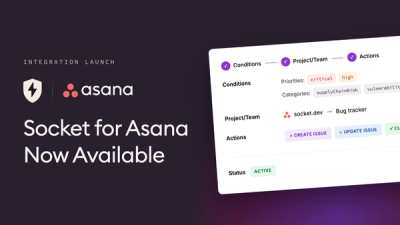
Create and manage Asana tasks directly from Socket alerts, with manual task creation, automated ticketing rules, and two-way sync.

Security News
Open VSX has removed three extension IDs from its malicious-extension list as the legitimate publishers they impersonated move to claim the names for themselves.