
Product
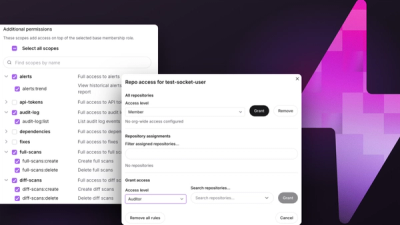
Introducing Repository Access Permissions and Custom Roles
Socket now supports Custom Roles and Repository Access Permissions so organizations can control who can access specific repositories and actions.
By Joe Werle - Jun 19, 2026
@fluojs/platform-cloudflare-workers
Advanced tools
Cloudflare Workers HTTP adapter for the Fluo runtime built on the shared Web Request/Response core.
English 한국어
Cloudflare Workers HTTP adapter for the fluo runtime, optimized for the edge.
npm install @fluojs/platform-cloudflare-workers
This package is intended to run on Cloudflare Workers. The published manifest intentionally does not declare engines.node, so npm metadata stays aligned with the Workers runtime contract; the repository's Node.js 20+ requirement only applies to the maintainer build/test toolchain.
Use this package when deploying fluo applications to Cloudflare Workers. It is designed for the serverless edge environment, providing a lightweight fetch-based adapter that respects Worker isolate constraints and native Web APIs.
The adapter binds each request lifecycle to executionContext.waitUntil(...) and keeps in-flight dispatches alive during close() so Worker shutdown does not drop active work mid-request.
During application shutdown, the adapter stops accepting new ingress immediately and gives active HTTP handlers a bounded 10-second drain window before close() fails with a timeout instead of hanging indefinitely. While that drain is still in progress, a concurrent listen() call rejects with Cloudflare Workers adapter cannot listen while shutdown is still draining. instead of reopening the Worker. Once closed, follow-up HTTP and WebSocket upgrade requests receive the same JSON 503 shutdown response until the adapter is explicitly listened again.
Bootstrap your application and export a standard Cloudflare Worker fetch handler.
import { fluoFactory } from '@fluojs/runtime';
import { createCloudflareWorkerAdapter } from '@fluojs/platform-cloudflare-workers';
import { AppModule } from './app.module';

const adapter = createCloudflareWorkerAdapter();
const app = await fluoFactory.create(AppModule, { adapter });

await app.listen();

export default {
  fetch: (req, env, ctx) => adapter.fetch(req, env, ctx),
};
Use the entrypoint helper for an even simpler setup that bootstraps on the first request.
import { createCloudflareWorkerEntrypoint } from '@fluojs/platform-cloudflare-workers';
import { AppModule } from './app.module';

const worker = createCloudflareWorkerEntrypoint(AppModule);

export default {
  fetch: worker.fetch,
};
The adapter supports Cloudflare's native WebSocketPair for real-time communication via the @fluojs/websockets/cloudflare-workers binding. Upgrade handling is opt-in through that binding, and createWebSocketPair can be injected for non-hosted runtime tests.
@WebSocketGateway({ path: '/ws' })
export class MyGateway {}
Standard fluo middleware (CORS, Global Prefix, etc.) is fully supported and optimized for the Cloudflare environment.
const adapter = createCloudflareWorkerAdapter({
  globalPrefix: 'api/v1',
  cors: true,
});
fetch() registers active work with executionContext.waitUntil(...) after listen() binds the dispatcher.listen() do not reach the configured binding.close() returns JSON 503 responses for new requests during and after shutdown and times out after 10 seconds if active requests never settle. Calling listen() while that close drain is still active rejects with the Cloudflare Workers adapter shutdown-draining error.rawBody.env object is passed through the fetch entrypoint boundary; package-level config resolution remains application-owned.packages/platform-cloudflare-workers/src/adapter.test.ts is the package-local regression target for the documented Worker contract. It covers shared Web dispatch delegation, executionContext.waitUntil(...) registration, websocket upgrade binding, listen-bound upgrade ownership, lazy entrypoint reuse, shutdown gating, drain-time listen() rejection, JSON 503 responses while closing and after close, and the bounded 10-second close timeout.
The shared edge portability suite in packages/testing/src/portability/web-runtime-adapter-portability.test.ts exercises Cloudflare Workers beside Bun and Deno for malformed cookie preservation, query decoding, JSON/text raw-body capture, multipart raw-body exclusion, and SSE framing. The README parity assertion in the package test keeps these documented edge-runtime coverage claims synchronized with the Korean mirror.
createCloudflareWorkerAdapter(options): Factory for the Worker HTTP adapter.createCloudflareWorkerEntrypoint(module, options): Creates a lazy-bootstrapping Worker entrypoint.bootstrapCloudflareWorkerApplication(module, options): Async bootstrap helper for Workers.CloudflareWorkerHttpApplicationAdapter: The core adapter implementation.CloudflareWorkerHandler: Fetch handler interface shared by Worker application wrappers and lazy entrypoints.CloudflareWorkerApplication: Fully bootstrapped Worker application wrapper with adapter, app, fetch(...), and close(...).CloudflareWorkerEntrypoint: Lazy entrypoint with fetch, ready(), and close() lifecycle methods.CloudflareWorkerAdapterOptions, BootstrapCloudflareWorkerApplicationOptions, CloudflareWorkerExecutionContext, CloudflareWorkerWebSocketBinding, and Worker websocket pair/upgrade types.@fluojs/runtime: Core framework runtime.@fluojs/websockets: Includes specific subpath @fluojs/websockets/cloudflare-workers.@fluojs/http: Shared HTTP decorators.packages/platform-cloudflare-workers/src/adapter.test.tspackages/websockets/src/cloudflare-workers/cloudflare-workers.test.tsFAQs
Cloudflare Workers HTTP adapter for the Fluo runtime built on the shared Web Request/Response core.
The npm package @fluojs/platform-cloudflare-workers receives a total of 63 weekly downloads. As such, @fluojs/platform-cloudflare-workers popularity was classified as not popular.
We found that @fluojs/platform-cloudflare-workers demonstrated a healthy version release cadence and project activity because the last version was released less than a year ago. It has 1 open source maintainer collaborating on the project.
Did you know?

Socket for GitHub automatically highlights issues in each pull request and monitors the health of all your open source dependencies. Discover the contents of your packages and block harmful activity before you install or update your dependencies.
Product
Socket now supports Custom Roles and Repository Access Permissions so organizations can control who can access specific repositories and actions.
Product
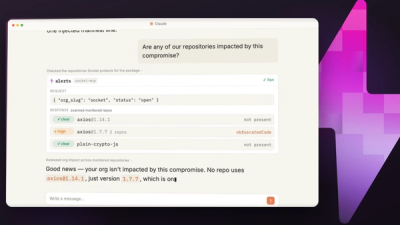
Socket MCP now lets AI assistants review org alerts, investigate threats using the Socket threat feed, and inspect package files in addition to dependency scoring.
Product
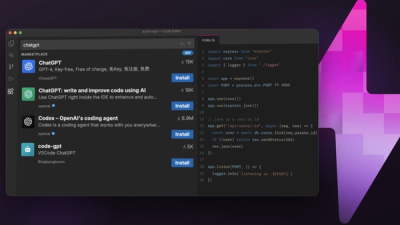
Socket Firewall blocks malicious VS Code and Open VSX extensions before install, protecting developers from compromised editor marketplaces.