
Product
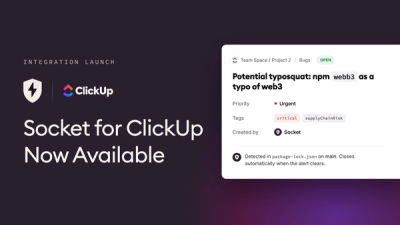
Socket for ClickUp Is Now Available
Create ClickUp tasks from Socket alerts, automate ticketing with custom rules, and keep alert and task status synchronized.
By Jeppe Hasseriis - Aug 26, 2026
@formio/mcp
Advanced tools
The MCP server (@formio/mcp) is independently usable from any MCP-aware client. From a clone of this repo:
pnpm install
pnpm --filter @formio/mcp dev
The server starts on port 3000. Override with the PORT env var.
| Transport | Endpoint | Compatible with |
|---|---|---|
| Streamable HTTP | POST /mcp | Claude Code, VS Copilot, modern MCP clients |
| SSE | GET /sse + POST /messages | Claude Desktop, legacy MCP clients |
| stdio | node dist/stdio.js | .mcp.json spawn-mode clients |
{
  "mcpServers": {
    "formio-mcp": {
      "type": "http",
      "url": "http://localhost:3000/mcp"
    }
  }
}
claude_desktop_config.json:
{
  "mcpServers": {
    "formio-mcp": {
      "url": "http://localhost:3000/sse"
    }
  }
}
.mcp.json (stdio){
"mcpServers": {
"formio-mcp": {
"command": "npx",
"args": ["-y", "@formio/mcp"],
"env": {
"FORMIO_BASE_URL": "https://api.form.io",
"FORMIO_PROJECT_URL": "https://your-project.form.io"
}
}
}
}
In standalone (non-plugin) mode, FORMIO_BASE_URL and FORMIO_PROJECT_URL are required env vars. In plugin mode, the plugin manages both via Claude Code's user-config + per-cwd ~/.formio/projects.json mapping.
The bundled @formio/mcp server exposes these tools. Skills prefer these over raw HTTP whenever an operation is covered.
| Tool | Purpose |
|---|---|
form_create | Create a new form. Use the formio-form skill first to build the JSON definition. |
form_get | Fetch a single form definition by ID or path. |
form_list | List forms with optional filtering and pagination. |
form_update | Update an existing form. Call form_get first, edit with formio-form, then update. |
| Tool | Purpose |
|---|---|
role_create | Create a new project role. |
role_list | List all project roles. |
role_update | Full-replacement update of a role. Include all fields you want preserved. |
| Tool | Purpose |
|---|---|
action_types_list | List all action types available on the server. |
action_type_get | Get an action type's settings schema. |
action_create | Attach a new action to a form. |
action_list | List actions on a form. |
action_get | Get a single action by ID. |
action_update | Update an action. |
action_delete | Detach an action from a form. |
| Tool | Purpose |
|---|---|
project_export | Export the project's complete template (roles, resources, forms, actions) as a portable JSON document. Use before project_import to snapshot. |
project_import | Import a template JSON — additively merges roles, resources, forms, and actions in one call. Same-machine-name items are overwritten in place; everything else is preserved. |
project_set | Plugin-mode only — persist a per-cwd Project URL mapping in ~/.formio/projects.json. Never exposed standalone (the standalone server binds to FORMIO_PROJECT_URL via env instead). |
| Tool | Purpose |
|---|---|
hello | Smoke-test tool. Returns a static greeting; useful for verifying MCP wiring before any authenticated call. |
The MCP server supports two authentication modes:
/callback endpoint, and formioFetch attaches x-jwt-token on every subsequent request. The flow is implicit — the first authenticated tool call triggers it on a cache miss. No explicit authenticate tool exists.FORMIO_API_KEY. All requests attach x-token; the browser flow is skipped entirely.When FORMIO_LOGIN_FORM is unset, the server probes these candidates on the first login attempt and caches the first one that responds (1.5-second timeout per candidate):
${FORMIO_BASE_URL}/formio/user/login (portal-base)${FORMIO_PROJECT_URL}/admin/login (project admin)${FORMIO_PROJECT_URL}/user/login (project user)The probe runs lazily — only when the local auth page is actually served.
| Name | Required | Default | Purpose | Hosted SaaS example | Self-hosted example |
|---|---|---|---|---|---|
FORMIO_BASE_URL | yes | — | Full base URL of your Form.io deployment. | https://api.form.io | https://forms.example.com |
FORMIO_PROJECT_URL | yes* | — | Full URL of your Form.io project. In plugin mode, only used as the pre-filled default offered when prompting for an unmapped cwd. | https://myproject.form.io | https://forms.example.com/myproject |
FORMIO_API_KEY | no | undefined | Long-lived project API key. When set, the server skips the browser login flow. | CHANGEME | CHANGEME |
FORMIO_LOGIN_FORM | no | Auto-resolved | Override the portal login form URL used by the JWT login flow. | https://formio.form.io/user/login | https://forms.example.com/formio/user/login |
FORMIO_PLUGIN_CONTEXT | no | 0 | Set by the plugin manifest. When 1, the server enables project_set and reads FORMIO_PROJECT_URL from ~/.formio/projects.json per cwd instead of env. |
* In plugin context, FORMIO_PROJECT_URL is captured per-cwd by the project_set tool and persisted to ~/.formio/projects.json. The verify-project-url SessionStart/PreToolUse hook offers formio_default_project_url (from plugin user-config) as the default the first time you enter a workspace.
FAQs
Form.io MCP Server
We found that @formio/mcp demonstrated a healthy version release cadence and project activity because the last version was released less than a year ago. It has 7 open source maintainers collaborating on the project.
Product
Create ClickUp tasks from Socket alerts, automate ticketing with custom rules, and keep alert and task status synchronized.
Product
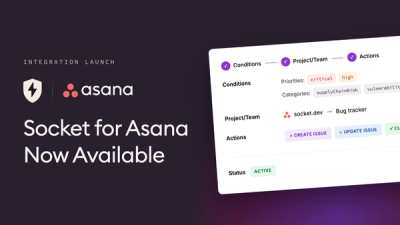
Create and manage Asana tasks directly from Socket alerts, with manual task creation, automated ticketing rules, and two-way sync.

Security News
Open VSX has removed three extension IDs from its malicious-extension list as the legitimate publishers they impersonated move to claim the names for themselves.