

Security News
Next.js moves to scheduled security releases
Vercel is formalizing a monthly release program for Next.js. The change follows React2Shell and a sharp rise in AI-assisted vulnerability discovery.
By Sarah Gooding - Jul 16, 2026
@inferagraph/cosmosdb
Advanced tools
Azure Cosmos DB NoSQL datasource, vector store, inferred-edge store, conversation store, and cache provider for InferaGraph
Azure Cosmos DB NoSQL bindings for @inferagraph/core: datasource, vector embedding store, inferred-edge store, conversation store, and cache provider — all in one package.
Data-safety fix. CosmosVectorEmbeddingStore.set() and .clear() now use Cosmos NoSQL JSON Patch for atomic, field-level updates. The 0.3.0/0.3.1 implementation followed a read -> merge -> upsert pattern that wiped pre-existing fields on the document (e.g., content, title, type) whenever the read returned partial data or failed transiently. With patch-based writes, every other field on the document is left untouched.
The same fix applies to CosmosConversationStore.appendTurn, which now uses add /turns/- to atomically append a turn (and add /ttl to slide the sliding TTL forward) instead of read-merge-upsert. Host-owned metadata fields on the conversation doc survive every append.
Behavior change (breaking, hence the !): CosmosVectorEmbeddingStore.set() no longer creates a stub {id} document when the target doc is missing. Hosts must ensure unit documents exist before indexing — the typical flow is a server-side upsert pass that writes the body, then a separate reindex pass that adds embeddings on top. The previous stub-creation fallback masked the wipe regression in production.
CosmosCacheProvider and CosmosInferredEdgeStore are unchanged: their documents are end-to-end owned by the provider/indexer (no host fields to preserve), so full upsert / bulk-replace is the documented contract. Contract pin-down tests were added for both.
Migration from
@inferagraph/cosmosdb-datasource@0.2.0:pnpm remove @inferagraph/cosmosdb-datasource pnpm add @inferagraph/cosmosdbClass renames:
VectorEmbeddingStore→CosmosVectorEmbeddingStore,CosmosDbDatasource→CosmosDataSource. Peer dependency bumped to@inferagraph/core@^0.9.0. The@azure/cosmosSDK is now a direct dependency of this package — hosts no longer need to install it themselves.
pnpm add @inferagraph/cosmosdb @inferagraph/core
The recommended on-ramp is the lowercase factory function for each piece. Hosts pass domain config (endpoint, key, database, container) and the package owns SDK construction internally:
import { cosmosDataSource } from '@inferagraph/cosmosdb';

const datasource = cosmosDataSource({
  endpoint: 'https://your-account.documents.azure.com:443/',
  key: 'your-key',
  database: 'my-database',
  container: 'my-container',
});

await datasource.connect();
const view = await datasource.getInitialView();
console.log(view.nodes, view.edges);
await datasource.disconnect();
For shared-client or custom-auth scenarios, use the PascalCase class constructors directly — they accept a pre-built CosmosClient (the escape hatch).
getNeighbors(nodeId, depth) supports depth > 1. Cosmos DB NoSQL has no native graph traversal, so the datasource does an application-level BFS — one 1-hop fan-out per level, deduping nodes and edges by id. Single-hop callers see no change.
| Option | Required | Description |
|---|---|---|
endpoint | Yes | Cosmos DB account endpoint URL |
key | Yes | Account key for authentication |
database | Yes | Database name |
container | Yes | Container name for nodes (and edges if not separated) |
edgesContainer | No | Separate container for edge documents |
inferredEdgesContainer | No | Separate container for inferred-edge embeddings (typically inferred_edges) |
embeddingPath | No | JSON path of the embedding field on documents (default /embedding) |
partitionKeyPath | No | Partition key path |
Nodes and edges are stored as JSON documents differentiated by a _docType field:
Node document:
{
  "id": "node-1",
  "_docType": "node",
  "name": "Example Node",
  "type": "person"
}
Edge document:
{
  "id": "edge-1",
  "_docType": "edge",
  "sourceId": "node-1",
  "targetId": "node-2",
  "type": "related_to"
}
This package ships five building blocks that turn a Cosmos NoSQL account into the persistence layer for @inferagraph/core's RAG pipeline:
provisionVectorContainers — one-time, idempotent setup of the units container's vector index policy plus the inferred-edges container.cosmosVectorEmbeddingStore / CosmosVectorEmbeddingStore — implements EmbeddingStore. Backed by the units container with a vector index on /embedding.cosmosInferredEdgeStore / CosmosInferredEdgeStore — implements InferredEdgeStore. Backed by a separate inferred_edges container with its own vector index.cosmosConversationStore / CosmosConversationStore — implements ConversationStore. One Cosmos document per conversation, sliding TTL on append.cosmosCacheProvider / CosmosCacheProvider — implements CacheProvider. Backs the engine's LLM-response cache with a TTL-enforced Cosmos container.All five are provider-agnostic. Embedding model, dimensions, distance function, vector data type, and the JSON path of the embedding field are constructor options — the datasource never assumes a specific LLM provider.
Call provisionVectorContainers once during setup (CI deploy, or a manual setup script):
import { provisionVectorContainers } from '@inferagraph/cosmosdb';

await provisionVectorContainers({
  endpoint: process.env.COSMOS_ENDPOINT!,
  key: process.env.COSMOS_KEY!,
  database: 'biblegraph',
  unitsContainer: 'units',
  // Optional — sensible defaults shown:
  inferredEdgesContainer: 'inferred_edges', // default
  embeddingDimensions: 3072,                // default; matches text-embedding-3-large
  embeddingPath: '/embedding',              // default
  vectorIndexType: 'quantizedFlat',         // default; alternatives: 'diskANN', 'flat'
  distanceFunction: 'cosine',               // default; alternatives: 'dotproduct', 'euclidean'
  dataType: 'Float32',                      // default; alternatives: 'Float16', 'Int8'
});
The function is idempotent: it no-ops on the units container when it already carries the policy, and only creates inferred_edges when missing.
If the units container exists but cannot be altered to add the vector policy (some legacy Cosmos modes reject in-place vector-policy changes), provisionVectorContainers throws an actionable error explaining that the container must be dropped and recreated. Unknown errors propagate raw.
GraphIndexer@inferagraph/core@^0.9.0 exposes GraphIndexer, the engine that walks the in-memory graph, calls the LLM provider's embed(), and persists vectors via the EmbeddingStore you give it. Pass the Cosmos-backed implementations from this package using the factory functions:
import { GraphIndexer } from '@inferagraph/core';
import {
  cosmosVectorEmbeddingStore,
  cosmosInferredEdgeStore,
} from '@inferagraph/cosmosdb';

const embeddingStore = cosmosVectorEmbeddingStore({
  endpoint: process.env.COSMOS_ENDPOINT!,
  key: process.env.COSMOS_KEY!,
  database: 'biblegraph',
  container: 'units',
});

const inferredEdgeStore = cosmosInferredEdgeStore({
  endpoint: process.env.COSMOS_ENDPOINT!,
  key: process.env.COSMOS_KEY!,
  database: 'biblegraph',
  // container defaults to 'inferred_edges'
});

const indexer = new GraphIndexer({
  store: graphStore,                      // GraphStore loaded from your DataAdapter
  provider: llmProvider,                  // any @inferagraph LLMProvider with embed()
  embeddingStore,
  inferredEdgeStore,
  contentKeys: ['content'],
  embeddingModel: 'text-embedding-3-large',
  embeddingDimensions: 3072,
});

await indexer.embedAll({ onProgress: (stage, done, total) => console.log(stage, done, total) });
await indexer.computeInferredEdges();
AIEngine for retrievalThe same instances power chat-time retrieval. The engine calls embeddingStore.searchVector(...) (and inferredEdgeStore.searchInferredEdges(...) via the same vector index) instead of the in-memory linear scan. You can also wire conversation memory and the LLM-response cache:
import { AIEngine } from '@inferagraph/core';
import {
  cosmosConversationStore,
  cosmosCacheProvider,
} from '@inferagraph/cosmosdb';

const conversationStore = cosmosConversationStore({
  endpoint: process.env.COSMOS_ENDPOINT!,
  key: process.env.COSMOS_KEY!,
  database: 'biblegraph',
  ttlSeconds: 3600 * 24, // sliding TTL: refreshed on every appendTurn
});

const cache = cosmosCacheProvider({
  endpoint: process.env.COSMOS_ENDPOINT!,
  key: process.env.COSMOS_KEY!,
  database: 'biblegraph',
  ttlSeconds: 60 * 60, // default per-entry TTL; per-call ttlSeconds wins
});

const engine = new AIEngine({
  store: graphStore,
  provider: llmProvider,
  embeddingStore,
  inferredEdgeStore,
  embeddingContentKeys: ['content'],
  chatRerankEnabled: true,
});

engine.setConversationStore(conversationStore);
engine.setCacheProvider(cache);

const stream = engine.chat('Tell me about Cain', { conversationId: 'session-1' });
for await (const event of stream) {
  // ...
}
CosmosDataSource.searchVectorHosts that want to bypass CosmosVectorEmbeddingStore can call straight into the datasource:
const hits = await datasource.searchVector(queryEmbedding, { top: 8 });
// or against the inferred_edges container:
const inferredHits = await datasource.searchVector(queryEmbedding, {
  top: 8,
  container: 'inferred_edges',
});
The SQL shape and sort guarantee are identical to CosmosVectorEmbeddingStore.searchVector.
quantizedFlat (default) is fast and cheap up to roughly 10K vectors per container.vectorIndexType to 'diskANN' for larger corpora.flat is exact but slow; useful for diagnostics only.cosine — change with distanceFunction: 'dotproduct' or 'euclidean' when your embedding model expects it.dataType defaults to 'Float32'. Use 'Float16' or 'Int8' to reduce storage + index size when the host writes pre-quantized embeddings.MIT
FAQs
Azure Cosmos DB NoSQL datasource, vector store, inferred-edge store, conversation store, and cache provider for InferaGraph
We found that @inferagraph/cosmosdb demonstrated a healthy version release cadence and project activity because the last version was released less than a year ago. It has 1 open source maintainer collaborating on the project.
Did you know?

Socket for GitHub automatically highlights issues in each pull request and monitors the health of all your open source dependencies. Discover the contents of your packages and block harmful activity before you install or update your dependencies.
Security News
Vercel is formalizing a monthly release program for Next.js. The change follows React2Shell and a sharp rise in AI-assisted vulnerability discovery.

Research
/Security News
11 malicious NuGet tools pose as game cheats to deploy Windows payloads, track hosts, and use Google Sheets for telemetry and control.
Research
/Security News
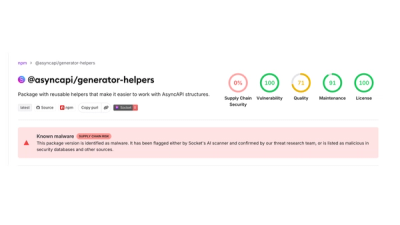
4 compromised asyncapi packages deliver miasma botnet loader on macOS, Linux and Windows.