
Product
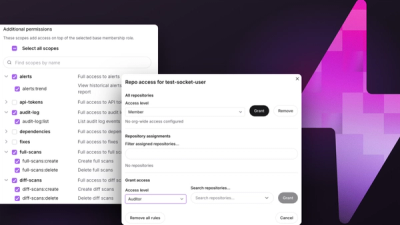
Introducing Repository Access Permissions and Custom Roles
Socket now supports Custom Roles and Repository Access Permissions so organizations can control who can access specific repositories and actions.
By Joe Werle - Jun 19, 2026
@mastra/posthog
Advanced tools
Affected versions:
PostHog AI Observability exporter for Mastra applications.
npm install @mastra/posthog
The exporter automatically reads credentials from environment variables:
# Required
POSTHOG_API_KEY=phc_...

# Optional
POSTHOG_HOST=https://us.i.posthog.com  # or eu.i.posthog.com
import { PosthogExporter } from '@mastra/posthog';

const mastra = new Mastra({
  ...,
  observability: {
    configs: {
      posthog: {
        serviceName: 'my-service',
        exporters: [new PosthogExporter()],
      },
    },
  },
});
You can also pass credentials directly:
import { PosthogExporter } from '@mastra/posthog';

const mastra = new Mastra({
  ...,
  observability: {
    configs: {
      posthog: {
        serviceName: 'my-service',
        exporters: [
          new PosthogExporter({
            apiKey: 'phc_...',
            host: 'https://us.i.posthog.com', // optional, defaults to US region
          }),
        ],
      },
    },
  },
});
$ai_generation: LLM model calls (MODEL_GENERATION, MODEL_STEP)$ai_span: Operations like tool calls, workflows, and streaming chunks$ai_parent_id$ai_session_idnew PosthogExporter({
apiKey: process.env.POSTHOG_API_KEY,
});
new PosthogExporter({
  // Required
  apiKey: process.env.POSTHOG_API_KEY,

  // Optional: Region/Host
  host: 'https://eu.i.posthog.com', // EU region
  // or
  host: 'https://your-instance.com', // Self-hosted

  // Optional: Batching (defaults: flushAt=20, flushInterval=10000)
  flushAt: 20, // Batch size before auto-flush
  flushInterval: 10000, // Flush interval in milliseconds

  // Optional: Serverless mode (auto-configures smaller batches)
  serverless: true, // Sets flushAt=10, flushInterval=2000

  // Optional: User identification
  defaultDistinctId: 'anonymous', // Fallback if no userId in metadata

  // Optional: Privacy
  enablePrivacyMode: false, // Set to true to exclude input/output from LLM events
});
When deploying to serverless environments (Lambda, Vercel Functions, etc.), enable serverless mode:
new PosthogExporter({
  apiKey: process.env.POSTHOG_API_KEY,
  serverless: true, // Auto-configures for serverless
});
Important: Always call await mastra.shutdown() before your serverless function exits to flush remaining events.
To exclude sensitive input/output data while still tracking token usage and latency:
new PosthogExporter({
  apiKey: process.env.POSTHOG_API_KEY,
  enablePrivacyMode: true, // Excludes $ai_input and $ai_output_choices
});
Note: Privacy mode only applies to $ai_generation events. Span events (tool calls, etc.) still include input/output state.
Include metadata in your Mastra spans to enrich PostHog events:
// User identification
{
  metadata: {
    userId: 'user-123',      // → distinctId in PostHog
    sessionId: 'session-abc', // → $ai_session_id for grouping

    // Custom properties (passed through to PostHog)
    environment: 'production',
    version: '1.0.0',
  }
}
PostHog automatically calculates costs from:
$ai_$ai_trace_id: Group all events in a trace$ai_session_id: Group traces in a session$ai_model: Filter by model (e.g., "gpt-4o")$ai_provider: Filter by provider (e.g., "openai")# Required
POSTHOG_API_KEY=phc_...
# Optional
POSTHOG_HOST=https://us.i.posthog.com # or eu.i.posthog.com
FAQs
PostHog observability provider for Mastra
The npm package @mastra/posthog receives a total of 16,980 weekly downloads. As such, @mastra/posthog popularity was classified as popular.
We found that @mastra/posthog demonstrated a healthy version release cadence and project activity because the last version was released less than a year ago. It has 6 open source maintainers collaborating on the project.
Did you know?

Socket for GitHub automatically highlights issues in each pull request and monitors the health of all your open source dependencies. Discover the contents of your packages and block harmful activity before you install or update your dependencies.
Product
Socket now supports Custom Roles and Repository Access Permissions so organizations can control who can access specific repositories and actions.
Product
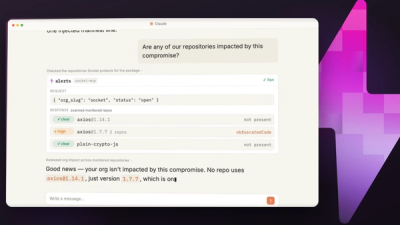
Socket MCP now lets AI assistants review org alerts, investigate threats using the Socket threat feed, and inspect package files in addition to dependency scoring.
Product
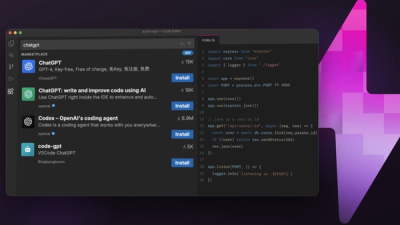
Socket Firewall blocks malicious VS Code and Open VSX extensions before install, protecting developers from compromised editor marketplaces.