
Product
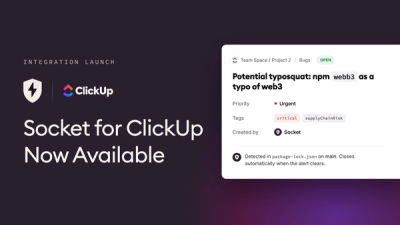
Socket for ClickUp Is Now Available
Create ClickUp tasks from Socket alerts, automate ticketing with custom rules, and keep alert and task status synchronized.
By Jeppe Hasseriis - Aug 26, 2026
@memberjunction/interactive-component-types
Advanced tools
MemberJunction: Interactive Component - Type specifications for MJ Interactive UI Componentry
Type definitions and interfaces for MemberJunction's Interactive Components system, enabling dynamic, data-driven UI components with AI capabilities.
The @memberjunction/interactive-component-types package provides the foundational types and interfaces for building interactive components in MemberJunction. These components are designed to be dynamically generated, data-aware, and AI-enhanced, allowing for rich user experiences with minimal configuration.
graph TD
    A["InteractiveComponentSpec<br/>(Component Definition)"] --> B["ComponentInitFunction"]
    B --> C["Props & Events"]
    B --> D["SimpleDataContext"]
    B --> E["SimpleMetadata"]
    B --> F["SimpleRunView / RunQuery"]
    B --> G["SimpleAITools"]

    G --> H["ExecutePrompt<br/>(LLM Calls)"]
    G --> I["EmbedText<br/>(Vector Embeddings)"]
    G --> J["VectorService<br/>(Similarity / KNN)"]

    A --> K["ComponentObject<br/>(Runtime Interface)"]
    K --> L["Standard Methods<br/>(print, refresh, isDirty)"]
    K --> M["Custom Methods<br/>(RegisterMethod)"]

    style A fill:#2d6a9f,stroke:#1a4971,color:#fff
    style B fill:#7c5295,stroke:#563a6b,color:#fff
    style G fill:#2d8659,stroke:#1a5c3a,color:#fff
    style K fill:#b8762f,stroke:#8a5722,color:#fff
    style H fill:#2d8659,stroke:#1a5c3a,color:#fff
    style I fill:#2d8659,stroke:#1a5c3a,color:#fff
    style J fill:#2d8659,stroke:#1a5c3a,color:#fff
npm install @memberjunction/interactive-component-types
Provides AI capabilities to interactive components:
interface SimpleAITools {
  // Execute LLM prompts for qualitative analysis
  ExecutePrompt: (params: SimpleExecutePromptParams) => Promise<SimpleExecutePromptResult>

  // Generate vector embeddings for similarity calculations
  EmbedText: (params: SimpleEmbedTextParams) => Promise<SimpleEmbedTextResult>

  // Vector operations service for KNN, similarity scoring, etc.
  VectorService: SimpleVectorService
}
Parameters for executing AI prompts within components:
interface SimpleExecutePromptParams {
  // System prompt to set context
  systemPrompt: string;

  // Optional conversation history
  messages?: Array<{message: string, role: 'user' | 'assistant'}>;

  // Preferred models in order of preference
  preferredModels?: string[];

  // Model power selection: 'lowest' | 'medium' | 'highest'
  modelPower?: 'lowest' | 'medium' | 'highest';

  // Optional user context
  contextUser?: UserInfo;
}
Parameters for generating text embeddings:
interface SimpleEmbedTextParams {
  // Single string or array of strings to embed
  textToEmbed: string | string[];

  // Model size selection
  modelSize: 'small' | 'medium';

  // Optional user context
  contextUser?: UserInfo;
}
Access to MemberJunction's metadata system:
interface SimpleMetadata {
  // Array of all entity metadata
  Entities: EntityInfo[];

  // Get entity object for CRUD operations
  GetEntityObject(entityName: string, contextUser?: UserInfo): Promise<BaseEntity>;
}
Execute database views dynamically:
interface SimpleRunView {
  // Run a single view
  RunView: (params: RunViewParams, contextUser?: UserInfo) => Promise<RunViewResult>

  // Run multiple views in parallel
  RunViews: (params: RunViewParams[], contextUser?: UserInfo) => Promise<RunViewResult[]>
}
Execute predefined queries:
interface SimpleRunQuery {
  // Run a predefined query with parameters
  RunQuery: (params: RunQueryParams, contextUser?: UserInfo) => Promise<RunQueryResult>
}
Interactive components receive initialization functions with access to all tools:
type ComponentInitFunction = (
  props: ComponentInitProps,
  events: ComponentEvents,
  data: SimpleDataContext,
  metadata: SimpleMetadata,
  runView: SimpleRunView,
  runQuery: SimpleRunQuery,
  ai: SimpleAITools
) => Promise<void>;
// In your interactive component initialization
async function initComponent(props, events, data, metadata, runView, runQuery, ai) {
  // Execute a prompt for data analysis
  const analysisResult = await ai.ExecutePrompt({
    systemPrompt: 'You are a data analyst. Analyze the provided dataset.',
    messages: [
      { message: 'What are the key trends?', role: 'user' }
    ],
    modelPower: 'medium'
  });

  if (analysisResult.success) {
    console.log('Analysis:', analysisResult.result);

    // Parse JSON if available
    if (analysisResult.resultObject) {
      const insights = analysisResult.resultObject;
      // Use insights in your component
    }
  }

  // Generate embeddings for similarity matching
  const embedResult = await ai.EmbedText({
    textToEmbed: ['Product A description', 'Product B description'],
    modelSize: 'small'
  });

  // Use vector service for similarity calculations
  const similarity = ai.VectorService.cosineSimilarity(
    embedResult.result[0],
    embedResult.result[1]
  );

  console.log('Product similarity:', similarity);
}
async function loadComponentData(props, events, data, metadata, runView) {
  // Get entity metadata
  const userEntity = metadata.Entities.find(e => e.Name === 'Users');

  // Run a view to get data
  const viewResult = await runView.RunView({
    EntityName: 'Users',
    ExtraFilter: "Status = 'Active'",
    OrderBy: 'LastName, FirstName',
    MaxRows: 100
  });

  if (viewResult.Success) {
    const users = viewResult.Results;
    // Process users data
  }

  // Create/update an entity
  const newUser = await metadata.GetEntityObject('Users');
  newUser.NewRecord();
  newUser.Set('FirstName', 'John');
  newUser.Set('LastName', 'Doe');
  await newUser.Save();
}
async function loadDashboardData(props, events, data, metadata, runView) {
  // Run multiple views in parallel for better performance
  const [salesData, customerData, productData] = await runView.RunViews([
    { EntityName: 'Sales', ExtraFilter: "Date >= '2024-01-01'" },
    { EntityName: 'Customers', ExtraFilter: "Active = 1" },
    { EntityName: 'Products', OrderBy: 'Name' }
  ]);

  // All data loaded in parallel
  console.log('Sales:', salesData.Results);
  console.log('Customers:', customerData.Results);
  console.log('Products:', productData.Results);
}
The ComponentObject interface defines the structure returned by compiled components, providing both the React component and method accessors:
interface ComponentObject {
  // The React component function
  component: Function;

  // Standard methods (all optional)
  print?: () => void;
  refresh?: () => void;
  getCurrentDataState?: () => any;
  getDataStateHistory?: () => Array<{ timestamp: Date; state: any }>;
  validate?: () => boolean | { valid: boolean; errors?: string[] };
  isDirty?: () => boolean;
  reset?: () => void;
  scrollTo?: (target: string | HTMLElement | { top?: number; left?: number }) => void;
  focus?: (target?: string | HTMLElement) => void;

  // Dynamic method access
  invokeMethod?: (methodName: string, ...args: any[]) => any;
  hasMethod?: (methodName: string) => boolean;
}
Components receive callbacks that enable interaction with their container:
interface ComponentCallbacks {
  // Open an entity record in the container
  OpenEntityRecord: (entityName: string, key: CompositeKey) => void;

  // Register a method that can be called by the container
  RegisterMethod: (methodName: string, handler: Function) => void;
}
RegisterMethod callbackinvokeMethod() for custom methodsfunction DataTableComponent({ callbacks, data, userState }) {
const [tableData, setTableData] = React.useState(data);
const [hasChanges, setHasChanges] = React.useState(false);
const [selectedRows, setSelectedRows] = React.useState([]);
React.useEffect(() => {
if (callbacks?.RegisterMethod) {
// Register standard methods
callbacks.RegisterMethod('getCurrentDataState', () => ({
data: tableData,
selectedRows: selectedRows,
totalCount: tableData.length
}));
callbacks.RegisterMethod('isDirty', () => hasChanges);
callbacks.RegisterMethod('validate', () => {
if (tableData.length === 0) {
return { valid: false, errors: ['Table cannot be empty'] };
}
return true;
});
callbacks.RegisterMethod('reset', () => {
setTableData(data);
setSelectedRows([]);
setHasChanges(false);
});
// Register custom business logic methods
callbacks.RegisterMethod('exportSelectedRows', () => {
return selectedRows.map(idx => tableData[idx]);
});
callbacks.RegisterMethod('deleteSelected', () => {
const newData = tableData.filter((_, idx) => !selectedRows.includes(idx));
setTableData(newData);
setHasChanges(true);
setSelectedRows([]);
});
}
}, [callbacks, tableData, selectedRows, hasChanges]);
return <div>{/* Table UI */}</div>;
}
// After component compilation
const componentObject = compiledComponent as ComponentObject;

// Use standard methods with type safety
if (componentObject.isDirty && componentObject.isDirty()) {
  console.log('Component has unsaved changes');

  const validation = componentObject.validate?.();
  if (validation === true || validation?.valid) {
    // Safe to proceed
    const currentState = componentObject.getCurrentDataState?.();
    await saveData(currentState);
  } else {
    console.error('Validation failed:', validation?.errors);
  }
}

// Use custom methods via invokeMethod
if (componentObject.hasMethod?.('exportSelectedRows')) {
  const selectedData = componentObject.invokeMethod('exportSelectedRows');
  await exportToFile(selectedData);
}

// Reset the component
componentObject.reset?.();
Components can declare their supported methods in the spec for static discovery:
interface ComponentSpec {
  name: string;
  code: string;

  // Optional method declarations for discovery/documentation
  methods?: Array<{
    name: string;
    category?: 'standard' | 'custom';
    description?: string;
    parameters?: Array<{
      name: string;
      type: string;  // Free-form type description
      required?: boolean;
      description?: string;
    }>;
    returnType?: string;  // Free-form type description
  }>;
}
Example declaration:
const spec: ComponentSpec = {
  name: 'DataTable',
  code: '...',
  methods: [
    {
      name: 'getCurrentDataState',
      category: 'standard',
      description: 'Returns current table data and selection state',
      returnType: '{data: any[], selectedRows: number[], totalCount: number}'
    },
    {
      name: 'exportSelectedRows',
      category: 'custom',
      description: 'Exports currently selected rows',
      returnType: 'any[]'
    },
    {
      name: 'deleteSelected',
      category: 'custom',
      description: 'Deletes selected rows from the table'
    }
  ]
};
The package includes comprehensive types for component specifications:
InteractiveComponentSpec: Full component specification including metadata, props, and initializationComponentDataRequirement: Defines data loading requirementsComponentOption: Configuration options for componentsComponentLibraryDependency: External library dependenciesComponentSpecCategory: Component categorization and metadataThe included SimpleVectorService provides:
modelPower parameter wisely - 'lowest' for simple tasks, 'highest' for complex analysisRunViews for parallel data loading instead of sequential RunView callssuccess flags in AI operation resultsresultObject when expecting structured data from AI promptsAll interfaces are fully typed with TypeScript, providing:
@memberjunction/interactive-component-types/forms)The /forms subpath provides the form-role contract for components that
declare componentRole: 'form' — the substrate that lets MJ render
runtime-author forms inside Explorer with the same toolbar / save / delete
behavior as a CodeGen-generated Angular form.
| Export | Purpose |
|---|---|
FormHostProps | What the host wrapper passes a form-role React component (entity name, primary key, record snapshot, mode, permissions). |
FormEventNames / FormBeforeSaveArgs / etc. | Standard event names + payload types the component emits via callbacks.NotifyEvent. |
FormMethodNames | Standard methods the component registers (RequestSave, RequestCancel) so the host toolbar can drive its save flow. |
isFormRole(spec) | Type-guard: does this ComponentSpec declare componentRole: 'form'? |
CuratedFormSchema, buildCuratedFormSchema(entityName, provider) | Curated, LLM-friendly view of an entity's schema for form authoring — FK references resolved to {entity, displayField}, value lists annotated with allowedValues, audit/virtual/computed fields stripped. |
buildDefaultFormScaffold(entityName, provider) | Produces a working form-role ComponentSpec that mirrors the CodeGen Angular default layout. Used as the baseline by the Form Builder agent and the dashboard's "New form" flow. |
buildFixtureFormHostProps(schema, mode?) | Synthesizes type-appropriate fixture values for live-preview rendering when no real BaseEntity is available (used by Component Studio preview + the chat artifact viewer's fallback mode). |
getDeclaredFormEntityName(spec) | Resolves the entity a form binds to from spec.entityName or spec.dataRequirements.entities[0].name. Pure helper shared by every form-role consumer. |
See /plans/interactive-forms/phase-2-runtime-loop.md for the full architecture, lifecycle, and security model (Create / Modify / Activate / Revert + ownership checks).
@memberjunction/core: Core MemberJunction types and interfaces@memberjunction/ai-vectors-memory: Vector operations and similarity calculationsISC
FAQs
MemberJunction: Interactive Component - Type specifications for MJ Interactive UI Componentry
The npm package @memberjunction/interactive-component-types receives a total of 2,455 weekly downloads. As such, @memberjunction/interactive-component-types popularity was classified as popular.
We found that @memberjunction/interactive-component-types demonstrated a healthy version release cadence and project activity because the last version was released less than a year ago. It has 11 open source maintainers collaborating on the project.
Product
Create ClickUp tasks from Socket alerts, automate ticketing with custom rules, and keep alert and task status synchronized.
Product
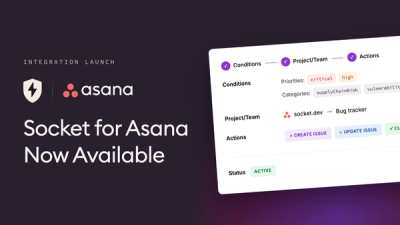
Create and manage Asana tasks directly from Socket alerts, with manual task creation, automated ticketing rules, and two-way sync.

Security News
Open VSX has removed three extension IDs from its malicious-extension list as the legitimate publishers they impersonated move to claim the names for themselves.