
Product
Socket Now Protects the Microsoft Edge Extension Ecosystem
Enterprise security teams can now detect malware, credential theft, suspicious network activity, and risky updates across Microsoft Edge extensions.
By John Tuckner - Aug 28, 2026
@molpha-oracle/sdk
Advanced tools
Molpha Consumer SDK — subscribe, create jobs, run gateway rounds, submit and read on-chain feeds.
Browser-first TypeScript SDK for Molpha data consumers and job owners.
Use it to:
Molpha turns off-chain API responses into verified on-chain data.
At a high level:
Job owner
└─ creates job on Solana with apiConfigHash + quorum settings
Gateway
└─ coordinates a round for a job
Verifier nodes
└─ fetch/recompute the API result independently
└─ sign the canonical result if valid
Solana / EVM / Starknet verifiers
└─ verify quorum, registry version, signer bitmap, timestamp, and aggregate signature
└─ finalize or expose the verified value
The gateway is a coordination layer, not a trusted oracle. A result is trusted only if it carries a valid threshold signature from the selected verifier nodes for the current registry version.
Molpha uses Solana as the canonical protocol chain for jobs, subscriptions, registry state, and feed state. EVM and Starknet verifier contracts are stateless verification surfaces: they verify signed Molpha data updates without needing to manage subscriptions or job configuration locally.
pnpm add @molpha-oracle/sdk
Solana support is optional and only needed for MolphaSDK / MolphaSolanaClient:
pnpm add @solana/kit @anchor-lang/core bn.js
| Import | Use |
|---|---|
@molpha-oracle/sdk | Facade (MolphaSDK), MolphaGateway, MolphaSolanaClient, core types, EVM/Starknet helpers. Browser-safe; no fs in the main entry. |
@molpha-oracle/sdk/utils | walletFromKeypairFile — load a Solana CLI keypair as an Anchor Wallet. Node.js only. |
The package is ESM with "sideEffects": false, so gateway-only or read-only apps can tree-shake the Anchor-heavy Solana path when they do not import it.
import { web3 } from "@anchor-lang/core";
import { MolphaSDK } from "@molpha-oracle/sdk";
import { walletFromKeypairFile } from "@molpha-oracle/sdk/utils";

const sdk = new MolphaSDK({
  connection: new web3.Connection("https://api.devnet.solana.com", "finalized"),
  wallet: walletFromKeypairFile("~/.config/solana/id.json"),
});

const { result, signature } = await sdk.requestAndSubmit(jobId, {
  apiConfig: {
    url: "https://api.example.com/price",
    responseParser: "$.price",
  },
});
requestAndSubmit requests a threshold-signed data update from the gateway (against the current on-chain registry version) and submits it to Solana in one call.
| Option | Description |
|---|---|
connection | Anchor-compatible Solana RPC connection. |
wallet | MolphaWallet. Used for Solana transactions and gateway authentication when available. |
| Option | Default |
|---|---|
endpoints | DEFAULT_GATEWAY_ENDPOINT — string or array for failover |
programId | MOLPHA_PROGRAM_ADDRESS from the vendored IDL |
idl | MOLPHA_IDL from idl/molpha.json |
commitment | "confirmed" |
import {
  DEFAULT_GATEWAY_ENDPOINT,
  MOLPHA_IDL,
  MOLPHA_PROGRAM_ADDRESS,
} from "@molpha-oracle/sdk";

const sdk = new MolphaSDK({
  connection,
  wallet,
  endpoints: [DEFAULT_GATEWAY_ENDPOINT, "https://backup.example.com"],
  // programId: "YourProgramAddress...",
  // idl: MOLPHA_IDL,
});
wallet is a single MolphaWallet used across both protocol surfaces:
| Layer | What it signs |
|---|---|
| Solana client | Transactions such as subscribe, createJob, submitDataUpdate (plus simulation flows such as verifyDataUpdate) |
| Gateway client | authMessage(jobId, timestamp) for authenticated gateway requests |
Gateway auth is resolved automatically when you use MolphaSDK:
wallet.signAuthMessage if provided.Wallet.payer when the secret key is available, such as with walletFromKeypairFile.authSig.MolphaSDK passes the resolved signer to sdk.gateway as its default, so
sdk.gateway.requestSignedData({ jobId, apiConfig }) authenticates without an
explicit signer. Standalone new MolphaGateway(...) omits auth unless you pass
a defaultSigner (third constructor arg) or per-call signer.
The all-zero authSig path is for development only. Production jobs should authenticate gateway requests.
import { walletFromKeypairFile } from "@molpha-oracle/sdk/utils";

const wallet = walletFromKeypairFile("~/.config/solana/id.json");
import type { MolphaWallet } from "@molpha-oracle/sdk";

const wallet: MolphaWallet = {
  publicKey: adapter.publicKey,
  signTransaction: (tx) => adapter.signTransaction(tx),
  signAllTransactions: (txs) => adapter.signAllTransactions(txs),
  signAuthMessage: async (msg) => new Uint8Array(await adapter.signMessage(msg)),
};
You can also override gateway auth per call with gateway.requestSignedData({ ..., signer }) or with the same field in requestAndSubmit.
Use MolphaSDK for the end-to-end path, or use MolphaSolanaClient / MolphaGateway separately when you only need one side.
import { web3 } from "@anchor-lang/core";
import {
  MolphaSDK,
  PlanType,
  deriveApiConfigHash,
} from "@molpha-oracle/sdk";
import { walletFromKeypairFile } from "@molpha-oracle/sdk/utils";

const sdk = new MolphaSDK({
  connection: new web3.Connection("https://api.devnet.solana.com", "confirmed"),
  wallet: walletFromKeypairFile("~/.config/solana/id.json"),
});
Subscriptions are paid in USDC on Solana.
For local/dev testing on Solana Devnet, you can request test USDC from Circle's faucet: https://faucet.circle.com/ (select USDC on Solana Devnet).
const plan = await sdk.solana.getPlan(PlanType.Basic);

// Show plan.subscriptionPrice to the user before charging.
const { pricePaid } = await sdk.solana.subscribe(PlanType.Basic, {
  maxPriceUsdc: plan.subscriptionPrice,
});
maxPriceUsdc is a safety bound. The transaction aborts if the live plan price is higher than the amount the user approved.
const apiConfig = {
  url: "https://api.example.com/price",
  responseParser: "$.price",
};

const apiConfigHash = deriveApiConfigHash(apiConfig);

const { jobId } = await sdk.solana.createJob({
  apiConfigHash,
  signaturesRequired: 3,
  decimals: 8,
});
The on-chain job stores the apiConfigHash, not the full API config. This commits the job to a specific off-chain data source and parsing logic while keeping large config payloads and secrets off-chain.
const result = await sdk.gateway.requestSignedData({
  jobId,
  apiConfig,
});
The gateway round uses the current on-chain registry version. Selected verifier nodes independently fetch/recompute the result and sign only if the observed value matches the canonical result.
The returned DataUpdateResult includes the signed value, canonical timestamp, registry version, required quorum, signer bitmap, and aggregate signature.
const { signature } = await sdk.solana.submitDataUpdate(result);
To simulate verification without submitting state:
const { value, canonicalTimestamp } =
  await sdk.solana.verifyDataUpdate(result);
Then read the finalized feed:
const feed = await sdk.solana.readFeed(jobId);
const { result, signature } = await sdk.requestAndSubmit(jobId, {
  apiConfig,
});
This is equivalent to:
const result = await sdk.gateway.requestSignedData({ jobId, apiConfig });
const { signature } = await sdk.solana.submitDataUpdate(result);
By default every requestSignedData call fetches slow-changing inputs up
front (in parallel): the on-chain registry version and redundancy buffer (one
account read), and the node set. When you run many rounds for the same feed,
fetch these once and reuse them so each round is a single gateway POST.
// Fetch registryVersion + redundancyBuffer + nodes once.
const context = await sdk.gateway.prepareContext(feedId);

// Reuse it across rounds — no prelude fetches.
const result = await sdk.gateway.requestSignedData({ feedId, apiConfig, context });
context is a Partial<RoundContext>, so you can cache only what you have
and let requestSignedData fetch the rest:
const result = await sdk.gateway.requestSignedData({
  feedId,
  apiConfig,
  context: { nodes }, // registryVersion + redundancyBuffer still fetched fresh
});
Caching is opt-in because these inputs can drift. A stale registryVersion,
redundancyBuffer, or node set yields a result the chain will reject — refresh
the context when the on-chain registry changes. The same context field is
accepted by requestAndSubmit.
Jobs can use private APIs without sending plaintext secrets to the gateway.
const result = await sdk.gateway.requestSignedData({
  jobId,
  apiConfig: {
    url: "https://api.example.com/private-price?key={{secret.apiKey}}",
    responseParser: "$.price",
  },
  encrypt: {
    secrets: {
      apiKey: process.env.API_KEY!,
    },
  },
});
Secrets are encrypted into per-node envelopes. The gateway coordinates the round but should not receive plaintext API credentials.
Private API access is still an active security-sensitive surface. Do not treat encrypted secret delivery as production-ready until gateway/node-side test vectors and validation are complete.
After a gateway round, the same signed result can be verified on EVM chains.
The SDK ships deployed testnet verifier addresses and framework-agnostic tuple builders. It does not depend on ethers or viem at runtime.
The verifier is deployed with CREATE2 so the contract address is the same on every supported EVM chain.
import { MOLPHA_VERIFIER_ADDRESS } from "@molpha-oracle/sdk";

const address = MOLPHA_VERIFIER_ADDRESS;
import { buildEvmVerifierArgs } from "@molpha-oracle/sdk";

const result = await sdk.gateway.requestSignedData({ jobId, apiConfig });

const { dataUpdate, signature } = buildEvmVerifierArgs(result);
The generated tuples match the Molpha EVM verifier ABI:
// dataUpdate:
// [bytes32 jobId,
//  uint32 registryVersion,
//  uint32 signaturesRequired,
//  bytes32 valuePacked,
//  uint64 timestamp]

// signature:
// [bytes32 s,
//  address commitment,
//  uint256 signersBitmap]
import { Contract } from "ethers";
import {
  buildEvmVerifierArgs,
  MOLPHA_VERIFIER_ADDRESS,
} from "@molpha-oracle/sdk";

const verifier = new Contract(
  MOLPHA_VERIFIER_ADDRESS,
  abi,
  signer,
);

const { dataUpdate, signature } = buildEvmVerifierArgs(result);

await verifier.verify(dataUpdate, signature);
import { createPublicClient, http } from "viem";
import {
  buildEvmVerifierArgs,
  MOLPHA_VERIFIER_ADDRESS,
} from "@molpha-oracle/sdk";

const client = createPublicClient({
  chain,
  transport: http(),
});

const { dataUpdate, signature } = buildEvmVerifierArgs(result);

await client.readContract({
  address: MOLPHA_VERIFIER_ADDRESS,
  abi,
  functionName: "verify",
  args: [dataUpdate, signature],
});
Lower-level helpers are also exported for manual integrations:
import {
  toFixedHex,
  signersBitmapToUint256,
  signersBitmapToDecimal,
} from "@molpha-oracle/sdk";
After a gateway round, the same signed result can be verified on Starknet.
The SDK ships deployed testnet verifier addresses and framework-agnostic struct
builders. It does not depend on starknet.js at runtime.
import {
  MOLPHA_VERIFIER_STARKNET_ADDRESSES,
  MOLPHA_VERIFIER_STARKNET_SEPOLIA,
  getMolphaStarknetVerifierAddress,
} from "@molpha-oracle/sdk";

const address = getMolphaStarknetVerifierAddress("starknet-sepolia");

// or:
const sepolia = MOLPHA_VERIFIER_STARKNET_ADDRESSES["starknet-sepolia"];
const sepoliaDirect = MOLPHA_VERIFIER_STARKNET_SEPOLIA;
| Network | Constant |
|---|---|
| Starknet Sepolia | MOLPHA_VERIFIER_STARKNET_SEPOLIA |
import { buildStarknetVerifierArgs } from "@molpha-oracle/sdk";

const result = await sdk.gateway.requestSignedData({ jobId, apiConfig });

const { dataUpdate, signature } = buildStarknetVerifierArgs(result);
The generated objects match the Molpha Starknet verifier interface:
// dataUpdate:
// {
//   job_id: u256,
//   registry_version: u32,
//   signatures_required: u32,
//   value: u256,
//   canonical_timestamp: u64,
// }

// signature:
// {
//   signature: u256,
//   commitment: felt252, // EVM-style 20-byte address as felt
//   signers_bitmap: u256,
// }
Lower-level helpers are also exported:
import {
  commitmentAddressToStarknetFelt,
  signersBitmapToStarknetUint256,
} from "@molpha-oracle/sdk";
A Molpha data update is valid only if the verifier can confirm:
jobId;registryVersion;signaturesRequired;Solana verification finalizes feed state. EVM and Starknet verification are stateless and return whether the signed Molpha update is valid for the deployed verifier registry.
The Solana client needs the Anchor IDL for the Molpha program.
A vendored copy ships under idl/ and is used by default:
import { MOLPHA_IDL, MOLPHA_PROGRAM_ADDRESS } from "@molpha-oracle/sdk";
Override idl and programId when targeting another deployment.
Keep the vendored IDL aligned with the deployed program. Mismatched IDL/program versions can produce invalid account derivations, decoding errors, or failed instruction simulation.
MolphaSDK is a convenience facade.
You can also use the lower-level clients directly:
import {
  MolphaSolanaClient,
  MolphaGateway,
} from "@molpha-oracle/sdk";

const solana = MolphaSolanaClient.create({
  connection,
  wallet,
});

const gateway = new MolphaGateway(
  endpoints,
  () => solana.getRegistrySelectionConfig(),
);
The facade wires the registry selection config resolver automatically.
0.1.0 — first public SDK iteration.
Current scope:
Known limitations:
Solana paths such as selection bitmap, previous-version remap, and verify_data_update decoding are aligned with the Molpha program version vendored in this repo.
pnpm install
pnpm typecheck
pnpm test
pnpm build
Versioning and publishing are automated with Changesets.
Versions follow semver and are driven by the nature of each change, not by the branch it merges from.
Add a changeset with your change:
pnpm changeset
Choose:
patch for fixes;minor for features;major for breaking changes.While the package is pre-1.0.0, use minor for breaking changes and patch for features/fixes. Only select major when intentionally cutting 1.0.0.
Stable releases from main
When changes land on main, the release workflow opens a release PR that bumps package.json and updates CHANGELOG.md.
Merging that PR publishes to npm on the latest tag:
npm install @molpha-oracle/sdk
Prereleases from dev
Pushes to dev publish a snapshot version on the dev dist-tag, for example:
0.2.0-dev-<timestamp>
Install with:
npm install @molpha-oracle/sdk@dev
Requires at least one pending changeset.
Add NPM_TOKEN under GitHub repo settings:
Settings → Secrets and variables → Actions
Use a granular npm automation token with publish access to the @molpha-oracle scope.
Publish a stable release from main first.
npm assigns the first published version to the latest tag regardless of --tag. If a dev snapshot is published before any stable release, that prerelease can become latest.
The dev workflow should guard against this and fail until a stable latest exists.
If latest ever points to a prerelease, repoint it after publishing a stable version:
npm dist-tag add @molpha-oracle/sdk@<stable-version> latest
FAQs
Molpha Consumer SDK — subscribe, create jobs, run gateway rounds, submit and read on-chain feeds.
The npm package @molpha-oracle/sdk receives a total of 8 weekly downloads. As such, @molpha-oracle/sdk popularity was classified as not popular.
We found that @molpha-oracle/sdk demonstrated a healthy version release cadence and project activity because the last version was released less than a year ago. It has 1 open source maintainer collaborating on the project.
Product
Enterprise security teams can now detect malware, credential theft, suspicious network activity, and risky updates across Microsoft Edge extensions.

Research
/Security News
Socket researchers found 18 Chrome extensions and one Edge extension delivering a wallet drainer, credential theft, and other malicious payloads.
Product
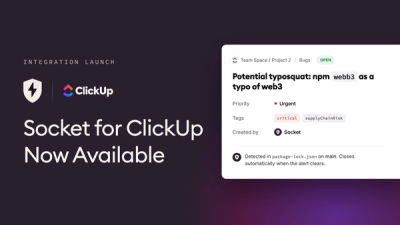
Create ClickUp tasks from Socket alerts, automate ticketing with custom rules, and keep alert and task status synchronized.